Metabolic adaptation calculator: has your metabolism slowed down? and by how much, in kcal/day
After weeks in a deficit, your body slows down. Your BMR runs below its theoretical value: 5 to 25 % depending on the study. Estimate your adaptation coefficient here (100→0 % convention), your adapted BMR in kcal/day, and what to do next.
 The Lean Team · 11 min read · Updated August 16, 2026

 Free download
Metabolic adaptation is the drop in your metabolism beyond what your weight loss explains: after weeks in a deficit, your BMR runs at 95, 90, sometimes 80 % of its theoretical value (published range: 5 to 25 %). It reads as a coefficient that modulates the BMR, 100→0 % convention: 100 % = optimal metabolism, 90 % = BMR slowed by 10 %. Good news: it is reversible (diet break, refeeds, gradually raising calories). Estimate your coefficient with the calculator below.
02 · CalculatorEstimate your metabolic adaptation coefficient
Enter your data below. The calculator estimates your current adaptation coefficient (bounded between 100 and 75 %, like the published ranges), then translates that coefficient into kcal/day: your theoretical BMR versus your adapted BMR. It is an educational estimate based on the literature, not a measurement: the real value is measured continuously, with your actual weigh-ins and body composition.
Your parameters
Educational estimate based on published ranges (BMR drop of 5 to 25 % depending on the study, Doucet 2001, Rosenbaum & Leibel 2010, Trexler 2014, Müller 2015). This calculator is not a diagnostic tool and does not replace medical advice.
03 · The scienceWhat actually slows down when you eat less
Your metabolism slows down in a deficit. But it can be measured.
The phenomenon is called adaptive thermogenesis : in a prolonged deficit, your energy expenditure drops beyond what your new body composition explains. Doucet and his team measured it as early as 2001: after weight loss, subjects’ resting metabolism was markedly lower than the value predicted by their remaining lean mass. The reviews that followed (Trexler 2014, Müller 2015) place the magnitude between 5 and 25 % of BMR depending on how long the deficit lasts, how aggressive it is and how lean you get.
The mechanisms are well identified. Leptin drops with fat stores and calorie intake: your brain receives a scarcity signal and reduces expenditure. Thyroid hormones (T3 especially) go down. The sympathetic nervous system idles. Your muscles become more efficient: the same effort burns less. And in parallel, your NEAT drops unconsciously : you fidget less, you walk more slowly, you take the elevator without thinking about it. TEF also decreases, mechanically, since you eat less.
How do you read all this properly? In Lean, the expenditure equation remains TDEE = BMR + NEAT + EAT + TEF. Metabolic adaptation is the 5th building block: a coefficient that modulates the BMR, never a term you add up. The convention is 100→0 %: at 100 %, your BMR is optimal; at 90 %, it is slowed by 10 %; below 85 %, you are in strong-alert territory and it is time to bring calories back up. Lean is the first app in the world to calculate this coefficient continuously.
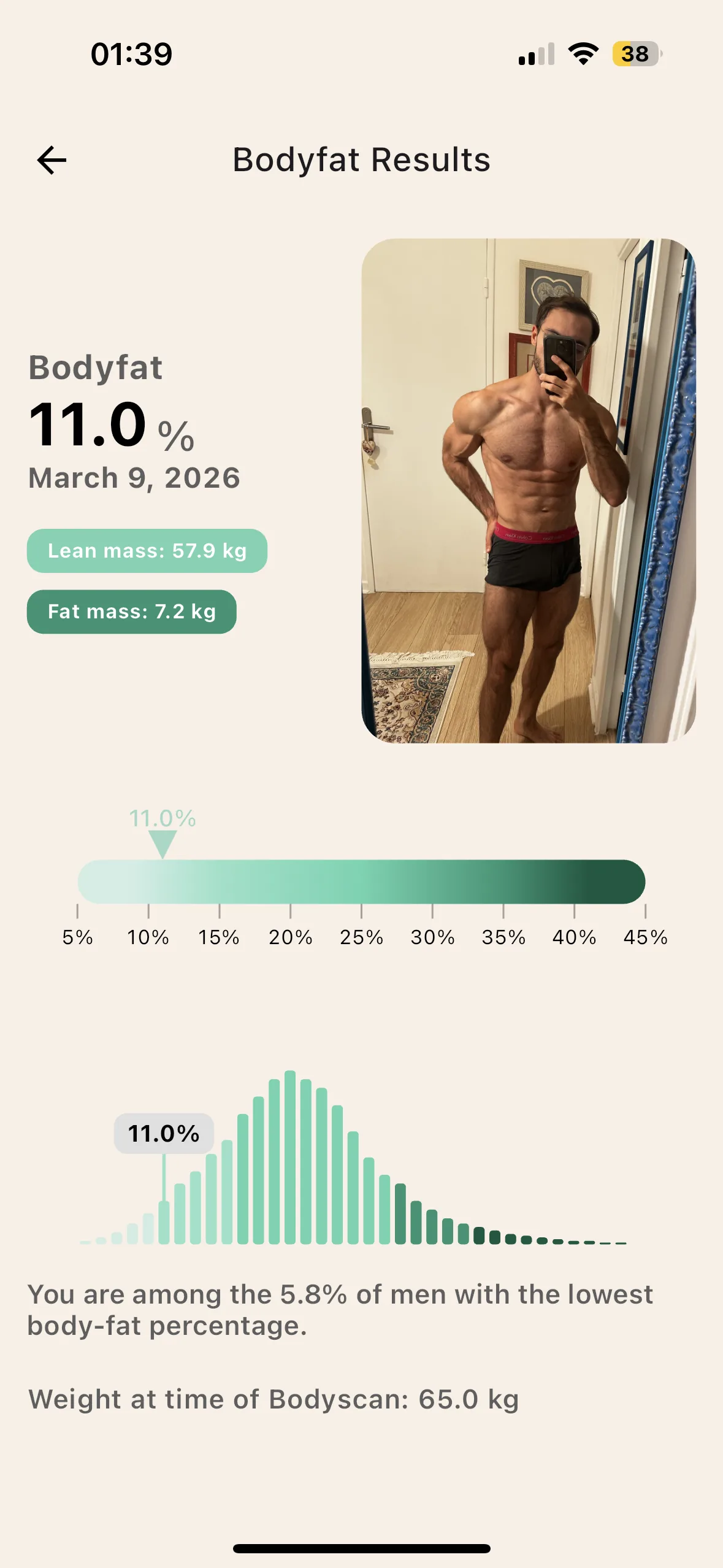
One crucial point: distinguishing the two drops. When you lose weight, your BMR drops mechanically (less mass to maintain): that is normal and expected. Metabolic adaptation is the additional drop, the one your body composition does not explain. That is why tracking body fat is essential: without it, you confuse the two and draw the wrong conclusions.
04 · Three profiles, three coefficientsAdaptation depends on your trajectory, not on a fixed rule
Three men, three deficits, three coefficients. The numbers below come from this page’s calculator: you can reproduce them by entering the same parameters.
Short, light deficit
Classic 12-week cut
Long, aggressive diet
05 · Continuous measurementHow Lean tracks your adaptation, week after week
An online calculator, however honest, can only give a snapshot based on what you declare. The real value of metabolic adaptation is measured over time: it takes your actual weight, your actual body fat, your actual activity and your deficit history. That is exactly what Lean does:
1. BMR recalculated at every weigh-in
Your theoretical BMR is recalculated on your lean mass at every weigh-in. It is the reference: without it, there is no way to know how far you deviate.
2. Recurring AI BodyScan
Regularly measured body fat separates the mechanical BMR drop (less mass) from the adaptive slowdown (same mass, less expenditure).
3. Continuous adaptation coefficient
Lean compares your actual loss to your expected loss and derives your coefficient. 96 %: all good. 88 %: alert, the time for a return to maintenance is getting closer.
4. Live calorie balance
Your daily calorie target is calculated on your BMR modulated by the coefficient, plus your actual NEAT, EAT and TEF. The plateau no longer takes you by surprise: you see it coming.
06 · Myth vs realityNo, your metabolism is not “broken”
“Years of dieting have destroyed my metabolism”
The “metabolic damage” idea: after repeated diets, the metabolism would be permanently damaged, sometimes “cut in half”, and nothing would work anymore. It circulates massively on social media, often to sell “metabolic repair” protocols.
A 5 to 25 % slowdown, reversible
Controlled studies measure an adaptation of 5 to 25 % of BMR, never a collapse by half. Even the subjects of the Minnesota Starvation Experiment, in severe semi-starvation, saw their metabolism recover upon refeeding (Müller 2015). Trexler 2014 reaches the same conclusion in athletes: adaptation is real, significant, and reversible.
What looks like a “broken” metabolism is almost always the sum of three things: a mechanically lower BMR (you weigh less), a degraded adaptation coefficient (reversible), and a NEAT that collapsed without you noticing. All three can be fixed: gradually raising calories, monitored daily steps, patience.
The practical consequence: if your estimated coefficient is low, the answer is never to cut calories even further. It is to bring the coefficient back up: diet break at maintenance, carb refeeds, NEAT rebuilt step by step. Only then do you resume the deficit, on a recalculated TDEE. A deficit is always calculated on your current actual expenditure, not on day one’s.
07 · FAQEverything you wonder about metabolic adaptation
What is metabolic adaptation?
It is the drop in your energy expenditure beyond what your weight loss explains. When you lose weight, your BMR drops mechanically (less mass to maintain). Metabolic adaptation is the additional drop: falling leptin, lower thyroid hormones, more efficient muscles, reduced NEAT. Studies place it between 5 and 25 % of BMR depending on the duration and aggressiveness of the deficit.
How do I know if my metabolism has slowed down?
The most reliable sign: your actual loss becomes markedly slower than your expected loss, with constant intake and activity. If you lose 0.2 kg/week when your theoretical deficit should produce 0.5, part of the gap comes from adaptation. This page’s calculator gives you an estimate; Lean measures it continuously by comparing your weigh-ins to your expected trajectory.
Is my metabolism broken after years of dieting?
No. Permanent “metabolic damage” is not supported by the literature. Controlled studies measure a 5 to 25 % BMR slowdown, reversible when calories come back up, including after severe restriction (Müller 2015 on the Minnesota Starvation Experiment data). What sometimes lingers is a NEAT that stayed low and underestimated intake, not a destroyed metabolism.
How long does metabolic adaptation last?
It sets in after 2 to 3 weeks of deficit, strengthens with duration, and recedes when you bring calories back up. Recovery is gradual: a few weeks at maintenance are often enough to regain most of the coefficient, but after a very long, aggressive diet, full normalization can take several months. Preserved lean mass and rebuilt NEAT speed up the return.
How do you restart a slowed metabolism?
In order: bring calories back up to maintenance (a 1 to 2 week diet break, or a gradual increase of 100 to 150 kcal per weekly step), rebuild NEAT (daily steps, visible goal), keep protein high and keep strength training to protect lean mass, sleep 7 to 9 hours. Cutting calories even further is the worst answer: the coefficient keeps dropping.
What is a diet break and when should you take one?
A diet break is a voluntary return to maintenance (your current TDEE) for 1 to 2 weeks, in the middle of a fat-loss phase. It is triggered when the cut exceeds 8 to 12 weeks, or when your adaptation coefficient enters the alert zone (around 85 % in the Lean convention). Goal: bring leptin, T3 and NEAT back up, then resume the deficit on a recalculated TDEE.
Does reverse dieting work?
Gradually raising calories (100 to 150 kcal more per week) is a reasonable strategy to exit a long diet without a sharp fat regain: it lets the adaptation coefficient recover while intake increases. It is not magic, it does not “boost” the metabolism beyond its normal value, but it avoids the classic end-of-cut rebound.
Is metabolic adaptation stronger in women?
The physiology is the same, but women reach the critical thresholds faster: leptin reacts strongly when body fat drops below roughly 22 to 25 %, and the hormonal response (cycle, hypothalamic amenorrhea) can add to the slowdown. In practice, at equal deficit and low body fat, the alert comes earlier. This page’s calculator uses a higher body fat threshold for women for that reason.
Why does Lean display adaptation from 100 to 0 %?
Because it is a metabolic health score, not a penalty. 100 % = optimal metabolism, no adaptation. 96 % = healthy zone. 90 % = mild alert. 85 % and below = strong alert, time to bring calories back up. Reading “I still have 90 % of my BMR” is clearer and more motivating than stacking loss percentages. And mathematically, it is a coefficient that modulates the BMR in the TDEE calculation, never a term you add up.
Does this calculator give a medical measurement?
No. It is an educational estimate built on published ranges (Doucet 2001, Rosenbaum and Leibel 2010, Trexler 2014, Müller 2015), from what you declare. Individual measurement requires longitudinal tracking: repeated weigh-ins, body composition, actual intake. That is what Lean does continuously. And in any case, neither this page nor the app replaces medical advice.
Scientific sources
- Doucet E, St-Pierre S, Alméras N, Després JP, Bouchard C, Tremblay A. Evidence for the existence of adaptive thermogenesis during weight loss. Br J Nutr. 2001 Jun;85(6):715-23. PubMed 11430776.
- Rosenbaum M, Leibel RL. Adaptive thermogenesis in humans. Int J Obes (Lond). 2010 Oct;34 Suppl 1:S47-55. PubMed 20935667.
- Hall KD. What is the required energy deficit per unit weight loss? Int J Obes. 2008 Mar;32(3):573-6. PubMed 17848938.
- Trexler ET, Smith-Ryan AE, Norton LE. Metabolic adaptation to weight loss: implications for the athlete. J Int Soc Sports Nutr. 2014 Feb;11(1):7. PubMed 24571926.
- Müller MJ, Enderle J, Pourhassan M, et al. Metabolic adaptation to caloric restriction and subsequent refeeding: the Minnesota Starvation Experiment revisited. Am J Clin Nutr. 2015 Oct;102(4):807-19. PubMed 26399868.
Your metabolic adaptation, measured continuously
AI BodyScan, 100→0 % coefficient updated at every weigh-in, live calorie balance. The first app in the world to calculate it. Free download, 7-day trial on the annual plan.