Alternative to MyFitnessPal. The 4 real options in 2026, honestly tested. And Lean, evaluated separately.
You want to leave MyFitnessPal. Yazio, Cronometer, Lifesum, FatSecret : strengths, weaknesses, who it's for, and the overall verdict without bullshit. Lean, which publishes this comparison, is evaluated separately, outside the ranking.
 The Lean Team · 14 min read · Updated May 22, 2026

 Free download
Cronometer remains unbeatable for anyone who wants to track micronutrients at USDA accuracy. Yazio is MyFitnessPal with a better design, but inherits the same scientific limitations (Harris-Benedict formula from 1919). Lifesum wins on premium UX but stays expensive for the rigor it actually delivers. FatSecret is the only 100% free alternative with a barcode scanner. Detailed strengths and weaknesses per app in the following sections. Lean, which publishes this comparison, is not ranked : it is presented separately, below, on the only point where it differs (calculating calorie expenditure via BMRBasal Metabolic Rate. Energy expended at rest. In Lean, calculated on actual lean mass via BodyScan AI. on actual body fat + metabolic adaptation).
Why you are looking for an alternative to MyFitnessPal
If you are reading this page, it is because MyFitnessPal no longer does the job. Four reasons come up in every user conversation, ever since the buyout by Francisco Partners in early 2020 and the spin-off from Under Armour.
For the technical detail of MFP's TDEE formula and why it gets it wrong, we wrote a Lean vs MyFitnessPal 1-vs-1 comparison that breaks down the three underlying scientific issues. Here we stay on the market question: if you leave MFP, where do you go?
The 5 criteria to compare a serious alternative
Before comparing the apps, we need to agree on the evaluation framework. Here are the five criteria we will apply to each one, without bending the scores to push Lean ahead artificially.
Does the app calculate BMR on actual lean mass or on a static activity coefficient? Does it factor in metabolic adaptation during a deficit? This is criterion #1.
How many seconds to log a meal? Barcode, photo scan, curated or crowdsourced database. Speed is what makes the difference between 6-week adherence and dropping off by day 10.
Free, honest freemium, frustrating freemium, fully paid. The transparency of the model is a trust signal as much as a price one. We do not get into numbers, just the philosophy.
Integration with HealthKit (iOS), Google Fit (Android), step import, heart rate, sleep. Without these signals, the NEAT remains an approximation.
An app you use 5 to 8 times a day has to feel good. Visual hierarchy, loading speed, restraint (or absence) of ads. The criterion that decides retention beyond the trial phase.
Comparison table : Yazio, Cronometer, Lifesum, FatSecret (and Lean, for transparency)
Honest scores on the 5 criteria, one cell per app. Lean, publisher of this comparison, appears in the table for transparency but does not enter the ranking of alternatives. Among the 4 alternatives, Cronometer wins on micronutrient accuracy, Lifesum on visuals, Yazio on simplicity, FatSecret on free.
Score legend: low · medium · excellent. Scores out of 5 per cell. Sources: official Cronometer documentation, internal Lean tests 2026, App Store and Google Play screenshots.
And Lean, the app that publishes this comparison (outside the ranking) : the only one to calculate each component of TDEE
Lean was born from one precise observation. On existing apps, the TDEETotal Daily Energy Expenditure. BMR + NEAT + EAT + TEF, plus metabolic adaptation that modulates BMR. is estimated via a generic formula multiplied by a static activity coefficient. Result: the caloric target can be off by several hundred kcal without anyone noticing. Lean approached the problem from the opposite angle, by calculating each component separately.
BMR on actual body fat via BodyScan AI
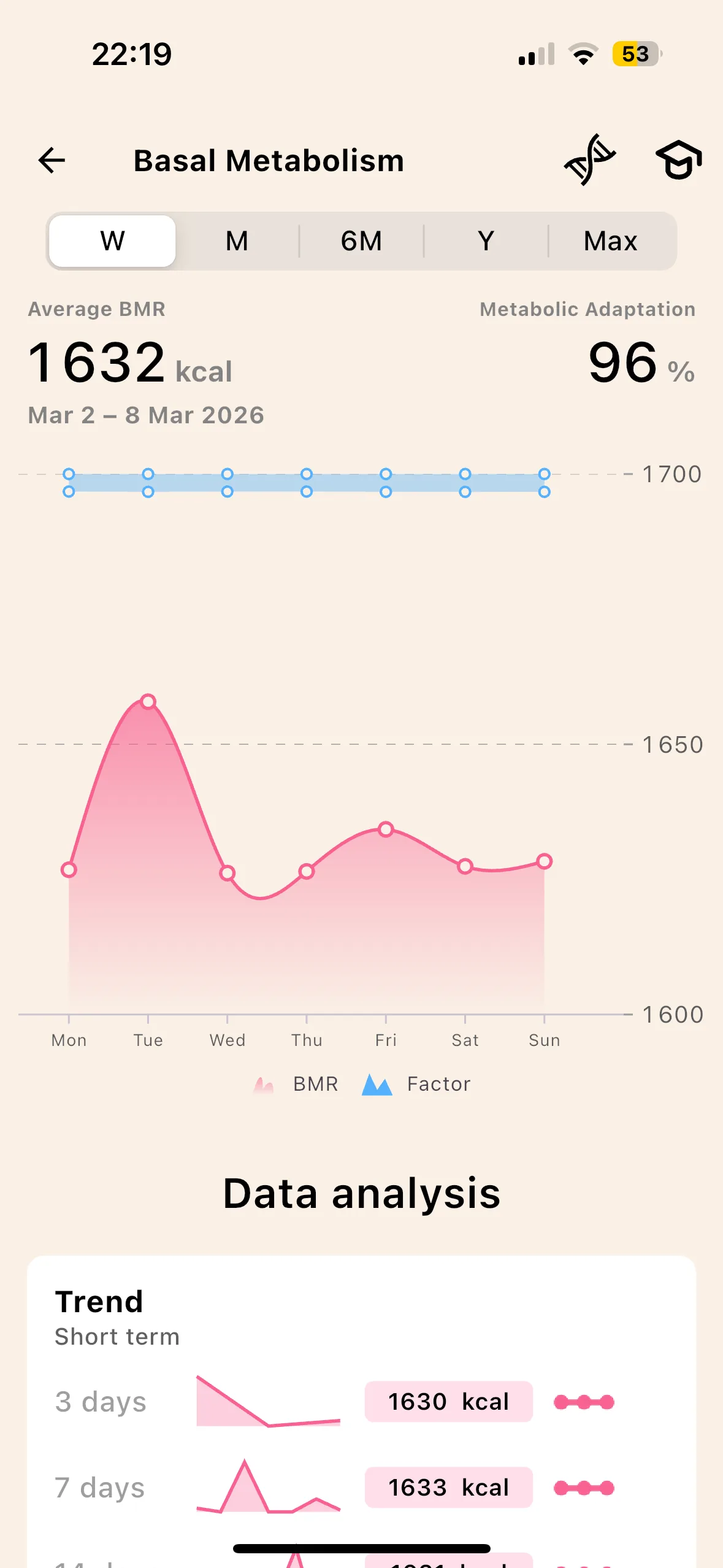
The BMR does not depend on weight but on lean mass. Two men at 80 kg, one at 10% body fat and the other at 30%, have BMRs separated by about 400 kcal. Lean measures body fat via a simple photo taken inside the app (BodyScan AI), retaken every week. BMR recalibrates continuously on actual lean mass, not on raw weight. No other consumer app offers this.
NEAT, EAT, TEF and metabolic adaptation
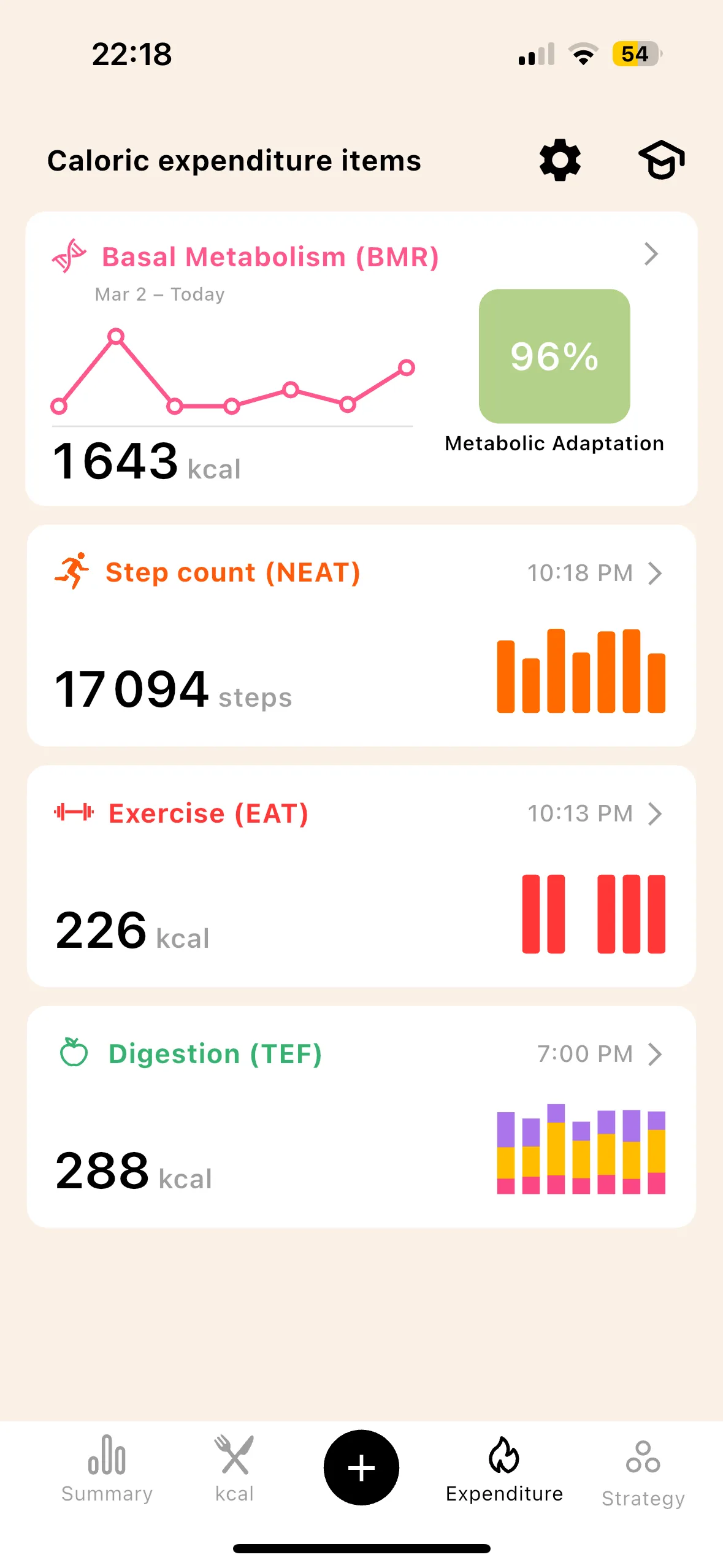
The three other components of TDEE are also calculated precisely. NEAT from real measured steps (HealthKit + Google Fit), TEF from the macros actually ingested (4 kcal/g protein, 4 kcal/g carbs, 9 kcal/g fat, thermic effect per macro), EAT per session and MET. And above all: metabolic adaptation. This is the spontaneous drop in metabolism during a prolonged deficit. Lean is the first app to model it automatically, week after week. That is what keeps your caloric target valid even 8 weeks into a cut.
Yazio: the German “Lite” alternative
Yazio is probably the first app mentioned when you ask “what is the honest replacement for MyFitnessPal”. Published in Erfurt, Germany by YAZIO GmbH since 2014, the app has clearly nailed its positioning: a clean UX, free of MFP's ad noise, and a free version that is genuinely usable day to day.
Strengths
Clear interface, thoughtful visual hierarchy. The built-in recipe catalogue is one of the most complete on the market, particularly suited to the “I cook at home 5 times a week” profile. The free version includes the barcode scanner, which is becoming rare. Good integration with HealthKit/Google Fit to pull in steps. Active FR community.
Weaknesses
Under the hood, Yazio uses Harris-Benedict or Mifflin-St Jeor (depending on the version) to calculate BMR. No body fat, no metabolic adaptation. It is exactly the same scientific foundation as MyFitnessPal. The “modernity” shows up in the design and the marketing, not in the formula. For anyone looking for an accuracy upgrade, this is a lateral move.
“MyFitnessPal with a better design, but with the same scientific limitations.” Excellent choice if what bothered you in MFP was the ads and the visual confusion. Not enough if you were aiming at TDEE accuracy.
Cronometer: the “data nerd” tracker
Cronometer, published by Cronometer Software Inc. (Canada) since 2011, is the reference app for anyone who wants to track nutrition at lab accuracy. The editorial positioning is clear: “track the nutrients that matter”. No gamification, no magical plateau-breaking, just data.
Strengths
Official USDA database, higher quality than every crowdsourced database on the market. Full tracking of more than 80 micronutrients (vitamins, minerals, omega 3/6, amino acids). Solid integration with connected scales, Garmin and Fitbit sensors. Katch-McArdle option available if you feed it body fat manually. Active scientific community.
Weaknesses
Austere interface. The learning curve is real, especially on mobile. TDEE calculation still relies on classic formulas with no metabolic adaptation modelling. No photo scan of a meal. Logging is rigorous, even tedious for the “I just want to know if I am in a deficit” profile.
“Excellent for scientific nutrition tracking, oversized for anyone who just wants to lose fat.” The right choice if the goal is to monitor micronutrients. The wrong choice if the goal is to calculate your TDEE properly and track your fat loss day to day.
Lifesum: the “lifestyle” alternative
Lifesum is published in Stockholm by Lifesum AB since 2008. It is probably the “prettiest” app on the market. The positioning is lifestyle: programs (keto, intermittent fasting, Mediterranean), subtle gamification, polished visual hierarchy, carefully styled food photos in the database.
Strengths
Undeniably premium UX, probably the best on the market in pure visual experience. Well-designed meal plans and themed programs, particularly for beginner profiles. Good barcode scanner. Well-calibrated motivational notifications (neither harassing nor missing). Decent HealthKit/Google Fit integration.
Weaknesses
Fully paid business model, very few features usable without a subscription. This is the main sticking point for users coming from free MFP. The TDEE formula is still classic, with no body fat and no adaptation modelling. The editorial focus is on “diets” (keto, IF, etc.) rather than on metabolic accuracy in a scientific sense.
“Pretty, motivating, but expensive for the scientific rigor actually delivered.” A good option if you are after a premium visual experience and you thrive on themed programs. A bad option if what bothered you in MFP was TDEE inaccuracy; Lifesum fixes nothing on that front.
FatSecret: the pure free pick
FatSecret is published by FatSecret Platform Pty Ltd (Australia) since 2007. It is probably the least glamorous alternative on this list, but also the most pragmatic on one precise criterion: it is 100% free, barcode scanner included. Where MFP moved its scanner behind the paywall in 2024, FatSecret continues to offer its own without a paywall.
Strengths
Transparent 100% free business model. Barcode scanner in the free version (unlike MFP). Active community for nearly 20 years, lots of products already in the database. Available in most markets (FR, EN, ES, PT, DE, etc.). Integrated calorie tracking is simple.
Weaknesses
Interface that has not evolved since the early 2010s. Basic TDEE formula (Harris-Benedict), no metabolic adaptation, no body fat. Crowdsourced database with very variable quality, lots of duplicates. No differentiating feature compared to MFP beyond the business model.
“Acceptable free alternative, but fixes none of MFP's scientific flaws.” The right choice if your only constraint is zero budget and you accept the inaccuracy. The wrong choice if you are looking for an improvement in TDEE accuracy.
Migration table: from MFP, to which alternative?
Five typical user profiles. For each one, the app we would honestly recommend after testing everything. No single answer: it depends on your goal.
Recommended choice among the alternatives : Cronometer (Katch-McArdle option if you enter your bodyfat). Outside the ranking, Lean closes this gap with a bodyfat measured every week. This is the only case where TDEE accuracy really matters. Without body fat or modelled metabolic adaptation, your caloric target stays inaccurate. Lean closes that gap.
Recommended pick: Cronometer. If you monitor 60 micronutrients a day to optimize your bulk/cut phases, the austerity of Cronometer is an acceptable trade-off. Lean does not position itself on this use case.
Recommended pick: Lifesum. For anyone who has never tracked and wants a playful onboarding, Lifesum's meal plans and gamification lower the friction. The fully paid model becomes acceptable for this profile.
Recommended pick: FatSecret. The only 100% free alternative with a scanner included. Provided you accept that no differentiating scientific feature is delivered. Plan B: Lean's free trial stays usable on the core features.
Recommended pick: Yazio. If the main friction was MFP's degraded UX (ads, slowness, confusion), Yazio delivers the same scientific foundation with better packaging. An honest solution for anyone who does not want to change paradigm.
And Lean ? What the publisher of this comparison does that the 4 alternatives do not
Lean is not ranked in this comparison, because it is our app. What follows is our argument, for you to verify yourself with the free trial. First, we acknowledge what is honest to acknowledge : Lifesum beats Lean on pure visuals, Cronometer on micronutrient accuracy, FatSecret on the “absolutely free” criterion.
But on the core problem for 80% of users leaving MFP, that is to say calculating a precise caloric expenditure to actually lose fat, Lean is the only app on the market to integrate:
Measured every week by BodyScan AI. No other consumer app offers this. It is the difference between a BMR accurate within 100 kcal and a BMR off by 400 kcal.
Real steps, sessions by MET, macros by thermic effect. No static activity coefficient to pick. TDEE is rebuilt component by component, with no approximation.
The first and only app in the world to model the spontaneous drop in metabolism during a prolonged deficit. Your caloric target stays valid after 8 weeks of cutting, while the other apps keep displaying the same number as on day 1.
It is this combination that no competitor delivers. For the technical detail of how Lean stacks up against MyFitnessPal, we wrote a dedicated 1-vs-1 comparison, with charts and numbers.
Frequently asked questions
What is the best free alternative to MyFitnessPal?
Is Lean really more accurate than MyFitnessPal?
Cronometer or Lean: which one to pick?
How do I migrate my data from MyFitnessPal?
Which alternative for cutting?
MyFitnessPal or Yazio: which is better?
Yazio or Foodvisor: which one should you choose?
Yazio or FatSecret: which is better?
Lean is available as a free download
iOS and Android. You can try BodyScan AI, see your TDEE recalculated on your actual body fat, and compare it with what MFP, Yazio or the other apps were showing you. The difference is visible in seconds.
Related articles on lean-app.com
- Lean vs MyFitnessPal: the TDEE formula that changes everything · 1-vs-1 deep dive if you want the technical detail of the MFP vs Lean fight.
- Free online TDEE calculator · web version, no signup, same logic as the app (BMR + NEAT + EAT + TEF, plus metabolic adaptation on BMR).
- Understanding TDEE in detail · in-depth scientific article on the 5 components.
- BMR: why basal metabolic rate must be calculated on lean mass.
- NEAT: expenditure from steps and non-exercise activity.
- TEF: digestion burns calories.
- How to count your calories properly · practical guide.
Scientific bibliography
- Müller M.J., Bosy-Westphal A. (2013). Adaptive thermogenesis with weight loss in humans. Obesity, 21(2), 218-228. Reference on modelling metabolic adaptation during a deficit.
- Hall K.D. et al. (2016). Persistent metabolic adaptation 6 years after “The Biggest Loser” competition. Obesity, 24(8), 1612-1619. Longitudinal study on the persistence of metabolic adaptation.
- Westerterp K.R. (2004). Diet induced thermogenesis. Nutrition & Metabolism, 1, 5. Reference on TEF per macronutrient.
- Levine J.A. (2005). Measurement of energy expenditure. Public Health Nutrition, 8(7A), 1123-1132. Reference on NEAT and inter-individual variability.
- USDA FoodData Central. Official nutrition database used by Cronometer and Lean.
- Mifflin M.D. et al. (1990). A new predictive equation for resting energy expenditure in healthy individuals. American Journal of Clinical Nutrition, 51(2), 241-247. Default formula used in MyFitnessPal.