Body fat calculator : your real body fat percentage one tape measure, four measurements: zero checkboxes
Your body fat percentage is the data point missing from 99 % of trackers: without it, there is no way to know your lean mass, hence your real metabolism. This calculator applies the US Navy circumference method (Hodgdon & Beckett 1984, validated on tens of thousands of subjects): one tape measure, four measurements, and you get your body fat %, your lean mass and your real BMR.
 The Lean Team · 8 min read · Updated August 25, 2026

 Free download
The US Navy method estimates your body fat percentage from tape measurements: neck and waist for men, neck, waist and hips for women, plus your height. Typical precision of ±3 to 4 points against reference methods (Friedl 1997), free and repeatable at home. The usual healthy ranges: about 10 to 20 % for a man, 18 to 28 % for a woman, a little more with age. Measure your percentage with the calculator below.
02 · CalculatorMeasure your body fat percentage with a tape
Grab a soft tape measure and take three measurements (four for women): the calculator applies the US Navy circumference formula (Hodgdon & Beckett 1984), then derives your fat mass, your lean mass and your BMR on lean mass (370 + 21.6 × FFM, the same formula as our TDEE calculator). Transparent formula, repeatable measurements: always measure at the same time, fasted, tape horizontal and without squeezing.
Your measurements
Educational estimate based on published equations (Hodgdon & Beckett 1984; Friedl 1997 validation). This calculator is not a diagnostic tool and does not replace medical advice.
Lean's AI BodyScan measures it in 5 seconds from a single photo: body fat, lean mass and fat mass, straight from your phone.
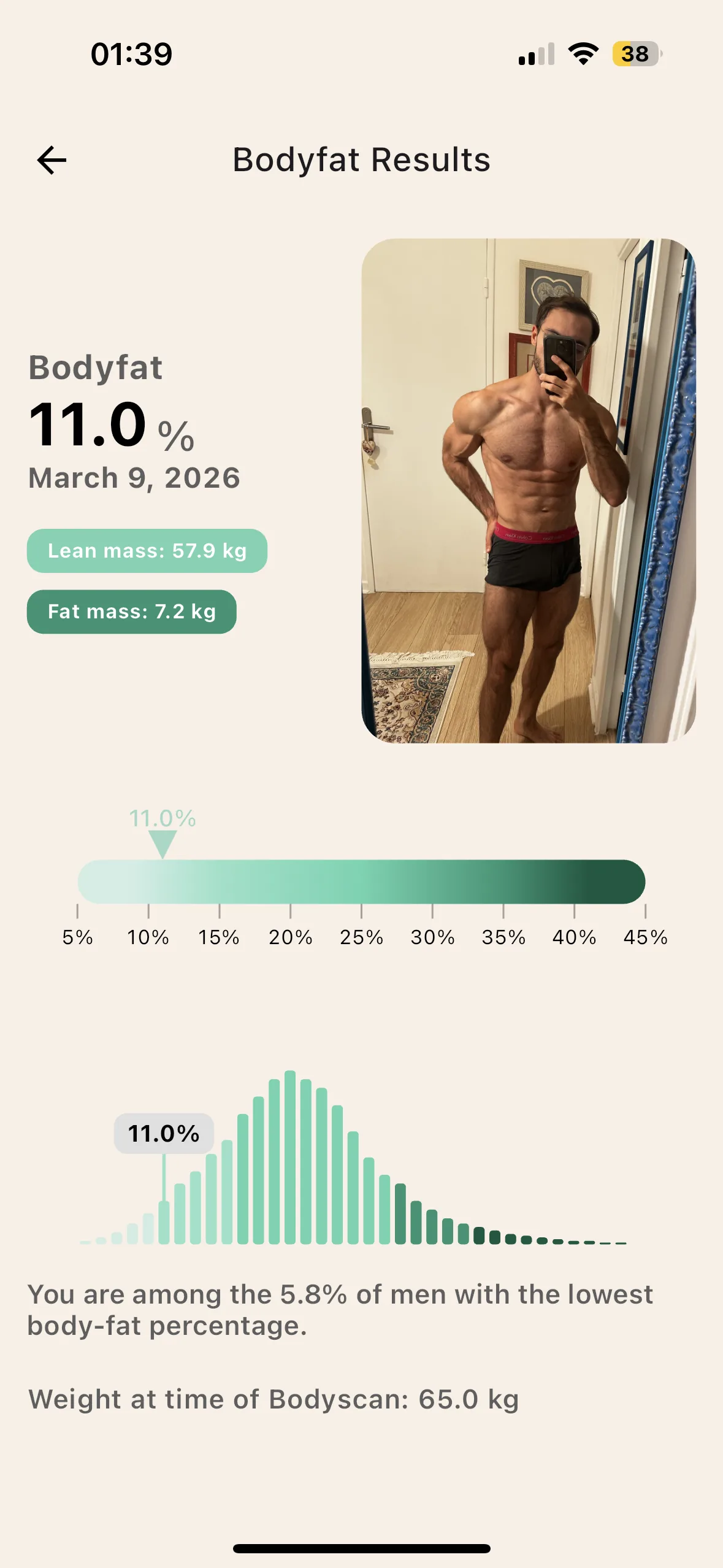
The tape is a good approximation; the photo is even simpler: no measurements to take, no tape placement error, and automatic trend tracking.
03 · The scienceWhy your body fat percentage changes your whole metabolism
Two 80 kg bodies can burn 400 kcal/day apart at rest. The difference is lean mass.
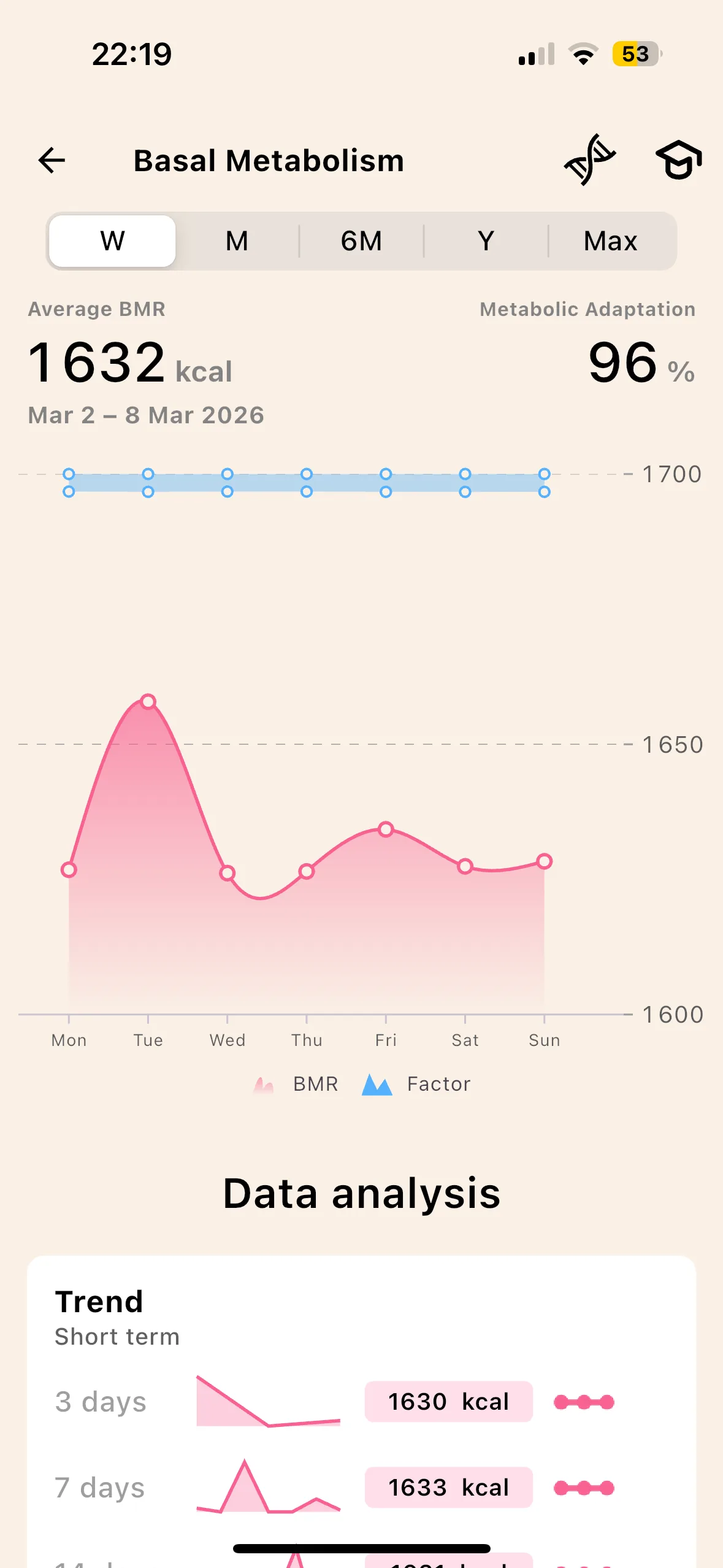
Your basal metabolic rate is not proportional to your weight: it is proportional to your lean mass. Muscles, organs, bones, water: that is the tissue burning energy at rest. Fat mass, on the other hand, is almost metabolically inert. Two 80 kg men, one at 10 % body fat (72 kg of lean mass), the other at 30 % (56 kg), sit about 400 kcal/day of BMR apart. Yet a formula that only knows your weight, height and age shows them the same number: it is mathematically unable to do better.
Hence the point of measuring your body fat percentage. The circumference method was developed for the US Navy (Hodgdon & Beckett 1984) precisely because it fits in a tape measure: the ratio between your neck, your waist (and your hips for women) and your height predicts your body density, hence your body fat percentage. Friedl's validation (1997) on military cohorts places it at ±3 to 4 points of reference methods: imperfect for an absolute number, very solid for tracking a trend, free and repeatable.
Once your percentage is known, everything unlocks: lean mass = weight × (1 − fat), and BMR = 370 + 21.6 × lean mass, the lean-mass formula displayed in the calculator, the same as our basal metabolic rate page. It is a completely different philosophy from weight-only population formulas: we start from your body composition, not from the average of people who look like you on three variables.
Where does it fit in the equation? In Lean, expenditure breaks down as TDEE = BMR + NEAT + EAT + TEF, and BMR is its first brick, the foundation. A 300 or 400 kcal error at the foundation propagates everywhere: wrong calorie target, phantom deficit, unexplained plateau. Metabolic adaptation, for its part, is the 5th brick: a coefficient that modulates BMR (100→0 % convention), never a term you add up.
One last note of honesty: no accessible method is perfect. The tape has its margin, impedance scales vary with your hydration, and the reference DEXA is expensive and not a weekly habit. The right strategy is not chasing the perfect number: it is measuring always the same way and steering on the trend. That is exactly what the next sections compare.
04 · Three tape profilesWhat four measurements reveal that your scale ignores
Three profiles, one tape measure, and the same math as this page. No labels: measurements only. The numbers come from the calculator above, you can reproduce them by entering the same parameters.
The false average
The underestimated athlete
The plateau explained
05 · Methods comparedFrom tape to DEXA: what every body fat measurement is worth
Not all methods share the same cost, precision or repeatability. The right choice depends on what you are steering: one absolute number once in your life, or a trend every week:
1. Tape measure (US Navy)
This page's method. Its strength: infinitely repeatable, zero equipment. Its limit: sensitive to tape placement and time of day. Perfect for the monthly trend.
2. Impedance scale
Sends a micro-current and derives fat from resistance. Problem: your hydration changes the result from one day to the next, sometimes by 5 points between morning and evening (Moon 2008). Trend yes, number no.
3. DEXA / hydrostatic weighing
The reference methods of the literature (Siri 1961 for density models). Precise, but occasional and constraining: nobody gets a weekly DEXA. Useful to recalibrate your home measurement once in a while.
4. BodyScan AI (Lean)
The AI estimates your composition from a photo: no tape to place, no hydration to skew it, and the measurement feeds your BMR in the app directly, recalculated continuously. Measuring becomes a reflex, not a chore.
06 · Myth vs realityBMI does not measure your body composition
« My BMI is normal, so my composition is fine »
BMI (weight / height²) was invented by a 19th-century statistician to describe whole populations. It sees neither muscle, nor fat, nor their distribution: a muscular athlete lands « overweight », a slim sedentary person lands « normal » with high body fat, the famous « skinny fat » profile. Formulas deriving body fat from BMI (Deurenberg 1991) inherit the problem: correct on average, wrong for individuals who deviate from the average, which is precisely athletes.
Composition is measured, not derived from weight
This page's tape measures where fat actually shows: the ratio between your neck, your waist and your hips. That is the whole difference: two people with the same BMI get different results because their bodies ARE different. Friedl's military validation (1997) is exactly about that: classifying individuals correctly, not populations.
The practical consequence: never steer a cut or a muscle gain phase on BMI or weight alone. Weight mixes muscle, fat, water and glycogen; body fat separates them. It is what tells you whether the kilos you lost were fat or muscle, and your lean mass is what sets your real calorie budget.
The practical consequence: measure your body fat every 3 to 4 weeks in the same conditions, follow the trend, and let your BMR recalculate on your lean mass at every measurement. That is the whole difference between a theoretical calorie target and one that actually matches you.
07 · FAQEverything you wonder about body fat
How do you calculate your body fat percentage ?
The most accessible method is the circumference method (US Navy): with a tape measure, measure your neck and waist (plus hips for women), enter your height, and the formula estimates your body fat percentage. That is this page's calculator. The alternatives: impedance scale (hydration-sensitive), skinfold calipers (operator-dependent), DEXA (reference, in a center) and Lean's BodyScan AI from a photo.
What is a good body fat percentage ?
The usual ranges: about 10 to 20 % for a man and 18 to 28 % for a woman in good shape, a little more with age. Below 6 % (men) or 14 % (women), you approach essential fat: not a zone to target long term. Above all, remember the trend matters more than the number: the error margin of accessible methods exceeds the difference between « good » and « very good ».
Is the US Navy method reliable ?
It was validated on large military cohorts: typical precision of ±3 to 4 points against reference methods (Friedl 1997), with possible bias at the extremes (very muscular, very high percentages). That is enough to locate your zone and follow a monthly trend, not to compare two measurements within 1 point. Always measure in the same conditions: fasted, tape horizontal, without squeezing.
Why does my percentage change from day to day on my scale ?
Impedance scales derive your composition from your body's electrical resistance, which varies with hydration, meals, and yesterday's training. From one morning to the next, the same body can show several points of difference (Moon 2008). It is not your fat that changed, it is your water. Weigh and measure yourself at the same time of day, and read the weekly average, never the daily number.
What is the difference between BMI and body fat ?
BMI divides your weight by your height squared: it cannot tell a kilo of muscle from a kilo of fat. Two people with the same BMI can be 15 points of body fat apart. Body fat percentage measures actual composition: it is what matters for your metabolism, your metabolic health and your physique. BMI remains a population statistics tool, not an individual steering tool.
Why does body fat change my basal metabolic rate ?
Because metabolism is carried by lean mass: muscles, organs, bones. At 80 kg, a body at 10 % fat has 72 kg of active tissue; at 30 %, only 56 kg. Result: about 400 kcal/day of BMR gap between the two, invisible to a weight-only formula. That is this page's whole point: measure your fat to know your lean mass, hence your real calorie budget.
How often should you measure body fat ?
Every 3 to 4 weeks is enough with a tape: fat evolves slowly, and measuring more often mostly measures noise. The exception: an automatic, effortless measurement like the BodyScan photo, which allows closer trend tracking without obsessing over the number. In any case: same conditions, same time, and decisions made on the trend of 2 to 3 measurements.
Can you lose fat without losing muscle ?
Yes, that is the whole point of a successful cut: moderate deficit, sufficient protein intake and strength training. The only way to verify it works is precisely to track your body fat on top of your weight: if weight drops and lean mass holds, you are losing fat; if both plunge, your deficit is too aggressive. Weight alone cannot tell the difference.
Does exercise turn fat into muscle ?
No: they are two different tissues, one never becomes the other. However, you can lose fat and gain muscle over the same period (body recomposition), especially early on. On the scale, your weight can then stall while your body changes completely: yet another situation where only body fat tracking shows the real progress.
Does this calculator give an exact measurement of my body fat ?
No. It applies a validated equation (US Navy) to your circumferences, with a typical precision of ±3 to 4 points: a solid estimate to locate yourself and follow your trend, not a truth to the decimal. No accessible method does better in absolute terms; what matters is consistent measurement conditions. And in any case, neither this page nor the app replaces medical advice.
Scientific sources
- Hodgdon JA, Beckett MB. Prediction of percent body fat for U.S. Navy men and women from body circumferences and height. Naval Health Research Center, Reports No. 84-11 & 84-29, 1984.
- Friedl KE, DeLuca JP, Marchitelli LJ, Vogel JA. Validity of percent body fat predicted from circumferences: classification of men for weight control regulations. Mil Med. 1997;162(3):194-200. PubMed 9121667.
- Deurenberg P, Weststrate JA, Seidell JC. Body mass index as a measure of body fatness: age- and sex-specific prediction formulas. Br J Nutr. 1991;65(2):105-14. PubMed 2043597.
- Moon JR, Tobkin SE, Smith AE, et al. Percent body fat estimations in college men using field and laboratory methods: a three-compartment model approach. Dyn Med. 2008;7:7. PubMed 18426582.
- Siri WE. Body composition from fluid spaces and density: analysis of methods. In: Techniques for Measuring Body Composition. Washington DC: National Academy of Sciences; 1961:223-244.
Your body fat, measured in one photo
BodyScan AI from a single photo, BMR continuously recalculated on your lean mass, calorie balance that follows your real composition. The data your scale ignores, finally measured. Free download, 7-day trial on the annual plan.