NEAT (Non-Exercise Activity Thermogenesis). The complete guide to understanding and leveraging your hidden calorie burn.
NEAT can vary by +700 kcal per day between two individuals of the same weight. All apps ask you to check a box: “lightly active”. Lean calculates it in real time via your pedometer.
Looking to calculate your NEAT? The calculator converts your real steps into kcal/day on your measured profile, with no checkboxes. Open the NEAT calculator →
 The Lean Team · 10 min read · Updated May 27, 2026

 Free download
The NEAT (Non-Exercise Activity Thermogenesis) is the caloric expenditure linked to daily physical activities outside structured sport. It is part of the equation TDEE = BMR + NEAT + EAT + TEF. It is the most variable component: between a sedentary person and someone who walks 15,000 steps per day, the gap reaches 700 kcal per day according to Levine (2005).
02 · DefinitionNEAT, the 2nd building block of TDEE
The NEAT (Non-Exercise Activity Thermogenesis) is the energy burned by all daily physical activities that are not structured sport and are not part of basal metabolism. In plain terms: walking to the coffee shop, fidgeting while talking, doing the dishes, climbing stairs, gardening, grocery shopping, standing.
It fits into the fundamental metabolic equation:
TDEE = BMR + NEAT + EAT + TEF
The BMR (Basal Metabolic Rate) is the resting expenditure. TheEAT (Exercise Activity Thermogenesis) covers your workout sessions. The TEF (Thermic Effect of Food) is the heat produced during digestion. NEAT covers everything else, and it is often the easiest component to increase, without adding a single workout session.
Themetabolic adaptation comes on top as a multiplicative coefficient of BMR in prolonged caloric deficit. Lean convention: 100 % = optimal, 90 % = 10 % adaptation. It does not enter not in the TDEE sum.
03 · Variability+700 kcal gap between individuals of the same weight
This is the most surprising finding: two people of the same weight, same age, same morphology can have a NEAT that differs by 700 kcal per day. This is not an estimate: it is the figure measured by James A. Levine in a study published in Science (2005, PMID 15681386).
The reason: involuntary motor behaviors (fidgeting, gesturing, posture) are deeply individual. What is conscious is your baseline activity level: do you take the stairs or the elevator, do you stand at your desk, do you walk between meetings.
Practical implication: if your calorie deficit has stalled, NEAT is the first variable to investigate, before adding cardio or cutting intake.
“NEAT between individuals can vary by more than 2 000 kJ/day (478 kcal/day)”
Levine JA et al., Science 2005, PMID 15681386
04 · 3 profilesFrom sedentary to active: the measured gap
Three concrete profiles, calculated for an 80 kg, 35-year-old man with 12 % body fat. BMR is identical in all three cases. Only NEAT changes.
Sedentary
Moderate
Active
05 · Why apps failStatic PAL vs dynamic calculation
When you set up MyFitnessPal or Yazio, you are asked for your “activity level”. You check a box: sedentary, lightly active, moderately active. And that checkbox defines a PAL (Physical Activity Level) coefficient that applies to your BMR forever.
The problem: that coefficient does not change on Monday when you do 15,000 steps versus Sunday when you never leave the couch. If you checked “lightly active” (PAL 1.375), you have 1.375 forever, regardless of what you actually do.
Johannsen & Ravussin (2008, PMID 18769211) measured that NEAT estimation errors via static PAL can reach 30 %. 300 to 500 kcal per day. That is the order of magnitude that explains a deficit that “is not working” or unexplained weight gain while “eating well”.
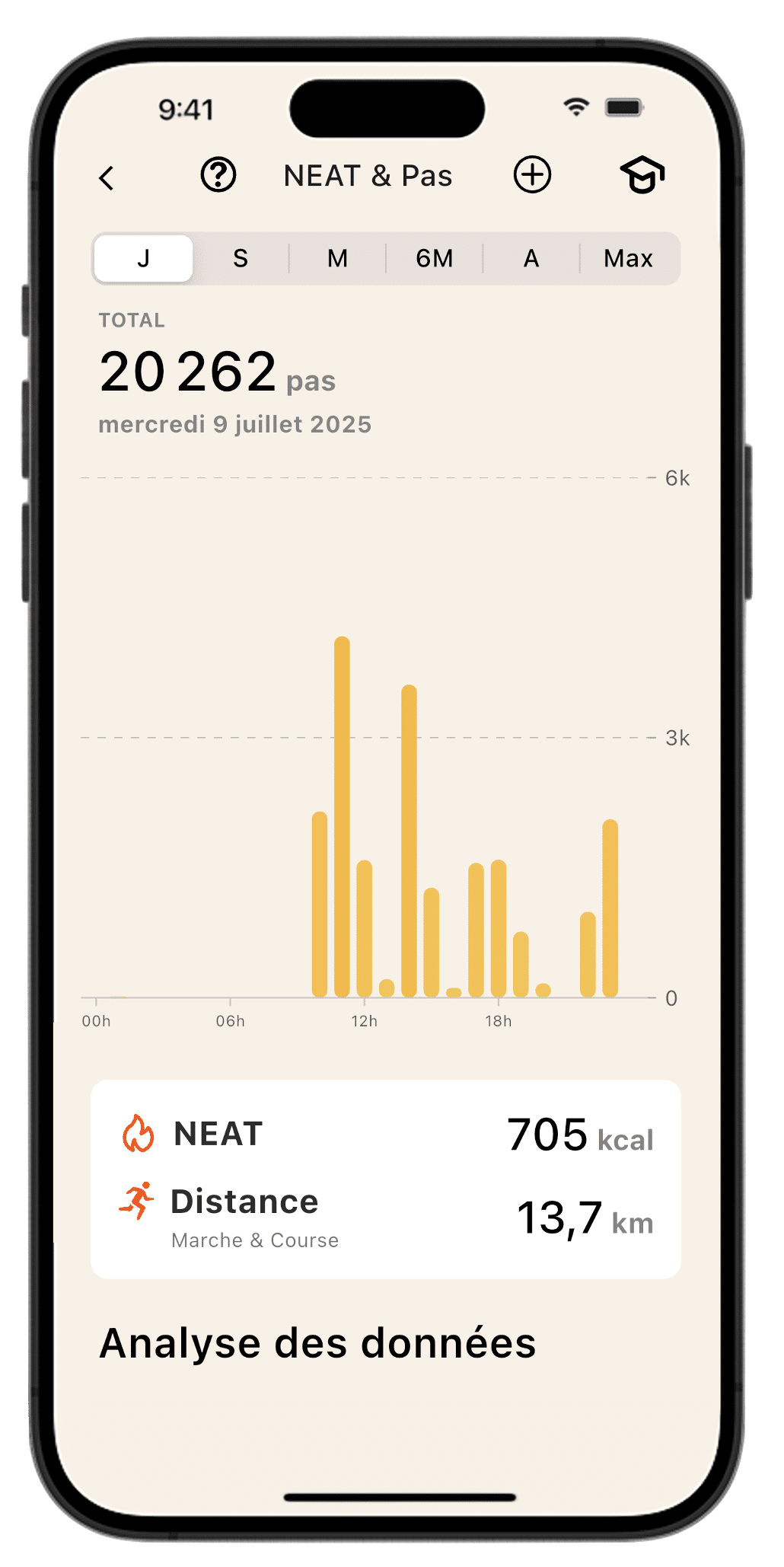
06 · MFP vs Lean189 kcal vs 705 kcal for 20 000 steps
A concrete example: 20 000 steps in a day for an 80 kg man with 12 % body fat.
MyFitnessPal
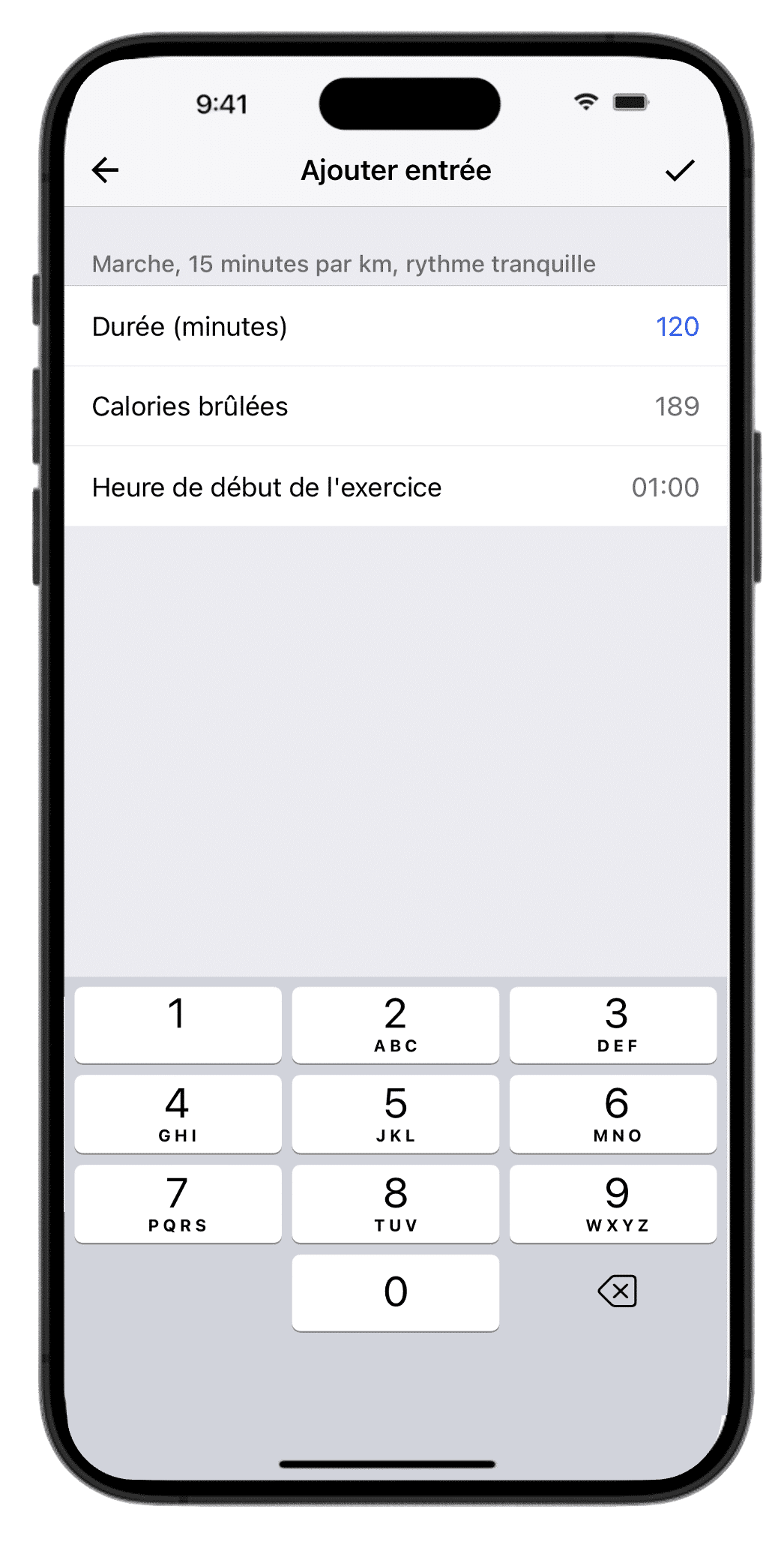
Lean
07 · BMR & NEATWhy your BMR changes the value of every step
This is the argument that most articles on NEAT overlook. The caloric cost of a step is not a constant: it depends on your actual lean mass, therefore on your BMR.
The physiological reason: effort expenditure is proportional to metabolically active mass (muscles, organs), not total weight. Two 80 kg individuals with 12 % and 22 % body fat have 70.4 kg and 62.4 kg of lean mass respectively. Their energy cost for the same number of steps differs by nearly 12 %. Applied to 10 000 steps per day, the gap reaches dozens of kilocalories, meaning hundreds of kilocalories per week.
Concretely: if your NEAT calculation is not indexed to your real BMR, you can be in a calorie surplus while thinking you are in a deficit, or vice versa. This is exactly the mechanism behind inexplicable fat-loss plateaus.
Thanks to AI BodyScan, Lean knows your body fat. It derives your lean mass, calculates your BMR via its patented proprietary model, and calibrates the cost of each step to that unique profile.
Lost 3 kg of fat in a month? Your BMR changes, and the cost of each step is automatically recalculated in Lean. Other apps keep the constant set at sign-up.
Someone with a BMR of 1 900 kcal and someone with a BMR of 1 500 kcal do not burn the same calories walking 10 000 steps. Applying the same generic constant to both is a structural error.
This is the difference between a generic NEAT calculation and a personalized one. Lean is the only app that implements this complete architecture: body-fat-aware BMR, NEAT indexed to that BMR, dynamic TDEE to the calorie.
08 · Connected devicesWhy your watch systematically overestimates your NEAT
Apple Watch, Garmin, Fitbit and connected treadmills share one thing: they do not know your BMR. Their expenditure algorithm relies on a generic constant multiplied by your total weight, with no account for body composition.
Result: a systematic overestimation of +30 % to +100 % on the expenditure linked to walking. Over a day at 10,000 steps, an Apple Watch can display 700 kcal where the actual value is closer to 350 kcal for the same profile.
Concrete example: targeting a −100 kcal/day deficit
Your watch shows 700 kcal for 1h of walking (10,000 steps). Actual value: ~350 kcal. Overestimation: +350 kcal/day. Weekly balance: +350×7 − 700 = +1,750 kcal. You were in a caloric surplus.
This error can entirely undermine a caloric deficit. Lean integrates your watch data via Apple Health or Health Connect, but recalibrates on your actual BMR. You benefit from your watch sensor precision without absorbing its systematic calculation bias.
See also: BMR Pillar: why bodyfat changes everything about your basal metabolic rate.
09 · AI BodyScanReal body fat: the foundation of Lean's NEAT calculation
For NEAT to be calculated on your real BMR, you first need to know your real BMR. And for that, you need your body fat, not just your weight. This is where Lean's AI BodyScan comes in.
Most apps calculate BMR from total weight (Harris-Benedict 1919, Mifflin-St Jeor 1990). Lean calculates it on your real lean mass. lean mass estimated via bodyfat, thanks to a proprietary patented model. Two individuals at 80 kg with 12 % and 22 % bodyfat have a BMR that differs by 200 kcal per day. If you are wrong about BMR, your NEAT (and the entire TDEE) is wrong from the foundation.
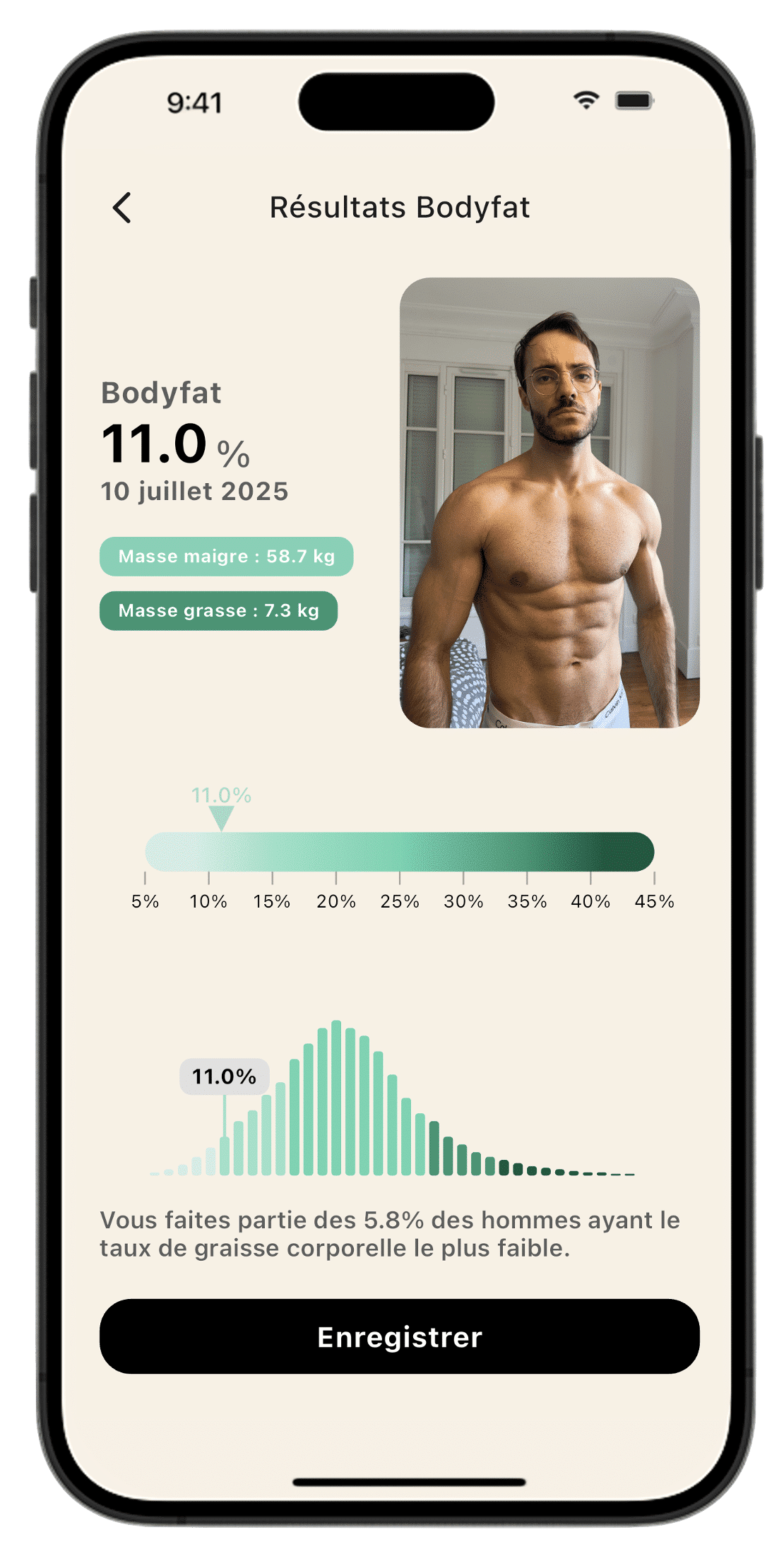
AI BodyScan : actual bodyfat in 5 seconds, from a photo
One photo, 5 seconds, and Lean knows your body fat precisely. This figure directly feeds your BMR calculation via Lean's patented proprietary model, which in turn forms the basis for your NEAT calculation. This is the chain architecture that other apps do not offer.
10 · Lean & NEATReal-time calculation via the pedometer
Lean calculates your NEAT from your pedometer (Apple Health on iOS, Health Connect on Android) and indexes it on your complete metabolic profile. Each step is counted and converted into energy based on your actual body composition.
Lean reads your steps via Apple Health (iOS) or Health Connect (Android) in the background. No need to open the app for your steps to be counted.
Your NEAT in Lean changes throughout the day. At noon, you see your real morning NEAT expenditure, indexed to your current BMR.
Walked without your smartphone? You can add (or remove) steps manually in Lean's NEAT section via the “+” button. They are immediately integrated into your calorie balance.

If your watch is synced with Apple Health (iOS) or Health Connect (Android), Lean uses its step data (more precise than the smartphone alone), while recalibrating the expenditure on your actual BMR.
Lean adjusts your daily goal based on your real NEAT. If you walked 12 000 steps this morning, your evening calorie goal accounts for that extra expenditure.
11 · TutorialsActivating the pedometer in Lean
First, Lean needs access to your step data. The path differs depending on your smartphone. Official Lean tutorials: iPhone · Android.
Open the Settings on your iPhone. In the search bar at the top, type “health”. Tap Data Access & Devices, then Lean in the list. Verify that Step Count Integration is properly enabled.
1. Download Health Connect on the Play Store, open it, then go to App permissions > Lean and tick Steps. 2. Download your device brand's fitness app : Google Fit (Google), Samsung Health (Samsung), Huawei Health (Huawei), Lifelog (Sony) or your brand's health app. In this app, verify that step tracking is enabled. 3. In Health Connect, authorize this fitness app to share “Steps” in read and write. Verification : Health Connect > Data & access > Activity > Steps > See all entries: data should appear (take a few steps if it is empty).
12 · MET & classificationWhy walking is classified as NEAT and not EAT
The question comes up often: is walking NEAT or EAT? The answer rests on MET (Metabolic Equivalent of Task), the unit used in scientific literature to classify physical activities.
1 MET = the energy expended at seated rest. The NEAT/EAT boundary is set at MET = 3 : below that, it is NEAT; above, it is EAT.
Walking sits at the boundary: slow walking (< 4 km/h) is MET ≈ 2.5-3; fast walking (> 6 km/h) rises to MET 4-5. In the scientific literature, walking at normal pace is overwhelmingly classified as NEAT. Lean follows this convention.
NEAT activities (MET < 3)
EAT activities (MET > 3)
13 · NEAT strategiesWalk more, eat more
The fundamental principle of NEAT: each additional step increases your expenditure, which increases your caloric target. Walk more, eat more. This is the key trade-off that athletes in a cut quickly grasp: rather than lowering intake, first increase expenditure.
The NEAT advantage over EAT: no recovery needed, no injury risk, no hormonal stress from intense cardio. Here are the most effective levers.
Add 2 blocks of 10-minute walks to your day. Morning between tasks, afternoon before the next meeting. 20 minutes, +2 000 steps, +70 kcal without touching your workout plan.
Standing for 3 hours instead of sitting burns ~150 extra kcal. Alternating sitting and standing every 30 minutes is more effective than one continuous standing block.
A 20-minute round-trip bike commute at moderate pace counts as NEAT if effort stays below MET 3. Above that (sport cycling, elevated heart rate), it is EAT: log it separately in Lean.
Climbing 10 floors burns ~8 kcal. 4 trips/day in a 5-floor building = 32 kcal. Over 22 working days = 700 kcal that month, without a single extra workout.
Be aware of the compensation effect (Pontzer et al., 2021, PMID 34385400): if you increase NEAT too fast, your body may partially reduce other spontaneous expenditures. The actual increase is often 60 to 70 % of the theoretical burn. Lean models this effect in its adapted TDEE calculation.
14 · NEAT liveStep-by-step tracking in Lean
Lean's Expense tab details each TDEE component in real time: BMR, NEAT, EAT, TEF. The displayed NEAT corresponds to your actual steps for the day, converted to kilocalories based on your complete metabolic profile.
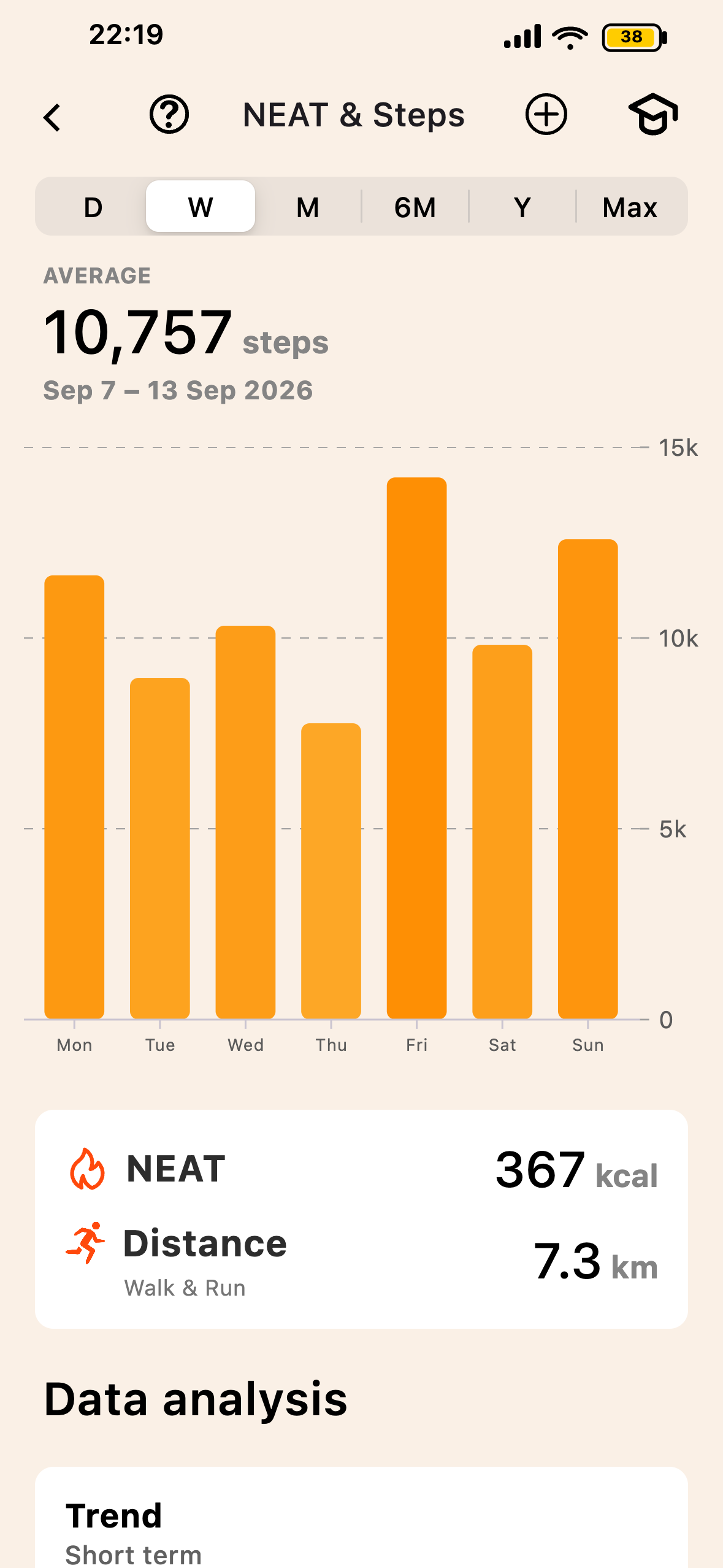
15 · GoalsNEAT strategy for cut, bulk, or recomp
Once your precise NEAT is known, practical application is straightforward. Three goals, three levers.
Cut (fat loss)
Bulk (muscle gain)
Recomp (maintenance + building)
16 · The PyramidLean Progression Pyramid
The Lean Progression Pyramid ranks priorities for reaching your body goal. NEAT occupies the 3rd level, after dietary adherence and precise calorie target.
17 · FAQEverything you want to know about NEAT
What is the difference between NEAT and EAT?
TheEAT (Exercise Activity Thermogenesis) covers your structured workout sessions (weight training, running, cycling). The NEAT covers all the rest of daily activities: walking, housework, gestures, stairs. The boundary is at MET = 3: below that is NEAT, above that is EAT. Both are calculated separately in the equation TDEE = BMR + NEAT + EAT + TEF.
Why does my Apple Watch overestimate my calories?
The Apple Watch calculates your walking expenditure without access to your actual BMR. It applies a generic constant multiplied by your weight, with no account for body composition. Result: an overestimation of +30 to +100 % depending on the profile. Lean recalibrates your watch data on your bodyfat-aware BMR to eliminate this bias.
How does NEAT affect my caloric deficit?
Directly: actual deficit = intake − (BMR + NEAT + EAT + TEF). If your NEAT increases by 300 kcal that day, your TDEE increases by 300 kcal and your deficit deepens. In Lean, the daily caloric target adjusts in real time as your NEAT progresses throughout the day.
Does NEAT decrease in a caloric deficit?
Yes, this is metabolic adaptation. In prolonged deficit, the body involuntarily reduces NEAT (less fidgeting, less motivation to move). Rosenbaum et al. (2010) measured a reduction that can reach 150 kcal/day in severe deficit. Lean models metabolic adaptation separately, as a multiplicative coefficient of BMR.
How many steps per day for optimal NEAT in a cut?
Levine and Healy's data point toward 8,000 to 12,000 steps/day as the high NEAT zone without overcompensation. In practice, aim for a target you can hold 6 days out of 7. A base of 10,000 steps is a clear first achievable goal. Lean displays your weekly NEAT average to help you calibrate this target.
Can I eat more if I walk more?
Yes, this is the central principle. Each additional step increases your TDEE, which increases the caloric target calculated by Lean. The formula: walk more, eat more, while staying within your target. In a cut, this is often preferable to lowering intake, as it limits food frustration.
Which sensor does Lean use for NEAT?
Lean reads steps from Apple Health (iOS) or Health Connect (Android, the service that replaced Google Fit since 2024). Your smartphone or connected watch accelerometer (Apple Watch, Garmin, Fitbit, Samsung Galaxy Watch) feeds these platforms. If your watch is synced, Lean uses its data while recalibrating the expenditure on your actual BMR, not on the watch's internal constant.
What is fidgeting and how does it impact NEAT?
The fidgeting refers to involuntary micro-movements (rocking, gesturing, tapping fingers). Levine (2005) showed that highly fidgety individuals burn up to 350 kcal more per day at identical activity. This behavior is largely unconscious, which is why measuring NEAT via pedometer matters more than estimating it via static PAL.
Scientific sources
- Levine JA, Lanningham-Foster LM, McCrady SK, et al. Interindividual variation in posture allocation: possible role in human obesity. Science. 2005;307(5709):584-586. PubMed 15681386
- Healy GN, Dunstan DW, Salmon J, et al. Breaks in sedentary time: beneficial associations with metabolic risk. Diabetes Care. 2008;31(4):661-666. PubMed 18252901
- Johannsen DL, Ravussin E. Spontaneous physical activity: relationship to diet, obesity, and time spent in the physical activity. Curr Opin Endocrinol Diabetes Obes. 2008. PubMed 18769211
- Pontzer H, Yamada Y, Sagayama H, et al. Daily energy expenditure through the human life course. Science. 2021;373(6556):808-812. PubMed 34385400
- Rosenbaum M, Leibel RL. Adaptive thermogenesis in humans. Int J Obes. 2010;34 Suppl 1:S47-55. PubMed 20935667
- Tudor-Locke C, Craig CL, Brown WJ, et al. How many steps/day are enough? For adults. Int J Behav Nutr Phys Act. 2011;8:79. PubMed 21798015
Calculate your NEAT on your real body fat
Built-in pedometer. NEAT recalculated every hour, indexed to your real BMR. Patented proprietary model. No generic Apple Watch constant, no frozen MFP PAL. Free download, 7-day trial on the annual plan.