Lean vs MyFitnessPal. The TDEE formula that changes everything. 1919 vs 2026, in science.
Why MyFitnessPal gets it wrong for 80% of users, and the alternative that does what MFP cannot.
 The Lean Team · 12 min read · Updated May 21, 2026

 Free download
MyFitnessPal calculates your TDEE with a 1919 formula (Harris-Benedict) with no bodyfat input, plus a nearly random activity multiplier, and ignores metabolic adaptation. Your calorie target can be off by 500 to 800 kcal. Lean recalculates each component (BMRBasal Metabolic Rate. Energy expended at rest. In Lean, calculated on actual lean mass via BodyScan AI. on real bodyfat, NEATNon-Exercise Activity Thermogenesis. Expenditure from steps and daily activities outside of sport. from steps, EATExercise Activity Thermogenesis. Expenditure from your sport sessions, calculated via MET. via MET, TEFThermic Effect of Food. Energy spent on digestion. Depends on the macros you eat. from macros, automatic metabolic adaptation) with no activity multiplier to pick.
Why 80% of MFP users don't lose weight despite a "deficit"
If you're reading this, you've probably been there. You downloaded MyFitnessPal, filled in your profile, the app told you "your TDEETotal Daily Energy Expenditure. The BMR + NEAT + EAT + TEF formula, plus metabolic adaptation that modulates BMR. is 2,500 kcal per day, eat 2,250 kcal to lose weight". You did it. Religiously. You weighed your food. You even went Premium. And at the end of the month, you're at the same weight. Maybe even a touch heavier.
You tell yourself: "I must have tracked badly, I must have under-counted my calories". You tighten the screw. You drop to 2,000 kcal. Still nothing.
Imagine MFP shows you a TDEE of 2,500 kcal. You eat 2,250 (theoretical deficit of 250 kcal). But in reality, your TDEE is 2,200 kcal. Well, there is no chance, I mean zero chance, you'll lose weight. You're in a 50 kcal surplus without knowing it.
That's why it's crucial, hyper-important, to calculate your expenditure precisely. And that's exactly where MyFitnessPal fails.
The 1919 BMR formula
To calculate your basal metabolic rate (BMR, the energy you burn at rest), MyFitnessPal uses the Harris-Benedict equation. Or its direct successor, Mifflin-St Jeor. Depending on the app version.
Estimated BMR. Lean's patented proprietary model accounts for lean mass. Harris-Benedict (MFP) does not. A 500 kcal gap, the equivalent of a whole lunch.
Harris-Benedict is from 1919. We're just out of World War I. Two researchers take 239 people from a single city (Boston), lay them in a bed with a mask to measure oxygen consumed, and produce a formula that depends on weight, height, age and sex.
For its time, it was groundbreaking. In 2025, it's unusable. Three reasons:
- The sample is laughable : 239 people, from a single American city, in 1918. At a time when there was far less obesity than today, when average hormone levels and body composition looked nothing like ours.
- The measuring instrument was imprecise : indirect calorimetry back then had a huge error margin. More modern studies show that Harris-Benedict systematically overestimates basal metabolic rate.
- The conceptual flaw : the formula only accounts for weight. Not bodyfat. Not lean mass.
Yet since the 1980s, we've known that fat mass burns very little energy compared to the rest of the body. The liver, brain, heart, kidneys, and especially muscles are the real energy sinks. Fat mass is inert. Someone at 30% bodyfat does not burn anywhere near as much as someone at 10% bodyfat, even at identical weight.
500 kcal is not nothing. If MFP tells you "your BMR is 2,500" when it's actually 2,000, everything downstream is wrong.
Partial conclusion: if an app calculates your BMR only from your weight, height, age and sex, run. It's mathematically impossible to get a reliable result.
The "nearly random" activity multiplier
This is where it gets serious. And this is probably the point nobody ever explained to you.
Once MFP has computed your BMR (wrongly), it has to estimate your total TDEE. TDEE is BMR plus everything else : expenditure from steps, daily activities, sport, and digestion. Everything that isn't basal metabolism.
How does MyFitnessPal do this? It asks you to tick a box:
- Sedentary
- Lightly active
- Active
- Very active
And depending on your choice, it multiplies your BMR by a coefficient (typically 1.2 / 1.375 / 1.55 / 1.725). That's it. That's everything behind your daily calorie target. A box YOU ticked once during sign-up. Often six months ago. Unchanged since.
And here's the silent scandal: this approximation is wildly imperfect. The difference between a day glued to the sofa watching Netflix and a day at Disneyland with your kids walking 9 miles is over 1,000 kcal.
Real expenditure measured over 7 days for a Lean user. The grey line is what MFP was showing (fixed 2,400 kcal). The pink annotations explain why each day moves.
You can't reduce your activity level to a static box. You're maybe active in weeks when you barely work from home, and sedentary when you don't leave the office. Maybe active in summer and sedentary in winter. Maybe active Tuesday to Friday and sedentary on weekends.
Which box will you tick this week? The truth is, none of the four will be right. So MFP gives you a TDEE that is systematically disconnected from reality.
It's nearly random. A bit better than a coin flip, but not by much.
The key point of this article: even if MyFitnessPal had a perfect BMR formula (it doesn't), the activity multiplier alone would still break everything. You cannot estimate NEAT, EAT and TEF with a single multiplier on top of BMR. Conceptually absurd.
You get it: a completely broken BMR formula plus an approximation of the other expenditure components means zero chance of hitting your goals.
Metabolic adaptation, ignored
This is the final boss. The most subtle concept. And probably the most important.
When you're in a calorie deficit, your body realises it's getting less energy than before. To protect itself, it switches to power-saving mode. Exactly like your iPhone's low-power mode: everything keeps working, but using less energy. Your BMR drops. Your NEAT drops. Your EAT drops.
This is metabolic adaptation. Here are the numbers:
- Deficit of −250 kcal/day, over 2 to 8 weeks: metabolic adaptation of 5 to 10%
- Deficit of −500 kcal/day: 10 to 15%
- Deficit of −750 kcal/day: 15 to 25%
And since NEAT, EAT and TEF all derive from BMR, nearly your entire TDEE gets hit.
Real TDEE over 8 weeks of deficit at −500 kcal/day. The pink curve falls. The grey MFP line stays flat. By week 6, you're already at maintenance. Without changing anything.
Concretely: if you planned a 10% deficit on a 2,500 TDEE (eating 2,250/day), and your body adapts by 10%, your real TDEE is now 2,250. You're at maintenance. You stop losing.
The trap is that it's insidious. At first, you lose. You're happy. You continue. But week after week, adaptation accumulates. And at some point, without changing a thing in your tracking, you stop losing.
95% of people go through this without understanding. They blame their willpower. They blame their "broken metabolism". They jump into harsher diets, which makes adaptation worse. Spiral.
MyFitnessPal never calculates metabolic adaptation. It gives you a fixed, static target. When you stall after 6 weeks, the app has zero idea why.
How Lean fixes each of the 3 problems
Lean wasn't built as an improved MyFitnessPal clone. Lean was built as the app we wished existed to seriously follow the complete TDEE theory. Concretely, here's how Lean handles each component.
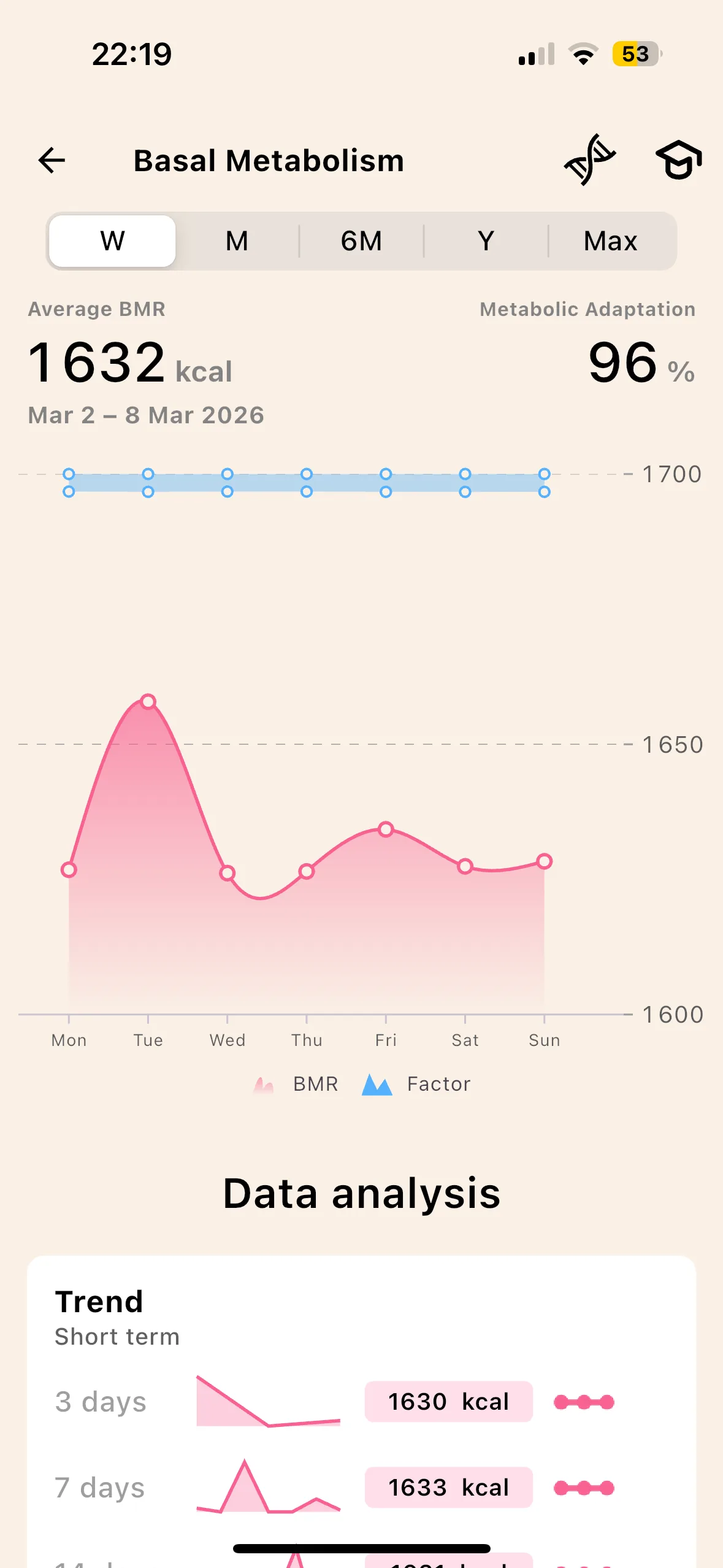
Proprietary patented model, built on lean mass
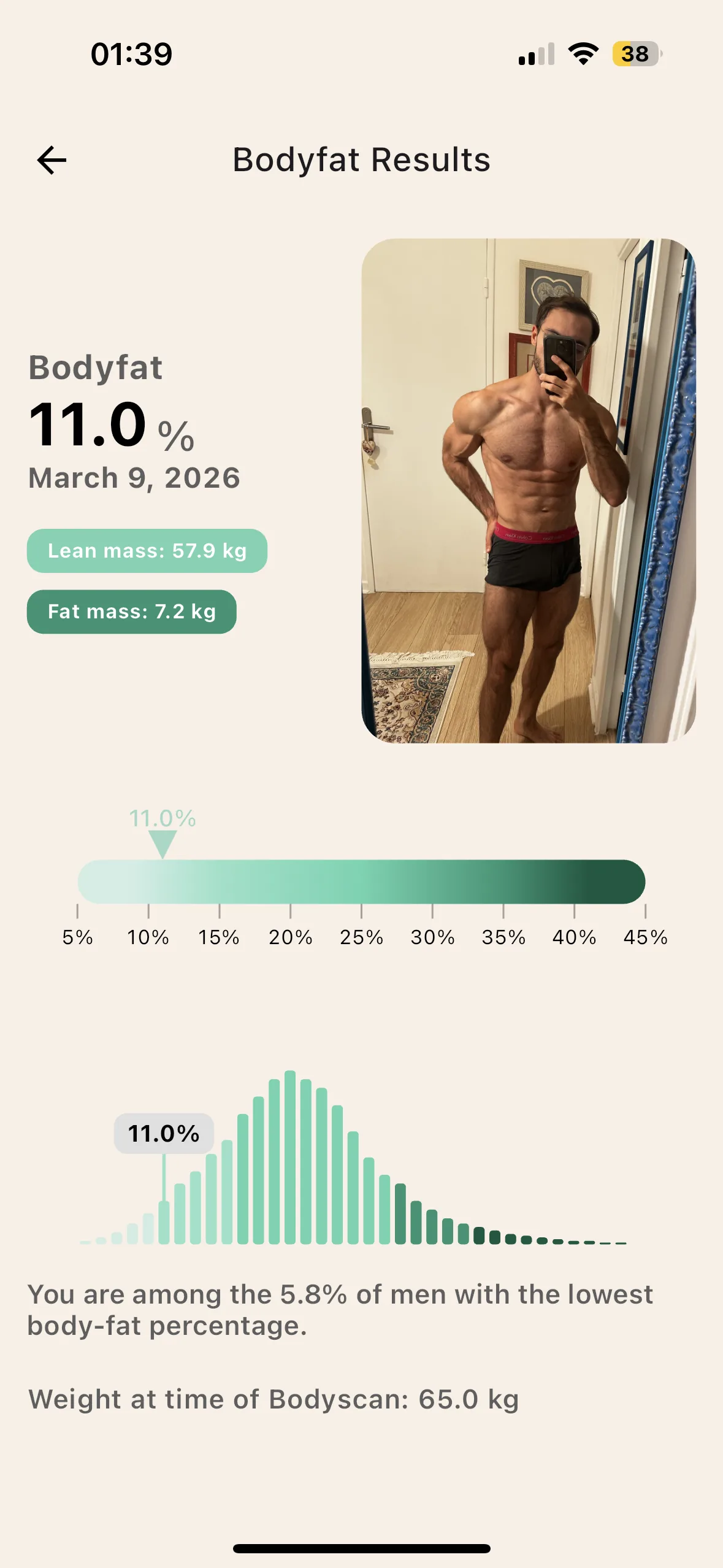
Lean uses a proprietary patented model that depends directly on lean mass, not raw weight. For that, the app needs your bodyfat. Which is historically the most painful part: how do you measure your bodyfat without paying $100/week for a DEXA scan?
Lean's answer: the AI BodyScan. You snap a photo, the app sends it through a model trained on a massive DEXA scan bank, and you get your estimated bodyfat in seconds. You can redo it every week. BMR recalculates automatically.
Goodbye skinfold callipers (imprecise), goodbye bioimpedance scales (the scam of the century), goodbye DEXA scan (perfect but inaccessible). One photo, 5 seconds.
NEAT, EAT, TEF calculated separately
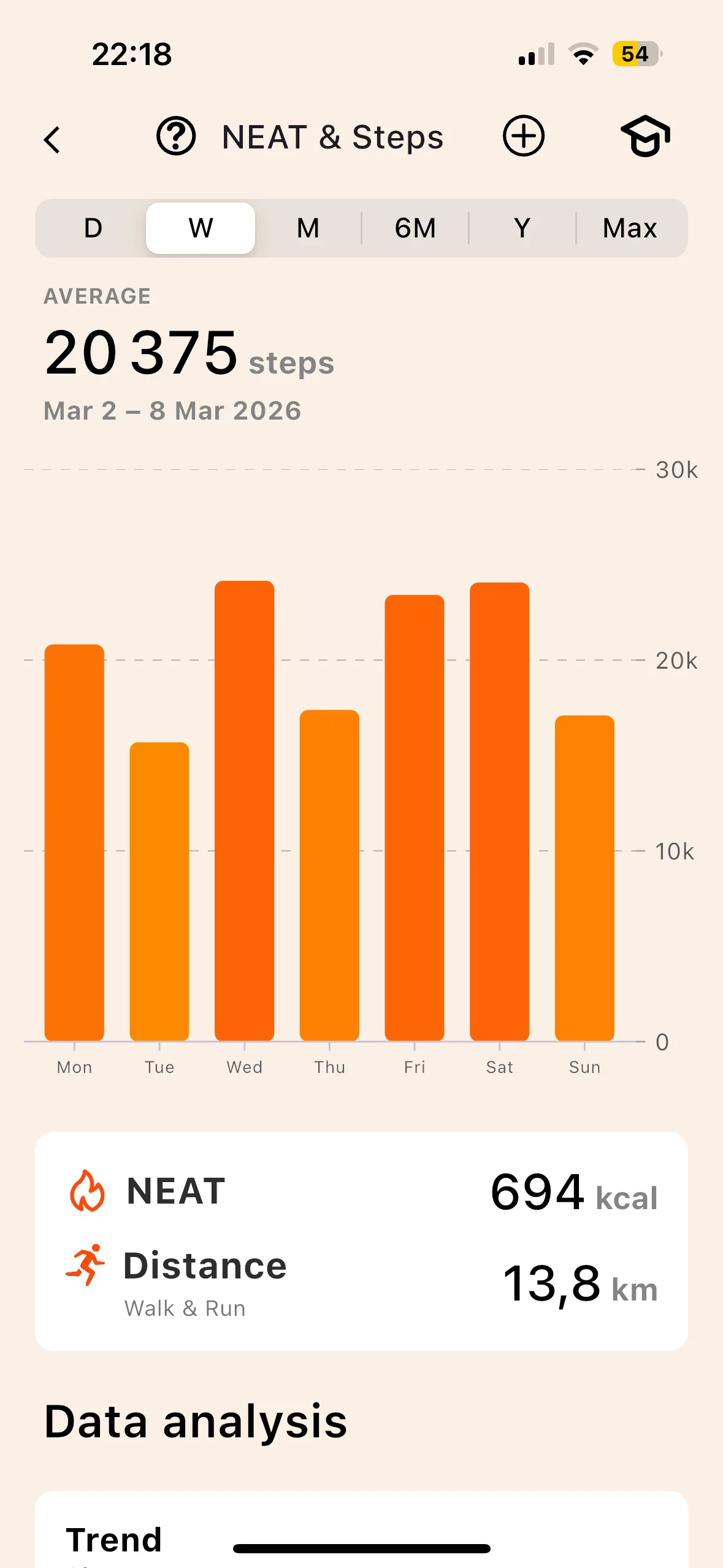
NEAT. Lean pulls your real step count via HealthKit (iOS) or Google Fit (Android). No self-reporting. No "I think I walk enough". Your steps, measured by the very accurate accelerometer in your smartphone. NEAT is computed by crossing these steps with your BMR.
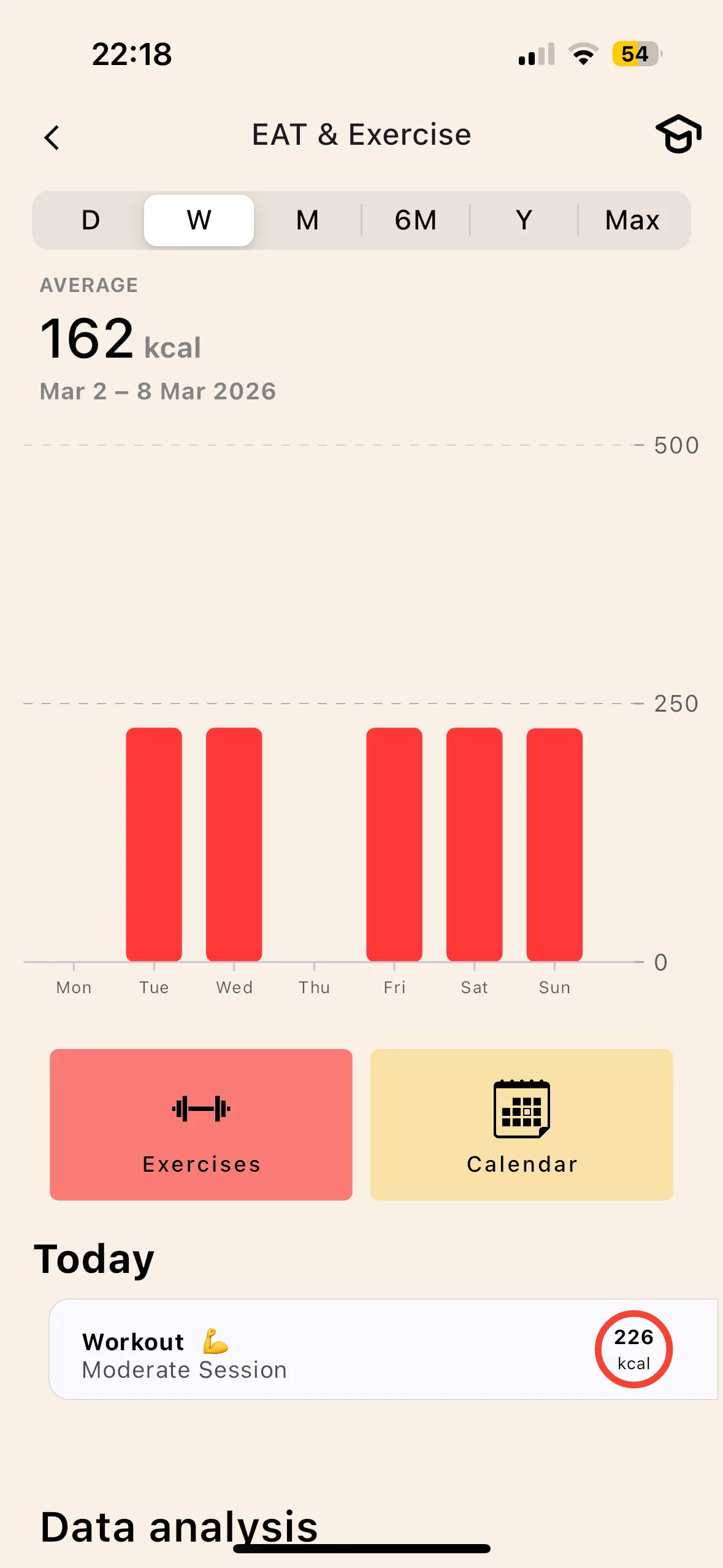
EAT. For each workout, you pick the sport in a list (lifting, running, tennis, swimming, etc.), and Lean uses that sport's MET (Metabolic Equivalent of Task) to compute real expenditure. You enter the effective time of sport (not total time including breaks: the mistake 100% of smartwatches make). A lifting session at 1,050 kcal according to your Apple Watch? Reality is closer to 200 kcal. Lean refuses that drift.
TEF. Digestion burns energy, and it isn't a flat 10% lump. Protein costs 20 to 30% of its calories in digestion. Carbs 5 to 10%. Fats 1 to 3%. Lean calculates your real TEF from your macros. On 3,000 kcal/day, that's up to 100 kcal of swing depending on your diet composition.
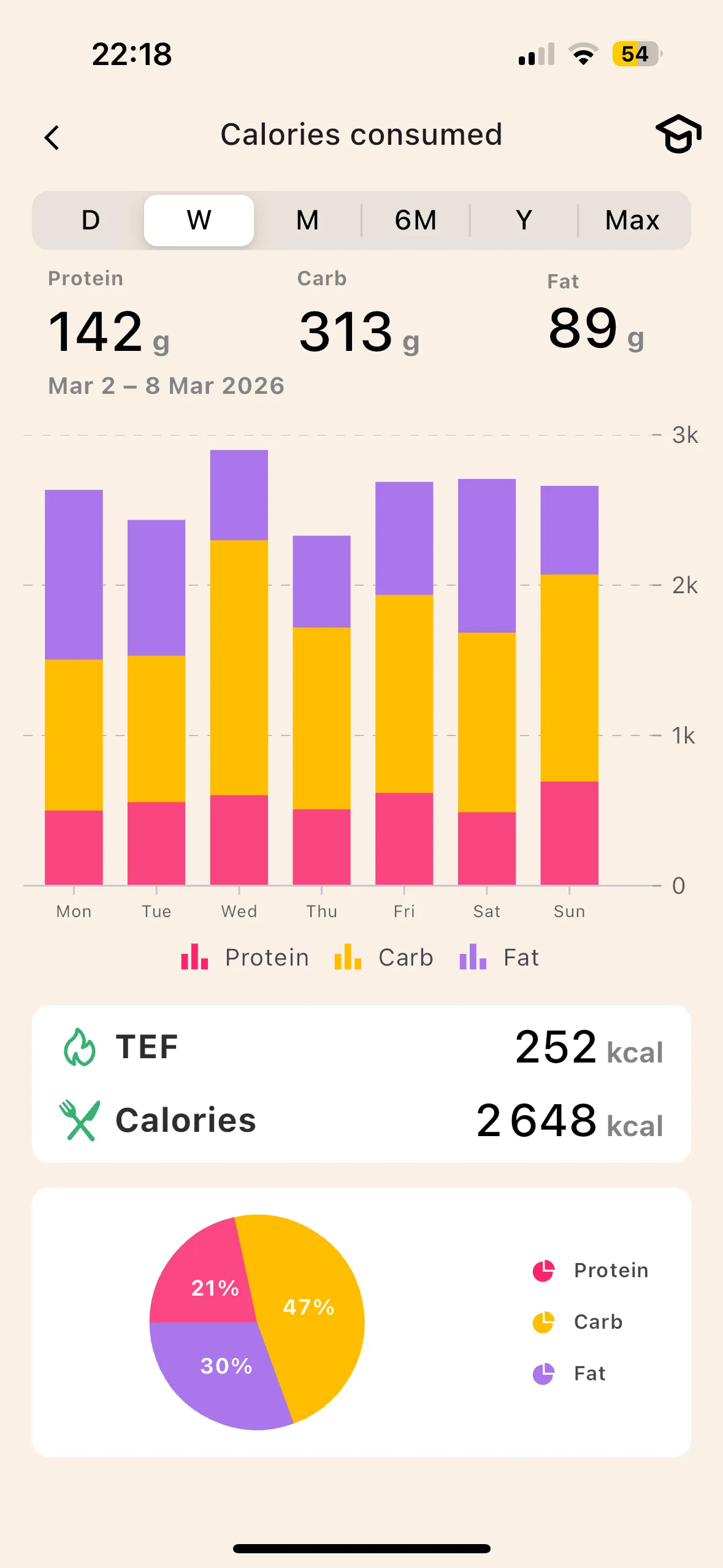
A world first on a consumer app
Lean is, to our knowledge, the first app to automatically compute metabolic adaptation. Week after week in deficit, the app adjusts your TDEE downward following the scientifically established numbers. You do nothing. You just see your calorie target quietly readjust, no surprise.
When you hit 10 to 15% adaptation, the app can recommend a return to maintenance to reset your BMR before diving back into deficit. Cycle, plateau, cycle. Like the real protocols.
No activity multiplier to pick. No static box. Just every component computed precisely, week after week.
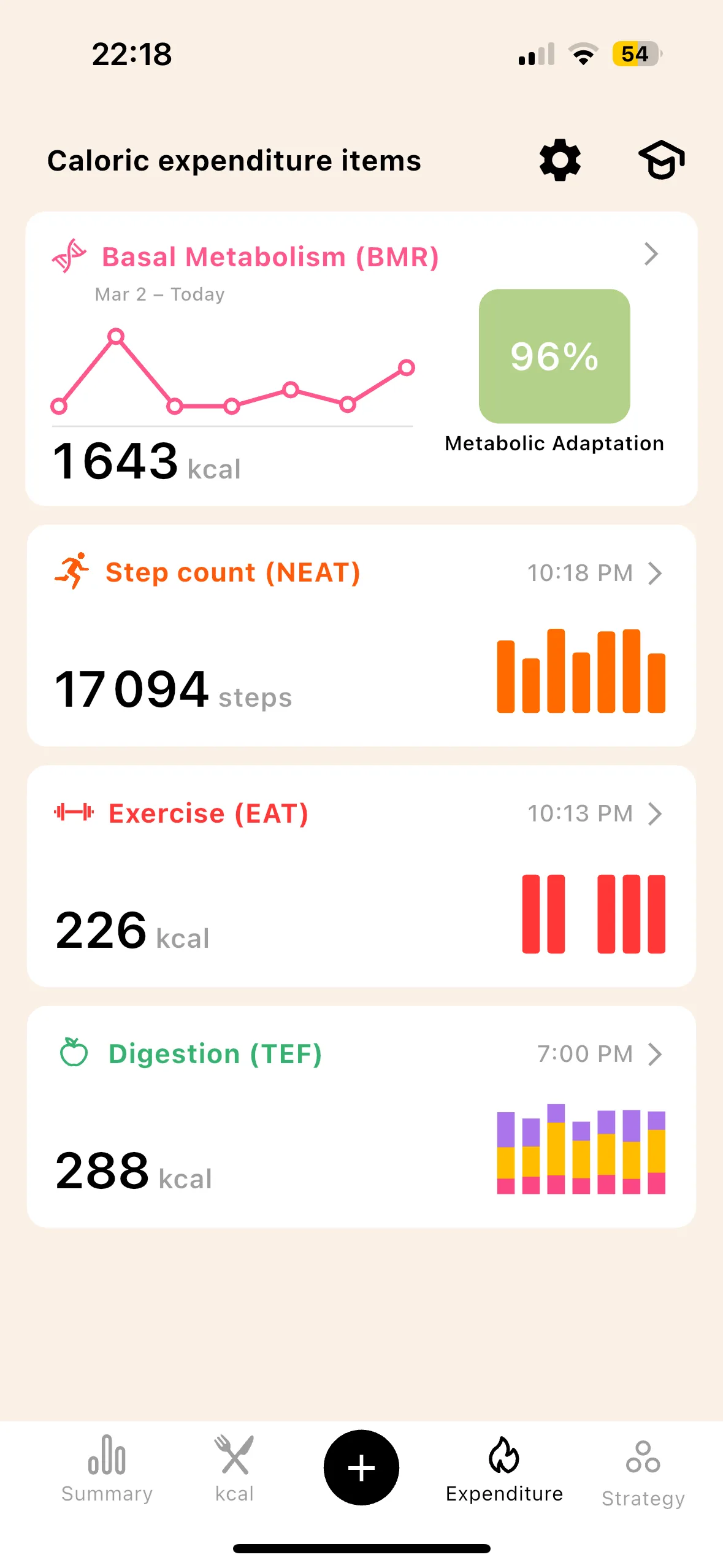
Lean vs MyFitnessPal, criterion by criterion
An honest read of each app's strengths and weaknesses. No criterion touches price.
 Lean MyFitnessPal
3 ways to track a meal
Tracking calories is fine. Doing it for 12 months is another story. Principle #1, before science, before macros, before everything, is adherence. If the tracking method bores you, you quit after 3 weeks. Lean offers 3 ways to track a meal:
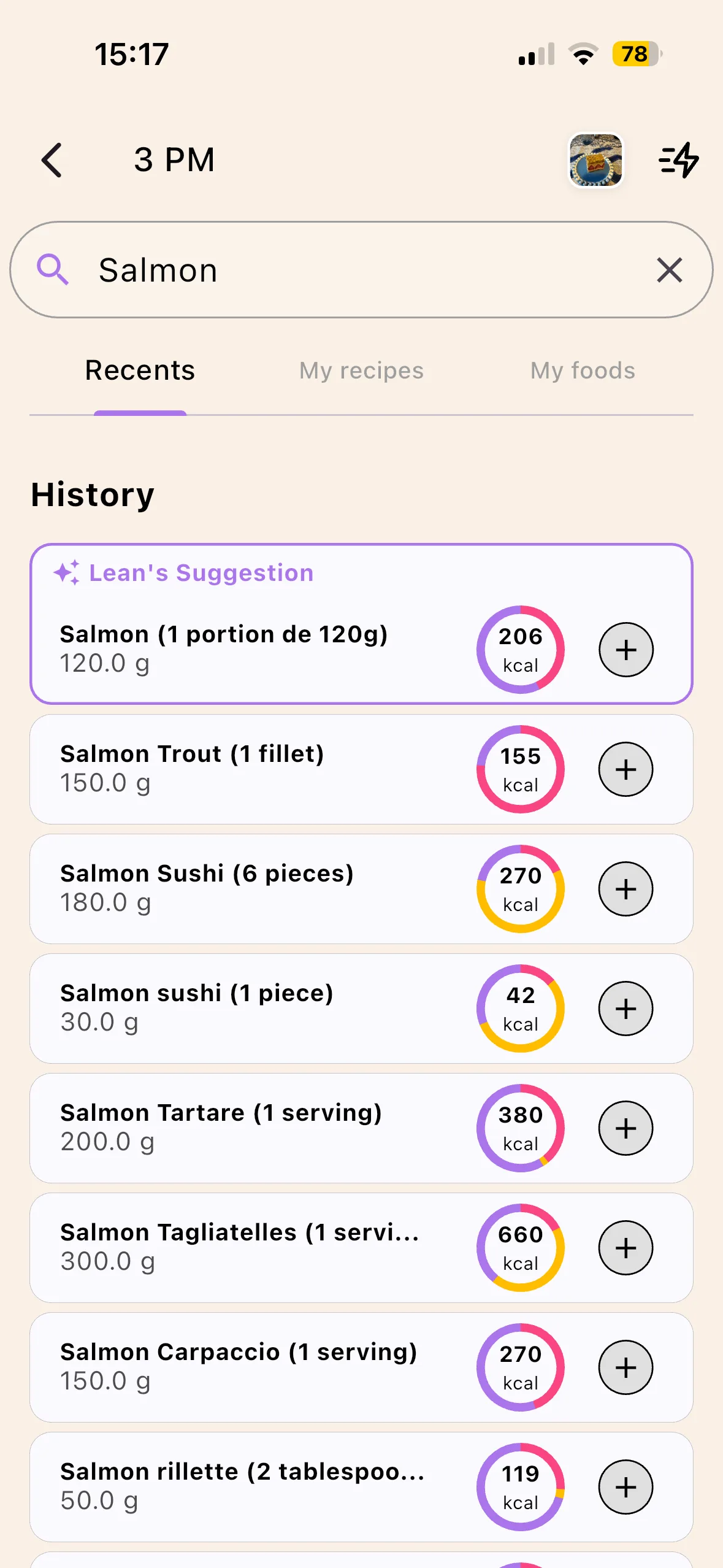

- Database search. Curated base, USDA + OpenFoodFacts. No community noise, no "Roast chicken" entered 47 times by 47 different users with 47 different values.
- Barcode scan. Standard. You scan your pasta pack, you get the macros.
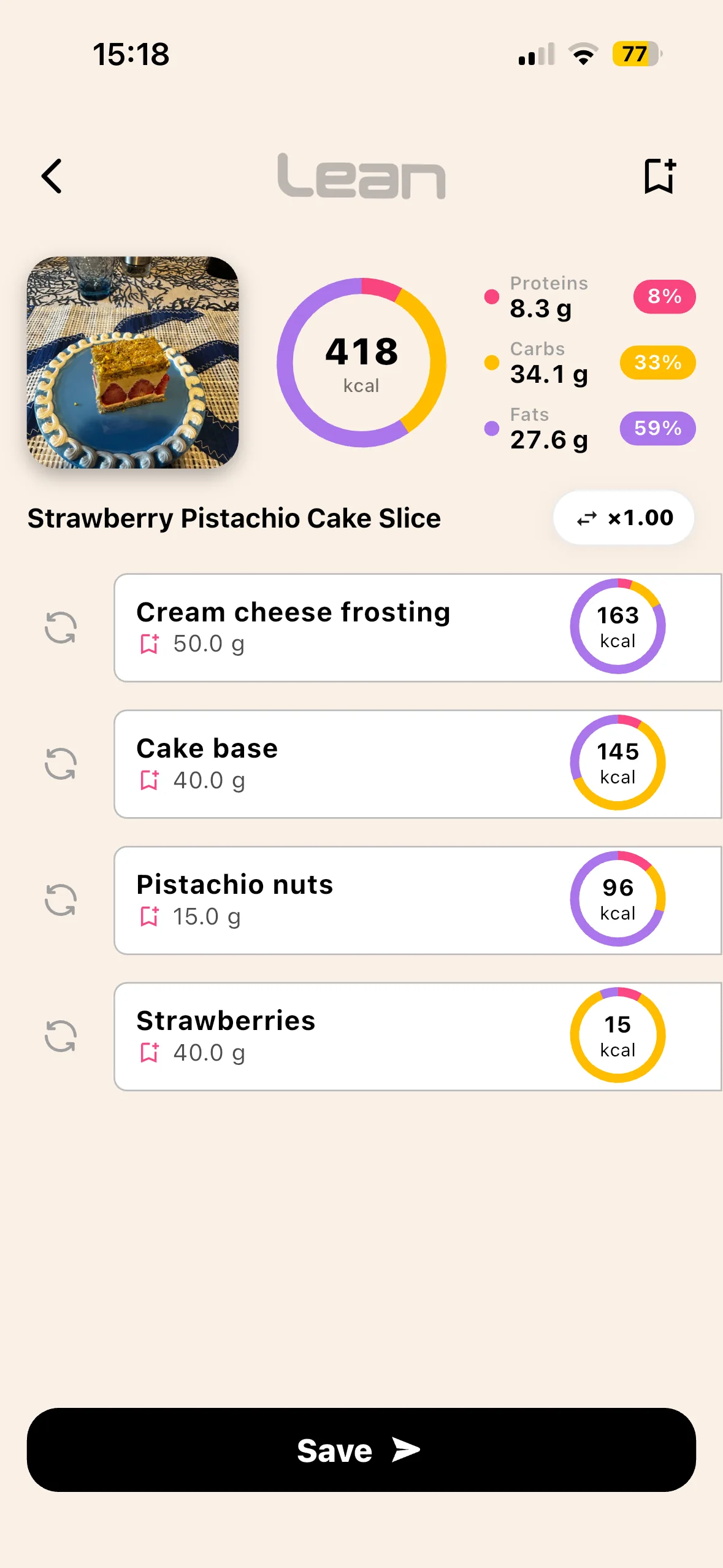
- AI photo scan of a meal. You photograph your plate, the AI detects the foods, you get calories and macros per food item.
The AI photo scan is the adherence game-changer. When you eat out, at a restaurant, at a friend's place, it's massively practical. One photo, you close the app, you enjoy your evening. Yes, it's less precise than gram-perfect weighing on a kitchen scale. But over 12 months, that's what makes the difference between sticking with it and quitting. And sticking with it is what counts.
Beyond meal tracking, Lean shows a live TDEE that updates throughout the day. The more you walk, the higher your expenditure, the more your calorie target shifts. You see your calorie balance live. Way more motivating than a number frozen at 8am.
And above all that sits the Progression Pyramid. A screen inside the app that ranks what actually matters:
What MyFitnessPal does better
Lean isn't perfect, MFP has a few advantages worth acknowledging. Honest read, axis by axis, on the dimensions where MFP still leads.
MyFitnessPal LeanHonest read. On brand awareness and social feed, MFP stays ahead. On raw food database size, MFP has more entries (but those 14 million entries are community-sourced and noisy, up to 10,000 variants of the same food). On third-party integrations, MFP has a wider ecosystem. Lean integrates with HealthKit and Google Fit, which covers 95% of cases.
In short, if all you want is a rough food diary with no precise target, MFP is more than enough. If you're looking to lose fat methodically with a precise TDEE, MFP isn't enough, and that's exactly what the previous 3 sections just demonstrated.
Who Lean is built for
4 profiles. If you recognise yourself in at least one, Lean is probably built for you.
You've tried MFP seriously and didn't lose
You ran an honest deficit for weeks, no result. The cause is very likely a broken TDEE. Lean fixes it at the root via BMR on real bodyfat.
You stall after several weeks of cutting
Plateau dragging on after 4 to 8 weeks. That's metabolic adaptation. Lean computes it automatically and re-adjusts your target each week.
You want to understand your metabolism
Lean shows every component (BMR, NEAT, EAT, TEF, adaptation) instead of hiding everything behind a single number. You see where every expenditure kcal comes from.
You want tracking that lasts 12 months
AI photo scan + curated database + barcode cover every use case, from raw ingredient to restaurant pizza. That's what makes the difference between sticking with it and giving up.
MyFitnessPal can be enough for : those who just want a food diary with no particular precision, or those who enjoy the social and community side.
Switch from MyFitnessPal to Lean in 5 minutes
Download Lean
App Store or Play Store. Sign-up in 30 seconds.
AI BodyScan
One photo, 5 seconds. You get your bodyfat.
Weight & height
Enter your weight and height. That's it.
Lean calculates
BMR, NEAT (HealthKit / Google Fit), EAT, TEF, adaptation. Automatic.
Track a meal
Photo, barcode or database. Get the flow.
Important note. Lean does not offer automatic import of your MyFitnessPal data. That's on purpose. The MFP database is hand-entered by users, so noisy. We prefer to start clean, with a curated USDA + OpenFoodFacts base, rather than inherit the noise.
What Lean does, and MFP never will
Six features that exist in no other consumer tracker. They all come from the same principle: compute every TDEE component precisely, not approximate it.
Your real bodyfat, measured from a single photo, redone every week. The data point that flips the entire BMR calculation. No other consumer app offers this.
Track your restaurant meal in 2 seconds. No scale, no manual entry. The adherence game-changer over 12 months.
Your TDEE re-adjusts week after week following the scientifically established numbers. You avoid the plateaus nobody can explain.
BMR + NEAT + EAT + TEF each shown, updated throughout the day. No more frozen 8am number. You see your calorie balance live.
Track weight, bodyfat, lean mass trends over months. Understand your cycles. Spot the phases where you progress and the ones where you stall.
Photo, barcode, curated database. No other app offers all three with this level of precision. You pick the method based on context.
You install the app for free, you try it without commitment, then you decide if the tool fits your goal.
Frequently asked questions
Is Mifflin-St Jeor better than Harris-Benedict?
Do you really need to know your bodyfat?
Does the activity multiplier just not work at all?
What exactly is metabolic adaptation?
How long to see results with Lean?
1919 face to 2025
This isn't MyFitnessPal versus Lean in marketing. It's 1919 face to 2025 in science.
MFP uses a formula from the aftermath of World War I, plus a nearly random activity multiplier, and ignores metabolic adaptation. The combo of the three makes any precise estimate impossible. It's mathematical.
Lean was built to do the exact opposite: BMR based on real bodyfat (measured by BodyScan AI) via a proprietary patented model, NEAT from real steps, EAT per sport via MET, TEF from macros, automatic metabolic adaptation. Every component computed precisely, no magic multiplier.
If you've tried MFP seriously and didn't get the results you hoped for, the problem isn't you. The problem is under the hood. Switch apps.
Lean is available as a free download
iOS and Android. The BodyScan AI works from a single photo. No skinfold calliper, no bioimpedance scale, no DEXA.
Internal links
- Free online TDEE calculator · web version, no sign-up, same logic as the app (BMR + NEAT + EAT + TEF).
- Understand TDEE in depth (BMR, NEAT, EAT, TEF, adaptation) · deep-science article.
- How to count your calories properly · practical guide for beginners.
- NEAT: expenditure from steps and non-exercise activity.
- TEF: digestion burns calories.
References
- Harris J.A., Benedict F.G. (1919). A Biometric Study of Basal Metabolism in Man. Carnegie Institution of Washington.
- Mifflin M.D. et al. (1990). A new predictive equation for resting energy expenditure in healthy individuals. American Journal of Clinical Nutrition.
- Shcherbina A. et al. (Stanford University, 2017). Accuracy in Wrist-Worn Wearable Devices for Measuring Heart Rate and Energy Expenditure.
- Westerterp K.R. (2004). Diet induced thermogenesis. Nutrition and Metabolism.
- Rosenbaum M., Leibel R.L. (2010). Adaptive thermogenesis in humans. International Journal of Obesity.
- Müller M.J., Bosy-Westphal A. (2013). Adaptive thermogenesis with weight loss in humans. Obesity.