Lean versus Noom. Psychological coaching versus metabolic precision.
Noom sells behavioral coaching to change your habits. Lean sees your real expenditure. Two promises that don’t play on the same field.
 The Lean Team · 12 min read · Updated May 24, 2026

 Free download
Noom calculates your TDEE with Mifflin-St Jeor 1990 (no bodyfat measured inside the app) and a static activity factor chosen during the sign-up quiz. Noom’s real strength is elsewhere: a personalized quiz that creates strong initial engagement, daily food-psychology lessons, a green/yellow/red food classification, and access to a human coach who works on adherence. Lean takes a different stance: recalculate every component of TDEE (BMRBasal Metabolic Rate. Energy expended at rest. In Lean, calculated on actual lean mass via BodyScan AI. on real bodyfat via a patented proprietary model, NEATNon-Exercise Activity Thermogenesis. Expenditure from steps and daily activities outside of sport. from steps, EATExercise Activity Thermogenesis. Expenditure tied to sport sessions, calculated through MET. via MET, TEFThermic Effect of Food. Energy spent on digestion. Depends on the macros you eat. per macros) and modulate the BMR through metabolic adaptation continuously, with no coefficient to pick.
Noom sells coaching, not your metabolic adaptation
If you’re reading this, you’ve probably already installed Noom. You took the long sign-up quiz, those 20 minutes of very personal questions about your history with weight, your blocks, your emotions, your habits. You felt understood. You entered your weight, your height, your age, your sex, and picked your activity level from a static list. The app showed you a calorie target, say 1,500 kcal to lose weight.
You followed the daily 5 to 10 minute lessons on food psychology. You classified your meals as green, yellow, red. You chatted with your human coach on tough days. For the first 6 weeks, it works. You lose. You’re happy. Then around week 8, the scale freezes. You tighten the screws. You drop to 1,350 kcal. Still nothing moves.
Imagine Noom shows you a TDEE of 2,000 kcal. You eat 1,500 (theoretical deficit of 500 kcal). But in reality, your TDEE has dropped to 1,700 kcal due to metabolic adaptation. You’re only at a 200 kcal real deficit, not 500. Loss slows drastically. No daily Noom lesson can fix that, because the problem isn’t in your head, it’s in the equation.
The Noom promise is clear and delivered on its behavioral side: you feel supported, you work on your emotional triggers, you learn to classify the quality of your choices. It’s valuable for adherence. What Noom doesn’t do is recompute your expenditure as weeks of deficit go by. And that's exactly where the "calorie tracker" promise stops, even though it's the lever that actually drives weight loss.
The 1990 BMR formula, with no bodyfat measured in the app
Behind the daily lessons and the food color system, Noom still has to set a number: your basal metabolic rate, the energy burned at rest. It gets it with the Mifflin-St Jeor equation, the one used by the overwhelming majority of consumer trackers.
Mifflin-St Jeor dates from 1990. On paper it is progress: 498 subjects, indirect calorimetry, a more representative population than the 1919 work. Noom applies it as is, with no variant.
Some competitors at least offer a way out, the Katch-McArdle equation, which works on lean mass if you enter your body fat percentage. Noom does not offer that option: no body fat field, no alternative calculation. The coaching therefore rests on an estimate that nothing ever corrects.
The progress from 1919 to 1990 is real but marginal, because the underlying flaw does not move: the equation only knows your weight. Neither your body fat nor your lean mass.
Yet fat mass burns very little energy at rest. Organs and muscles do the spending: liver, brain, heart, kidneys. Two bodies of the same weight with different compositions therefore do not have the same metabolism.
Frankenfield 2013 (PubMed 23631843) tested Mifflin-St Jeor against reference indirect calorimetry: 87% accuracy in non-obese subjects, but only 68% in obese subjects, with errors reaching 330 kcal per day.
Worked example. Woman at 1.65m, 85 kg, 38 % bodyfat :
Estimated BMR for a woman at 1.65m, 85 kg, 38 % bodyfat. The patented proprietary Lean model accounts for lean mass. Mifflin-St Jeor (Noom by default, with no lean-mass option), doesn’t. A 330 kcal gap, the equivalent of a full light meal.
A 330 kcal error is the difference between a deficit that works and an unexplained plateau. No behavioral support, however good, makes up for a calorie target that is wrong from the start: it will simply make you more diligent on the wrong target.
The conclusion is arithmetic: an app that only knows your weight, height, age and sex cannot individualize your metabolism. It lacks the variable that matters.
The activity factor, picked once and for all
That is the link coaching cannot compensate for.
Once the basal metabolic rate is estimated, Noom has to derive your total expenditure from it: BMR plus steps, daily activities, workouts and digestion.
The method fits in one question of the sign-up quiz: pick your activity level from a list. That coefficient is called PAL, for Physical Activity Level.
- Sedentary (PAL 1.25): desk job, little walking
- Lightly active (PAL 1.4): occasional walking, little sport
- Active (PAL 1.6): regular walking, sport 3 to 5 times per week
- Very active (PAL 1.8): intense sport almost daily or physical work
The BMR is then multiplied by that number. That is the whole mechanism behind your daily target: a box ticked on day one, never revisited.
The approximation is crude. Between a Sunday on the couch and a day spent standing and walking, the real gap far exceeds what a single coefficient can represent.
Noom syncs correctly with Apple Health and Google Fit and collects your steps. A calorie bonus can be added when a workout is detected. But the base of the calculation remains the multiplier chosen at sign-up.
Real expenditure measured over 7 days for a Lean user. The grey line is what Noom was showing (2,000 kcal flat, PAL Active × BMR). The pink annotations show why each day moves.
Your activity does not fit in a box. You can be very active the week you chain trips, and sedentary the week you work from home.
So which box do you tick? None is right, and the displayed TDEE stays durably off from reality.
This is the central point: even with a modern metabolism equation, a static PAL is enough to distort the whole. NEAT, EAT and TEF cannot be derived from a single multiplier.
A metabolism estimated without a body composition measurement, plus an activity expenditure approximated by a frozen coefficient: the odds that the final target is right are low.
Metabolic adaptation, never modeled
It is the blind spot that neither the daily lessons nor the coaches cover.
In a prolonged deficit, your body notices it is receiving less energy and reduces its consumption. Like a phone switching to low-power mode: everything keeps running, but slower.
That is metabolic adaptation, and the literature is consistent: Müller 2015 (PubMed 26399868, reanalysis of the Minnesota study), Doucet 2001 on prolonged deficit, Nunes 2020 (PMC7484122). Published ranges run from 5 to 25% of basal metabolic rate.
- Deficit of −250 kcal per day, over 2 to 8 weeks: adaptation of 5 to 10% (TDEE drops to 90-95 % of the initial level)
- Deficit of −500 kcal per day: 10 to 15% adaptation (TDEE drops to 85-90 %)
- Deficit of −750 kcal per day: 15 to 25% adaptation (TDEE drops to 75-85 %)
Lean convention: 100% means an optimal metabolism, 90% a 10% adaptation. And since NEAT, EAT and TEF are all computed from BMR, the whole TDEE moves.
real TDEE over 8 weeks of deficit at −500 kcal/day. The pink curve drops. The Noom line stays flat. By week 6, you’re already at maintenance. Without having changed anything.
A worked example: you target a 25% deficit on a 2,000 kcal TDEE, so 1,500 kcal per day. Your body adapts by 14%, your real TDEE drops to 1,720. Only 220 kcal of deficit remain: the loss stops, without you having changed anything.
What makes the phenomenon formidable is its slowness. The first weeks work, you are confident, you keep going. The adaptation builds up silently until the day the scale freezes.
That is precisely the moment behavioral support turns against you. The coach will explain that the plateau is normal, that you must persevere, review your habits. Whereas the problem is neither your discipline nor your motivation: it is the target number that moved, and nobody measured it.
Noom does not model this phenomenon. Your calorie target stays frozen as long as you do not update your weight by hand. You can follow every lesson and color-code every food: if the target is wrong, the method cannot catch you.
How Lean fixes each of the 3 problems
Noom and Lean do not play on the same field. Noom bets on behavioral psychology: daily lessons, human coaches, food color coding. It is consistent, and for some profiles it is exactly what is needed. But behavioral support sitting on a wrong calorie target remains support toward the wrong target. Lean works on the other half of the problem: making that number right, by measuring every component of TDEE (BMR + NEAT + EAT + TEF) plus metabolic adaptation. Here is how.
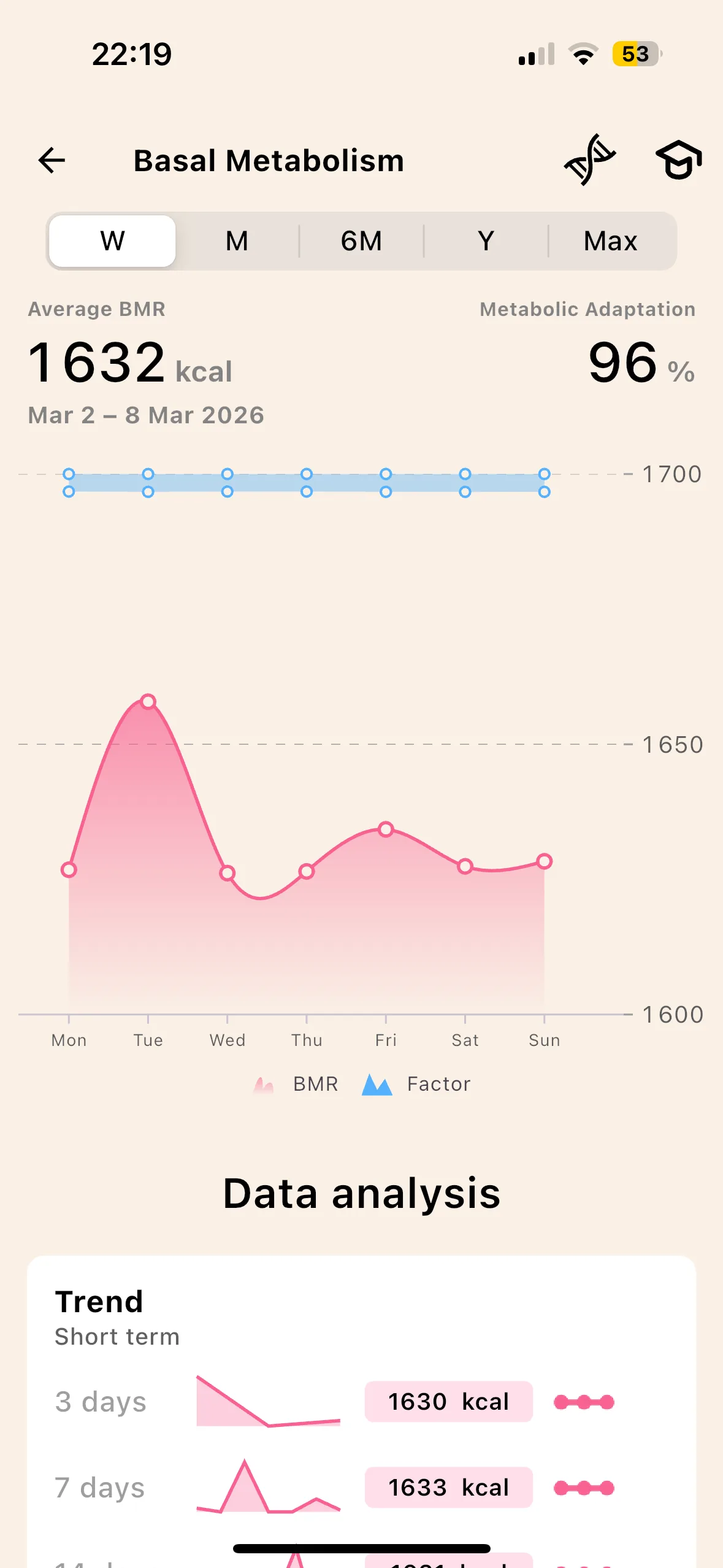
Proprietary patented model, built on lean mass
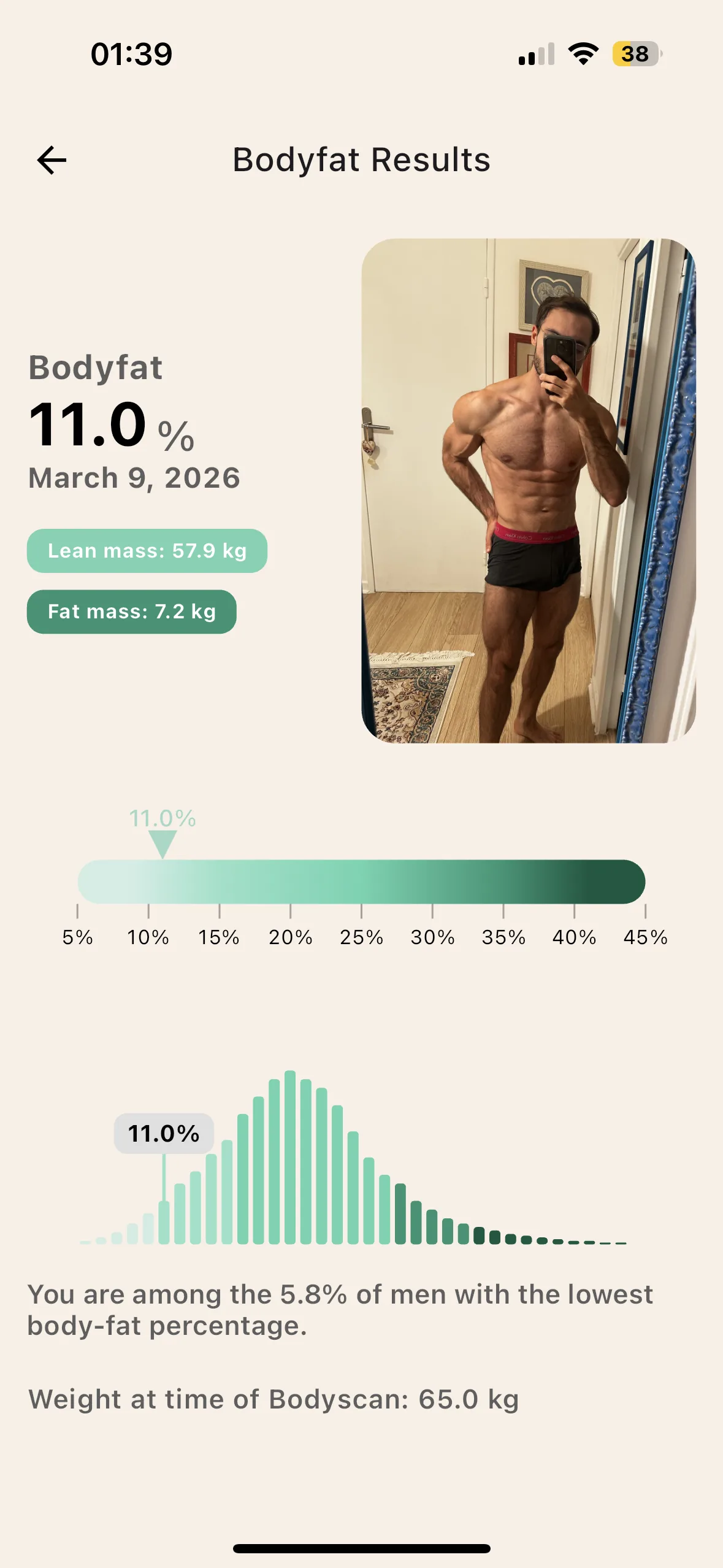
Noom's coaching starts from a calorie target computed on your weight. Lean starts from your lean mass, because that is what burns at rest: at identical weight, two people do not have the same metabolism. You still need to know your body fat percentage without going through a clinical DEXA scan.
Hence the AI BodyScan : one photo, analyzed by a model trained on a bank of DEXA scans, and your body fat appears in a few seconds. Repeated every week, it updates your metabolism automatically. No human coach can produce this measurement at this frequency.
Gone are the skinfold calipers, the impedance scale and its swings with hydration, the DEXA scan and its price. One photo a week is enough.
NEAT, EAT, TEF calculated separately
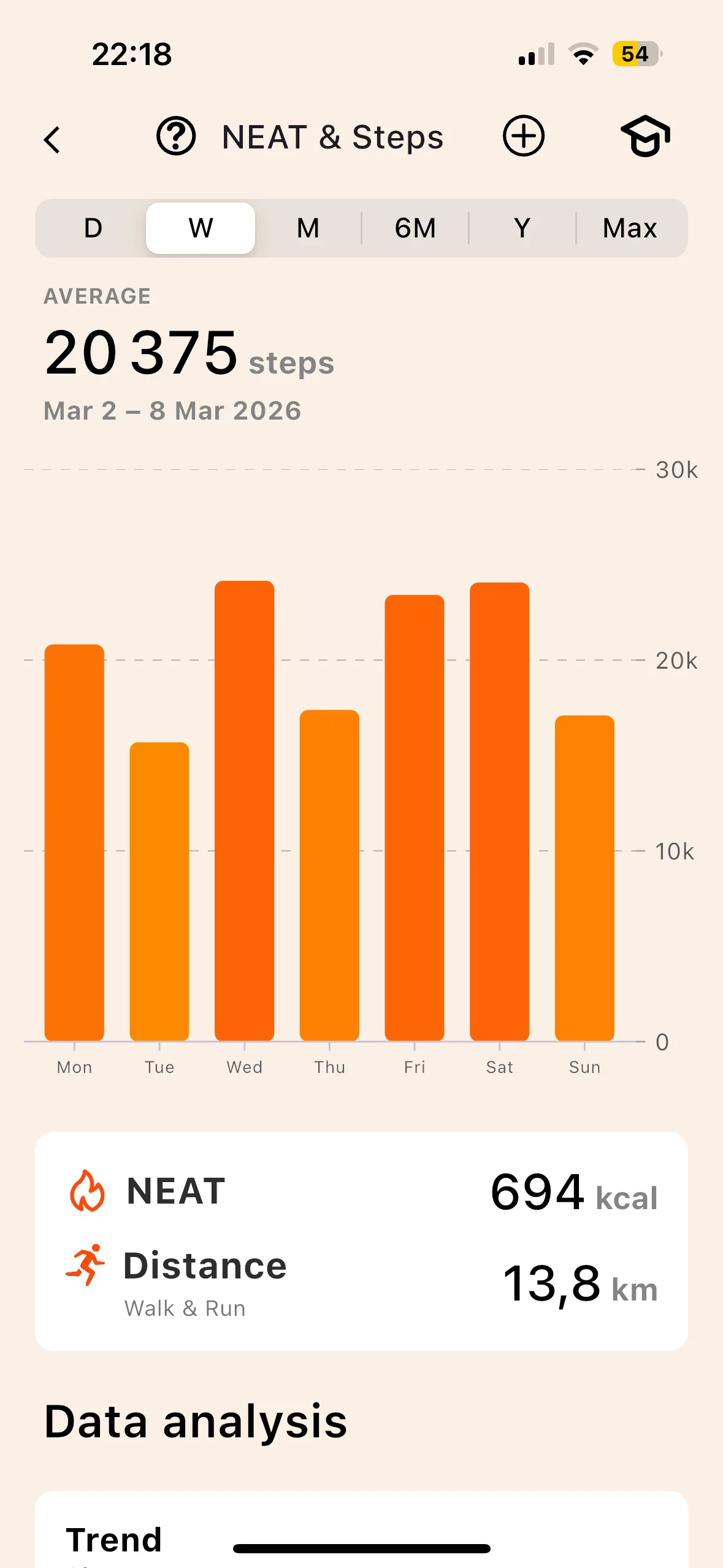
NEAT. Your real steps arrive via HealthKit (iOS) or Google Fit (Android). Where a coaching program asks you to describe your activity level, Lean reads your phone's accelerometers and converts those steps into calories according to your metabolism. The difference between a 4,000-step day and a 14,000-step day shows immediately in your target for the day.
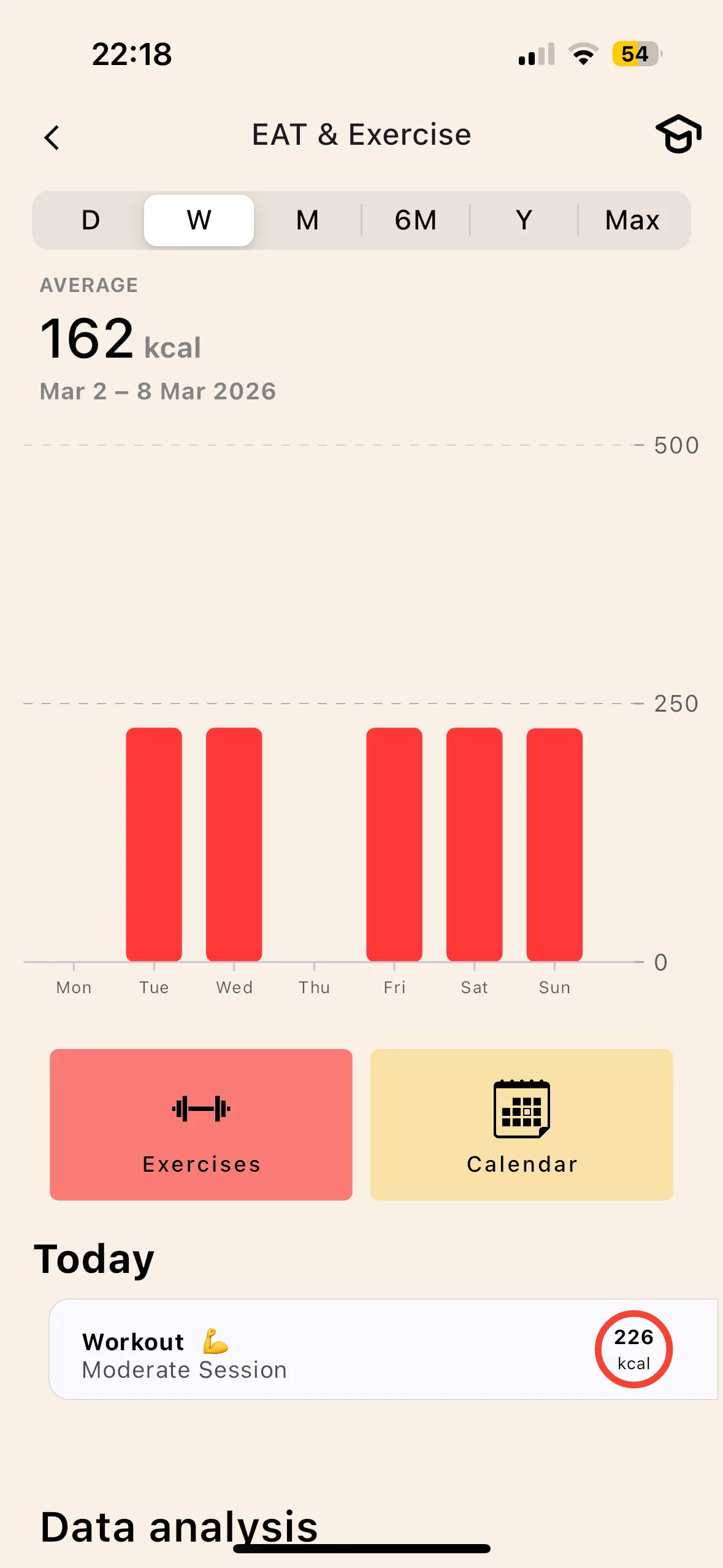
EAT. You pick your sport and Lean applies the matching MET to your actual effort time. An hour of lifting with its rest periods does not cost an hour of continuous running: counting them the same distorts the balance by several hundred kcal per week.
TEF. Digestion burns energy, and not at the same rate for each macro: 20 to 30% for protein, 5 to 10% for carbohydrates, 1 to 3% for fat. Lean computes this item on what you actually ate, instead of the flat 10% applied everywhere else.
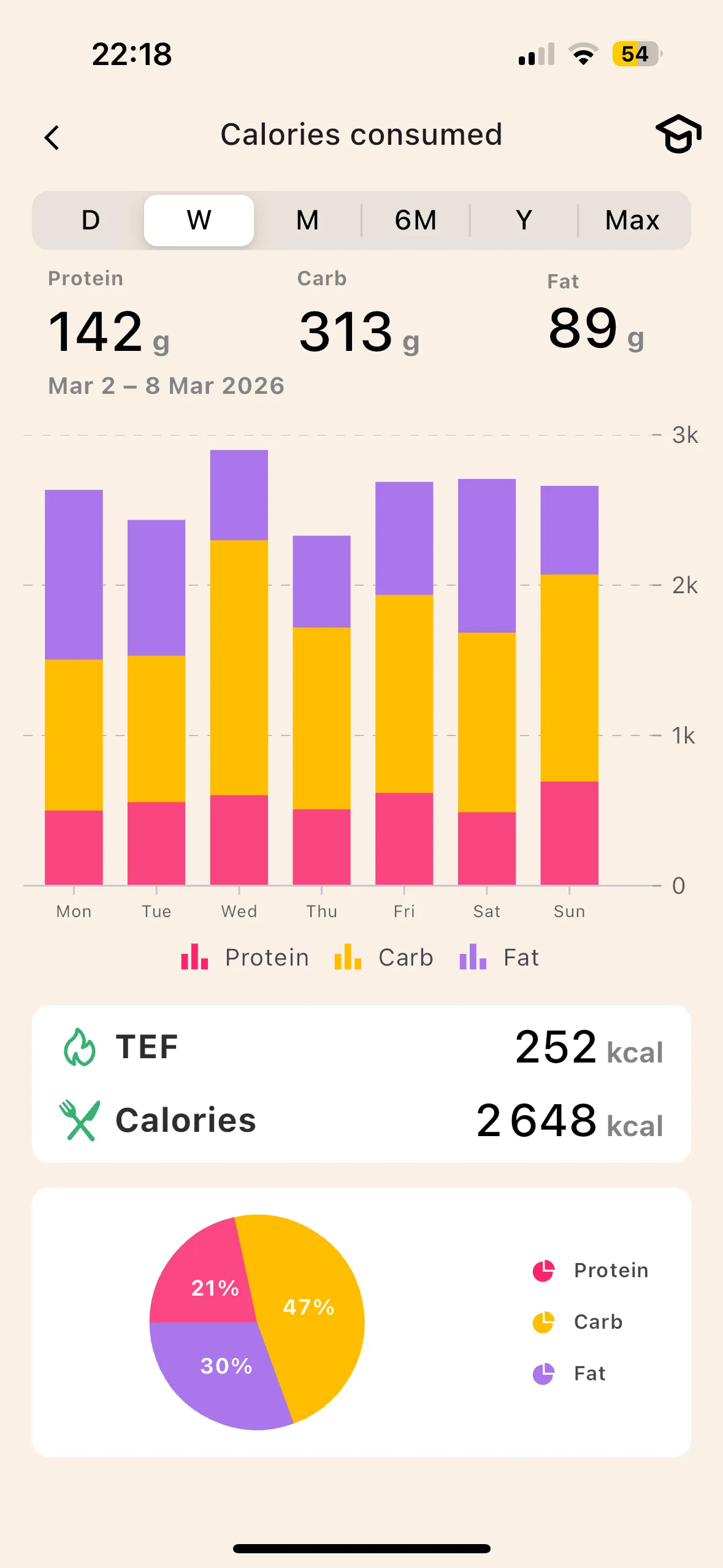
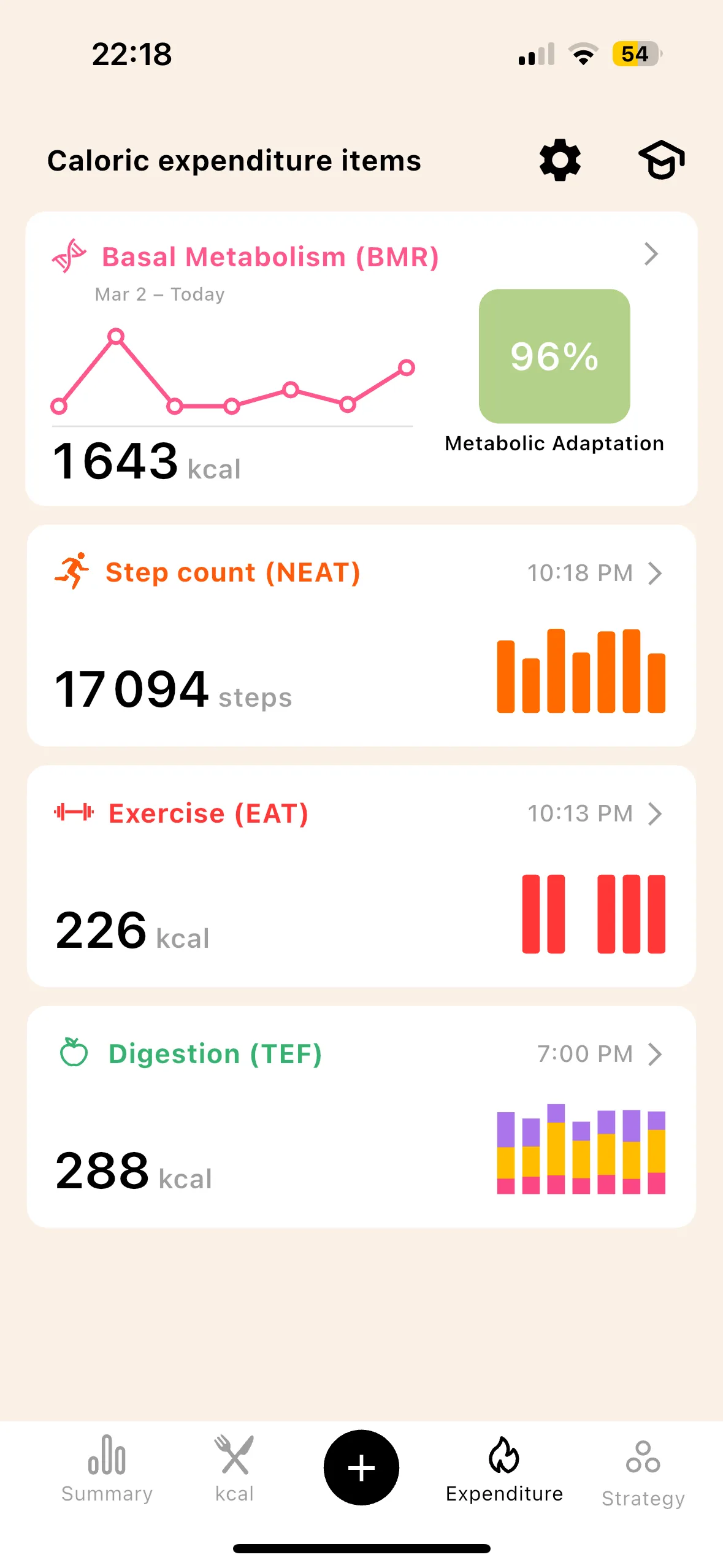
A world first on a consumer app
Metabolic adaptation. It is the blind spot of every behavioral program: after a few weeks of deficit, your metabolism slows down, and no motivation makes up for a calorie target that has become wrong. Lean adjusts your TDEE downward according to the published ranges (Müller 2015, Doucet 2001), week after week.
Beyond 10 to 15% adaptation, the app may recommend a return to maintenance to restart the metabolism before going again. That is what a coach does, except Lean computes it on your data.
No activity level to declare, no box ticked once and for all. Every brick is measured, every week.
Lean versus Noom, criterion by criterion
An honest read of each app's strengths and weaknesses. No criterion touches price.
Lean Noom
Noom3 ways to track a meal
A coaching program lasts if the daily gesture is simple. That is exactly Lean's bet on tracking: three ways to log a meal, so that no situation becomes an excuse to quit.
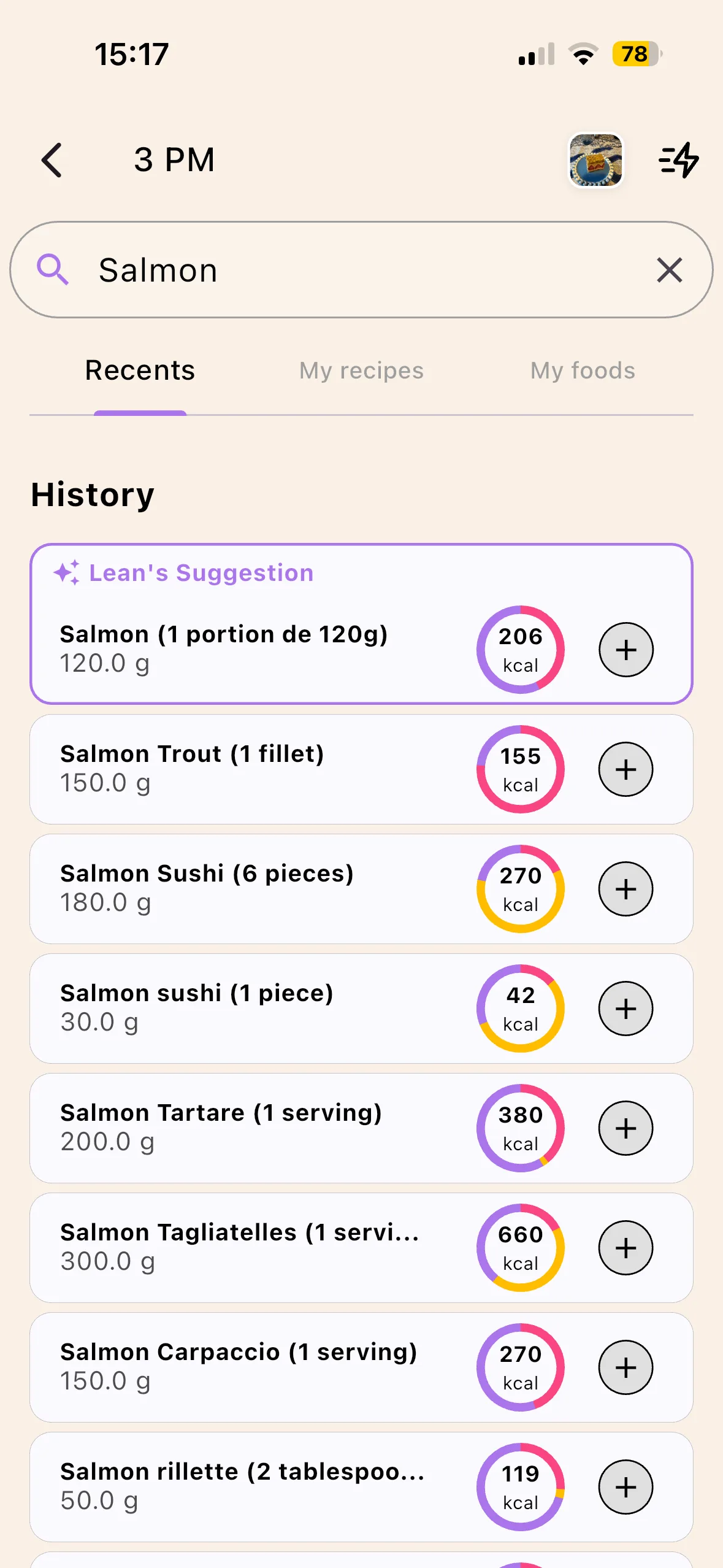

- Database search. Curated base, USDA + OpenFoodFacts. No community noise, no "Roast chicken" entered 47 times by 47 different users with 47 different values.
- Barcode scan. Standard. You scan your pasta box, you get the macros.
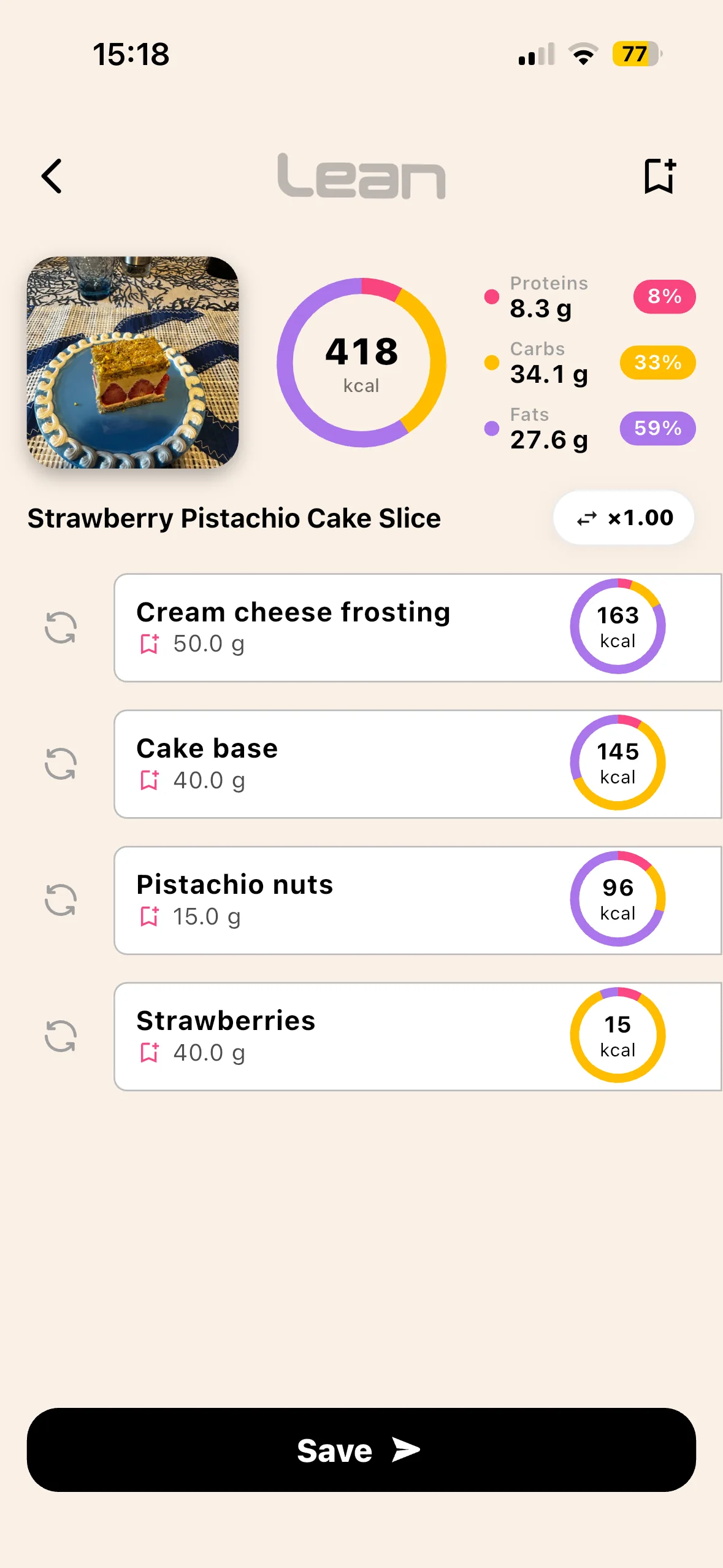
- AI photo scan of a meal. You take a photo of your plate, the AI detects the foods, you get calories and macros per food. Noom doesn’t offer this feature.
AI photo scanning is most useful when you eat out. Noom will ask you to qualify your dish by color; Lean asks you for a photo, and you move on. At a business lunch or a dinner with friends, the difference in friction is decisive.
Above the meal, Lean shows a TDEE that moves during the day: the more you walk, the higher your calorie target goes. A fixed weekly program cannot render that daily variation.
And to rank what really matters, the Progression Pyramid:
What Noom does better
Lean is not perfect, and Noom has several real strengths worth acknowledging. Honest read, criterion by criterion, on the axes where Noom stays ahead. None of these axes is secondary: they are real pillars of the Noom promise, and they explain its massive adoption among the target audience of women aged 35 to 55 on the long-term weight loss topic.
Noom LeanHonest read. On human coaching, Noom is the mainstream reference: your coach chats with you, the support groups (Noom community) run continuously, and it’s a real emotional accompaniment for those who need it. On the daily food-psychology lessons (5 to 10 minutes each day, inspired by CBT, cognitive behavioral therapy), Noom has invested massively and it’s unique on the market: no other calorie tracker offers this structured educational content. On the green/yellow/red classification, it’s an intuitive mechanism that saves the user time and works well for profiles who don’t want to dive into macros. On long-term adherence, Chin 2016 and many meta-analyses on behavioral therapy applied to weight loss show significant gains at 6 and 12 months. Noom builds scientifically on that axis.
If your main angle is psychological work on food habits, if you need a human coach to hold on, or if the green/yellow/red classification helps you make choices without calculating, Noom is more relevant than Lean. If your angle is the precision of TDEE calculation, bodyfat measured every week through BodyScan AI, and automatic metabolic adaptation, that’s exactly what was demonstrated in the 3 previous sections. Many users run Lean for measurement and Noom in parallel for psychological coaching, which is entirely defensible.
Who Lean is built for
Four profiles. If one of them sounds like you, Lean is likely a good fit.
You followed Noom seriously and didn’t lose
You took the quiz, followed the lessons, color-coded your meals, talked with your coach, and held on for several weeks without the curve really following.
You plateau after several weeks of cutting
The plateau settles in after four to eight weeks. That is the signature of metabolic adaptation: Lean computes it and corrects your target instead of sending you back to your motivation.
You want to understand your metabolism
You want to see the detail of the calculation: BMR, NEAT, EAT and TEF displayed separately, adaptation explained on its own, rather than a single number commented by a coach.
You want tracking that lasts 12 months
You often eat out and you need fast logging: photo, curated database or barcode depending on the context.
Noom stays more relevant for : working psychologically on food habits, enjoying a human coach and support groups, following daily lessons of cognitive behavioral therapy applied to weight loss, or relying on the green/yellow/red classification to make choices without calculating. Precision of TDEE calculation and metabolic adaptation just aren’t part of its main promise.
Switching from Noom to Lean (or using both) in 3 minutes
Download Lean
App Store or Play Store. Sign-up in thirty seconds, with no twenty-minute quiz.
AI BodyScan
One photo, five seconds: your body fat percentage appears.
Weight & height
You enter your weight and height. Nothing else is asked.
Lean calculates
BMR on real lean mass, NEAT from your steps via HealthKit or Google Fit, EAT by MET, TEF on your macros, and metabolic adaptation modulating it all week after week.
Log a meal
Photo, barcode or database: you choose depending on the meal.
Important note. Lean doesn’t import your Noom history automatically, nor your exchanges with your human coach. If you appreciate Noom’s psychological coaching and daily lessons, many users keep using Noom for behavioral work and support groups, while using Lean daily for the TDEE calculation and precise tracking. The HealthKit / Google Health Connect sync, on the other hand, takes over immediately for your steps and activity history.
What Lean does, that Noom doesn’t (on TDEE)
Six features absent from consumer trackers. They all rest on the same choice: measuring every component of TDEE rather than estimating it, then dressing it up with teaching.
Your body fat percentage, obtained from a photo and updated every week. It is the variable that makes the metabolism individual, and no coaching program measures it.
A restaurant meal logged in two seconds, with no scale and no typing. The friction removed that makes you last twelve months, without needing a coach to chase you.
Your TDEE corrects itself week after week according to the published ranges. The plateaus that a program blames on motivation find their numerical explanation here.
BMR, NEAT, EAT and TEF displayed separately and updated during the day. Your target moves with your real activity, instead of being fixed when you wake up.
Your weight, body fat and lean mass trends over several months. You identify your cycles instead of reacting to the day's weigh-in.
A clear hierarchy of what matters: adherence first, then calorie target, then steps. Enough to know what to adjust when things stall.
You install the app for free, you test without commitment, then you decide whether the tool fits your goal.
Frequently asked questions
Noom is known for its psychological coaching, why compare it to Lean on TDEE ?
Why doesn’t Noom calculate the BMR on real bodyfat ?
Is Noom’s green/yellow/red classification a real metabolic measure ?
Noom imports steps via HealthKit, is that enough for NEAT ?
Does Noom’s human coaching replace a precise TDEE calculation ?
Can you use Lean and Noom in parallel ?
Coaching versus measurement
It’s not Noom versus Lean in marketing. It’s psychological coaching versus metabolic precision, two different promises.
Noom remains one of the best mainstream apps for behavioral work on eating, and nobody in the mainstream does better on daily food-psychology lessons and human-coach accompaniment. But for your TDEE, Noom uses Mifflin-St Jeor 1990 without bodyfat measured inside the app, plus a frozen activity factor you tick once during the sign-up quiz, and ignores metabolic adaptation. The combination of all three makes any precise calorie tracking impossible beyond a few weeks of cut. It’s mathematics. No human coach corrects an equation he doesn’t see.
Lean was built to do the exact opposite: BMR based on real bodyfat (measured by BodyScan AI) via a proprietary patented model, NEAT from real steps, EAT per sport via MET, TEF from macros, plus metabolic adaptation that modulates the BMR week after week. Each component calculated precisely, no magic coefficient, no psychological wrapping.
Noom remains very solid on behavioral coaching and human accompaniment. The best results often come from combining the two: measuring right (Lean) AND acting with discipline (sometimes helped by a Noom coach). If you tried Noom seriously and didn’t get the results you hoped for on your cut, the problem isn’t you, nor Noom on its psychological promise. The problem is the TDEE frozen under the hood. Change the engine, keep the coach alongside if you need it.
Lean is available as a free download
iOS and Android. The BodyScan AI works from a single photo. No skinfold calliper, no bioimpedance scale, no DEXA.
Internal links
- Free online TDEE calculator · web version, no sign-up, same logic as the app (BMR + NEAT + EAT + TEF).
- Understand TDEE in depth (BMR, NEAT, EAT, TEF, adaptation) · deep-science article.
- How to count your calories properly · practical guide for beginners.
- NEAT: expenditure from steps and non-exercise activity.
- TEF: digestion burns calories.
References
- Harris J.A., Benedict F.G. (1919). A Biometric Study of Basal Metabolism in Man. Carnegie Institution of Washington.
- Mifflin M.D. et al. (1990). A new predictive equation for resting energy expenditure in healthy individuals. American Journal of Clinical Nutrition.
- Katch V.L., McArdle W.D. (1973). Prediction of body density from simple anthropometric measurements in college-age men and women. Human Biology.
- Chin S.O. et al. (2016). Successful weight reduction and maintenance by using a smartphone application in those with overweight and obesity. Scientific Reports, behavioral therapy and weight loss.
- Frankenfield D.C. et al. (2013). Validation of Mifflin-St Jeor equation in obese and non-obese populations. PubMed 23631843.
- Müller M.J., Bosy-Westphal A. (2015). Adaptive thermogenesis with weight loss in humans. Obesity, Minnesota revisit. PubMed 26399868.
- Doucet E. et al. (2001). Evidence for the existence of adaptive thermogenesis during weight loss. British Journal of Nutrition.
- Westerterp K.R. (2004). Diet induced thermogenesis. Nutrition and Metabolism.