Basal metabolic rate calculator. The most accurate formula: Harris-Benedict 1919, Mifflin-St Jeor 1990, or Lean with bodyfat?
Your BMR is the foundation of your calorie target. Without real bodyfat, it can be off by 200 to 500 kcal/day. Compare the 3 formulas, see the truth.
 The Lean Team · 11 min read · Updated May 26, 2026

 Free download
The most accurate formula to calculate your basal metabolic rate is the one that relies on your real lean body mass, not on statistical averages. Harris-Benedict 1919 and Mifflin-St Jeor 1990 estimate your BMR from weight, height, age and sex: error margin 200 to 500 kcal/day on muscular or sedentary profiles. Lean measures your bodyfat via AI BodyScan, then applies a proprietary patented model that computes your BMR on real lean mass, and recalibrates as your body composition changes.
02 · CalculatorCompare the 3 formulas on your own numbers
Enter your data below. The three calculations update live. The delta between Mifflin-St Jeor and the Lean approach (BMR on lean mass) shows the error you accumulate every day if you use a classic calculator.
Your parameters
03 · The flawWithout bodyfat, your BMR sits on 35-year-old averages
Harris-Benedict lumps every man of 80 kg / 180 cm / 32 years into the same box. A lean profile at 10 % bodyfat and a sedentary one at 28 % get the same number.
BMR measures the energy your body burns at rest to keep your heart, brain and kidneys running and to maintain your temperature. The amount depends almost entirely on your lean mass (organs + muscles). Fat mass, on the other hand, is metabolically nearly inert: 1 kg of fat burns about 4 kcal/day, versus 13 kcal/day for 1 kg of muscle.
Harris-Benedict (1919) and Mifflin-St Jeor (1990) don’t know where your lean mass ends and your fat begins. They estimate from total weight, height, age and sex, on a reference population from a century ago for the first one, from 35 years ago for the second. The result: a muscular profile at 12 % bodyfat is assigned the same BMR as a sedentary one at 28 %, even though its lean mass burns 200 to 400 kcal more every day.
On a weight-loss target, this gap compounds. Your "calorie deficit" shown as 500 kcal/day by MyFitnessPal can become a real deficit of 200 kcal/day (plateau) or 800 kcal/day (muscle loss). You don’t know which case you’re in, because your starting BMR was wrong.
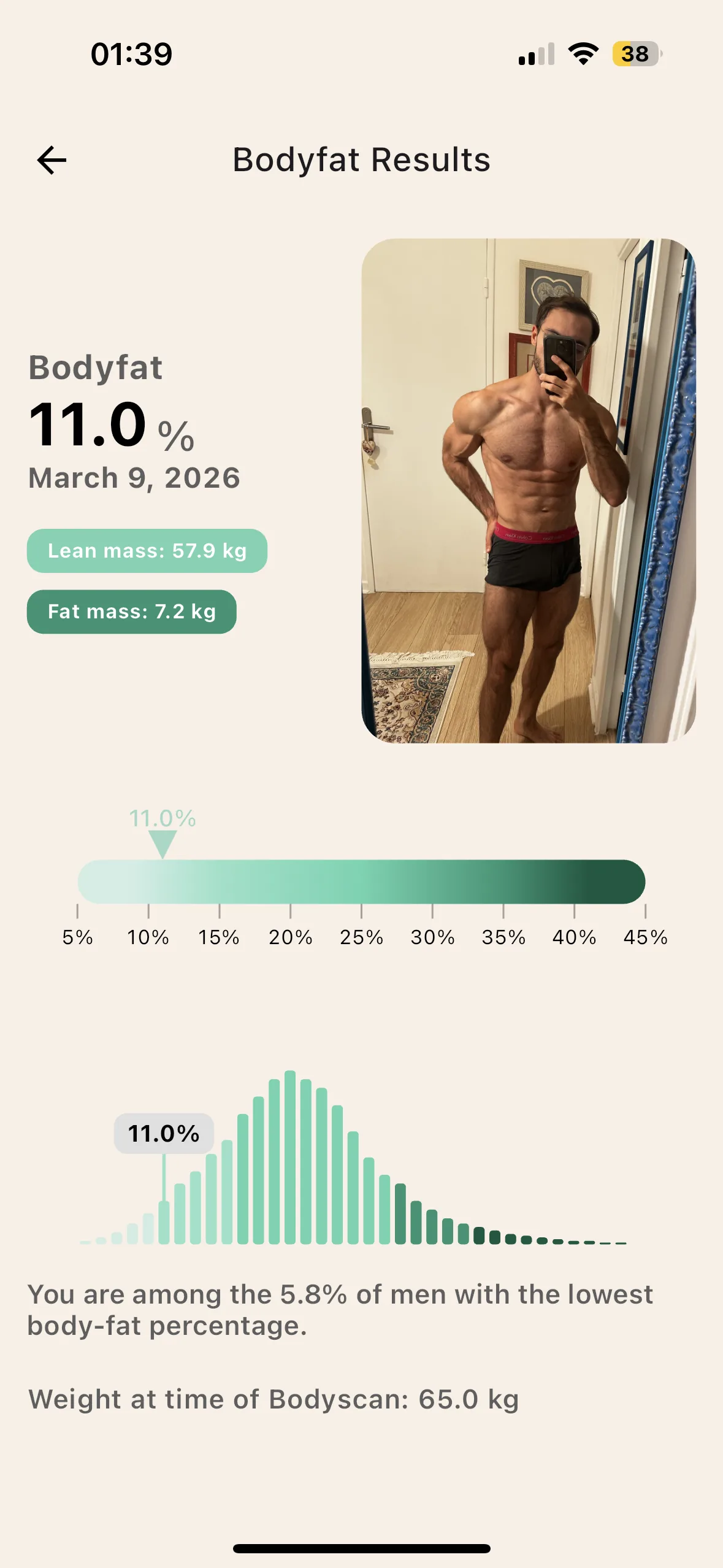
The scientific approach to compute a more accurate BMR when you have body fat relies on lean body mass (FFM). The public form of this equation, cited since the 1980s in the physiology literature, gives approximately 370 + 21.6 × lean mass (kg). That is what our calculator above does. The proprietary patented Lean model goes further: it integrates a metabolic-adaptation function, body water, glycogen, and recalibrates via the AI BodyScan at every weigh-in.
04 · Three profiles, three truthsThe Mifflin vs Lean gap grows with your body composition
Three men with different body types, calculations compared. The numbers come from the three formulas on 80 kg / 180 cm / 32 years, adjusting only bodyfat. You immediately see where Harris-Benedict and Mifflin-St Jeor go wrong.
Athletic profile
Average profile
Sedentary profile
05 · Honest comparisonStrengths and limits of each formula
No formula is useless. Each one answers a use case. The real question: can you measure your bodyfat? If so, you no longer need Mifflin nor Harris-Benedict.
Harris-Benedict
The grand ancestor. Still used by default by many online calculators, including consumer apps. Systematically overestimates BMR by 5 to 10 % on modern populations.
+ Cited everywhere, comparable from one calculator to another.
− Reference population from a century ago. Overestimates most profiles by 100 to 200 kcal/day.
Mifflin-St Jeor
Recalibrated on a US population in the late 1980s. Considered the "modern without bodyfat" reference by clinical dietitians. Accurate to ±10 % on the average profile, much less on the extremes.
+ More accurate than Harris-Benedict on 70 % of profiles.
− No body fat input. Margin of error 200 to 400 kcal on muscular or sedentary profiles.
Lean patented proprietary model
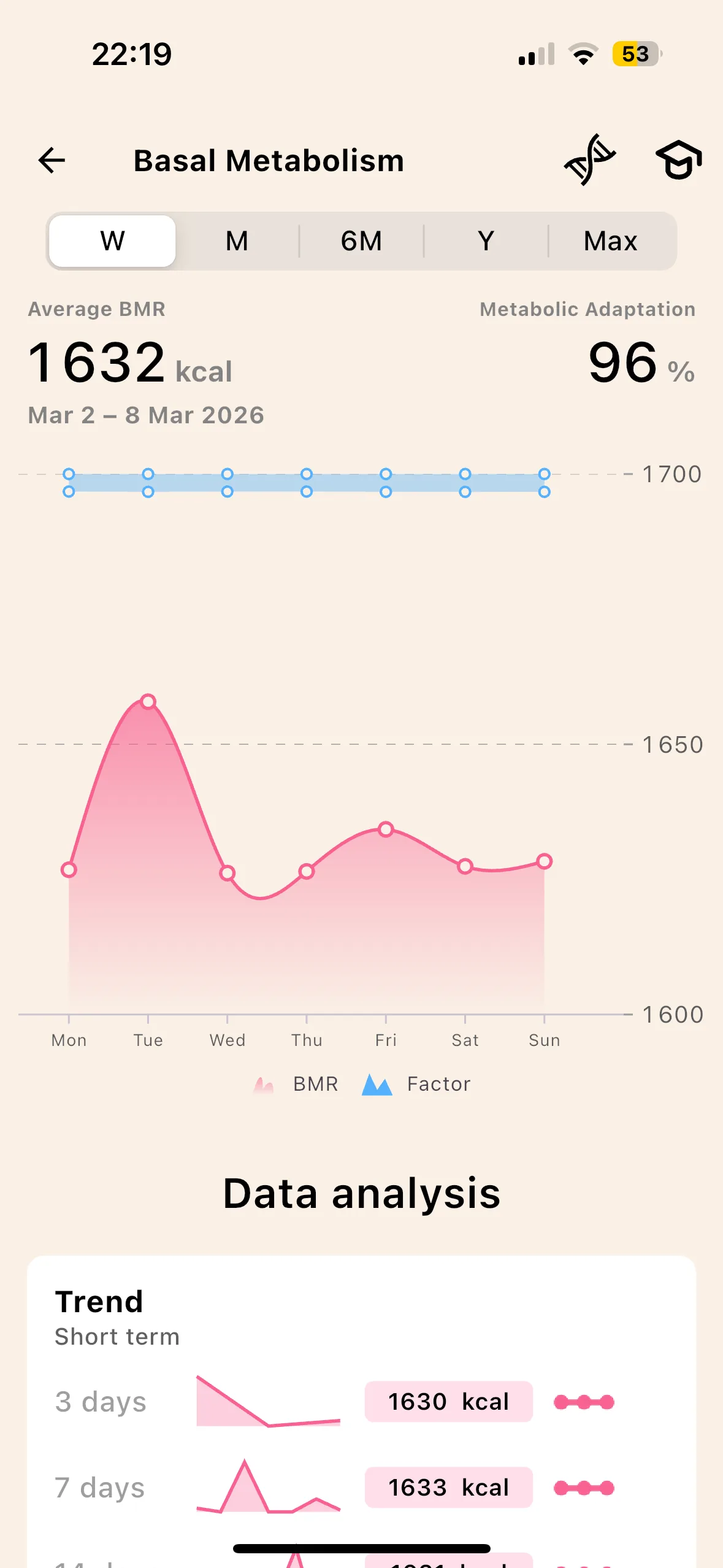
Relies on real lean body mass measured by AI BodyScan, integrates metabolic adaptation in deficit (Lean convention 100→0 %), recalibrated week after week via your weigh-in and your composition change. Not a paper formula: a model that learns from your data.
+ Accuracy ±3 % on muscular, sedentary, menopausal, postpartum profiles. Continuous recalibration.
− Requires an initial AI BodyScan (5 seconds, free in Lean) and regular weight data.
06 · The foundationWhy an accurate BMR is the bedrock of everything else
BMR is not an isolated number. It is the first brick of the canonical metabolism equation: TDEE = BMR + NEAT + EAT + TEF. Metabolic adaptation comes next as a multiplier coefficient on BMR in deficit (Lean convention: 100 % = optimal, 90 % = 10 % accumulated adaptation).
If your starting BMR is off by 150 kcal, your TDEE is off by 150 kcal. Your weight-loss target is off by 150 kcal. Your intake plan is off by 150 kcal. This is why Lean refuses to give you a target until your BodyScan is done. Not on a whim: for consistency.
07 · FAQEverything you wonder about basal metabolic rate calculation
What is the most accurate formula to calculate basal metabolic rate?
The most accurate formula is the one that relies on real lean mass, not on estimates from weight, height, age and sex. Without bodyfat, Mifflin-St Jeor 1990 remains the best approximation (±10 % on 70 % of profiles). With bodyfat, an equation on lean mass of the form 370 + 21.6 × FFM is more accurate. The proprietary patented Lean model refines further by integrating metabolic adaptation and continuous recalibration.
Why is Harris-Benedict outdated?
The original formula dates from 1919, revised in 1984. It was calibrated on 136 subjects, in a nutritional environment and lifestyle very different from ours. On modern populations, it overestimates BMR by 5 to 10 %. Clinical dietitians have considered it obsolete since Mifflin-St Jeor arrived in 1990.
Mifflin-St Jeor vs Harris-Benedict: what is the concrete difference?
On a man of 80 kg, 180 cm, 32 years, Harris-Benedict gives about 1 855 kcal, Mifflin-St Jeor about 1 780 kcal. Mifflin slightly underestimates Harris-Benedict by 75 kcal. Mifflin is generally more accurate, but neither distinguishes a muscular profile from a sedentary one.
Why does bodyfat change everything about BMR calculation?
Because lean mass, not total mass, drives expenditure at rest. 1 kg of muscle burns about 13 kcal/day, 1 kg of fat about 4 kcal/day. Two people at the same weight but with 10 bodyfat points apart can have BMRs that diverge by 200 to 400 kcal/day. No formula without bodyfat can capture that.
How does Lean calculate my basal metabolic rate?
Lean uses a proprietary patented model. The main input is your bodyfat measured by AI BodyScan (photo, 5 seconds, DEXA-grade precision). Lean derives your real lean mass, computes a BMR on that lean mass, then integrates a metabolic-adaptation function that recalibrates every week based on your weight and composition changes. Lean mass is the dominant factor; age fine-tunes the result (expenditure at rest decreases slightly at constant lean mass over the years).
How often should one recompute BMR?
As long as your body composition doesn’t move (stable weight, stable bodyfat), your BMR doesn’t move either. As soon as you lose or gain 2 kg, or your bodyfat varies by 2 points, you need to recalculate. Lean does it automatically at every BodyScan and every weigh-in.
Does my BMR drop when I lose weight?
Yes, for two reasons. First, physical: you weigh less, so you have less lean mass to maintain, so the mechanical BMR drops. Second, physiological: your body activates a metabolic adaptation under prolonged calorie deficit, which slows your BMR by 5 to 20 % below its expected value. Lean models both phenomena.
Basal metabolic rate calculation, men vs women: what is the difference?
At equivalent weight, height and age, women have on average 8 to 12 % less lean mass than men (hormonal and morphological difference). Their BMR is therefore structurally lower, on the order of 150 to 250 kcal/day. The two classic formulas integrate a different sex constant. On Lean, it is the measured lean mass that speaks, independently of sex.
Basal metabolic rate at rest vs during effort: what is the difference?
BMR is strictly expenditure at rest (lying down, fasted, thermal neutrality). When you walk, you add NEAT (Non-Exercise Activity Thermogenesis). When you work out, you add EAT (Exercise Activity Thermogenesis). When you eat, you add TEF (Thermic Effect of Food). The sum is your TDEE.
Which formula does the calculator above use for the ‘Lean approach’?
A public lean-mass equation, cited in the physiology literature: BMR ≈ 370 + 21.6 × lean mass (kg). Lean mass is derived from your weight and bodyfat. It is a useful approximation to understand the bodyfat effect. The proprietary patented Lean model in the app goes further (metabolic adaptation, water, glycogen, continuous recalibration).
Scientific sources
- Mifflin MD, St Jeor ST, Hill LA, Scott BJ, Daugherty SA, Koh YO. A new predictive equation for resting energy expenditure in healthy individuals. Am J Clin Nutr. 1990 Feb;51(2):241-7. PubMed 2305711.
- Harris JA, Benedict FG. A Biometric Study of Human Basal Metabolism. Proc Natl Acad Sci USA. 1918 Dec;4(12):370-3.
- Frankenfield DC. Bias and accuracy of resting metabolic rate equations in non-obese and obese adults. Clin Nutr. 2013;32(6):976-82. PubMed 23631843.
- Müller MJ, Bosy-Westphal A. Adaptive thermogenesis with weight loss in humans. Obesity. 2013 Feb;21(2):218-28. PubMed 26399868.
- Sabounchi NS, Rahmandad H, Ammerman A. Best-fitting prediction equations for basal metabolic rate. Int J Obes. 2013;37(10):1364-70. PubMed 23318721.
Get your BMR on your real bodyfat
AI BodyScan in 5 seconds. Continuous recalibration. No 1919 or 1990 formula. Free download, 7-day trial on the annual plan.