Calorie Deficit Calculator: the right approach for a cut based on your real bodyfat-aware TDEE
The right deficit isn’t a round number. It’s a percentage of your real TDEE. Compute it on your true expenditure (bodyfat-aware), pick a slow, moderate or aggressive pace, and watch muscle loss kick in as soon as you exceed −25 %.
 The Lean Team · 12 min read · Updated May 26, 2026

 Free download
To compute your calorie deficit correctly, start from your real TDEE (computed on your real bodyfat), pick a deficit as a percentage of that TDEE rather than a round number, and accept that metabolic adaptation slows fat loss after 2 to 3 weeks. Three recommended paces: slow (−10 %) to preserve muscle, moderate (−20 %) for a standard cut, aggressive (−25 to −30 %) only over short periods. Beyond −30 %, muscle loss and hormonal crash are guaranteed.
02 · CalculatorCalculate your deficit on your real TDEE
Enter your data below. Your estimated TDEE shows on top (computed on your lean mass via Lean’s bodyfat-aware approach, then scaled by your activity level). The three deficit scenarios below show your target intake and the estimated weekly loss for each.
Your parameters
03 · The myth bustedWhy 7,700 kcal = 1 kg no longer holds
The myth 7700 kcal = 1 kg comes from a 1958 study. Metabolic adaptation changed the game.
Wishnofsky published a 1958 approximation that became gospel: 1 kg of body fat contains about 7,700 kcal, so a cumulative 7,700 kcal deficit should make you lose 1 kg. The formula circulated for 60 years in dietetics textbooks, tracking apps, and the heads of coaches.
The problem: it assumes your TDEE stays constant during your deficit. It doesn’t. When you eat at a deficit for 2 to 3 weeks, your body activates a metabolic adaptation that slows your BMR by 5 to 20 % below its expected value (Müller 2015). Your unconscious NEAT also drops (less fidgeting, slower walking). Overall, your real TDEE can fall 15 to 25 % below the TDEE calculated at the start of your diet.
Concretely: a man with a 2,700 kcal TDEE eating at −500 kcal for 8 weeks will steps 8 × 0.45 ≈ 3.6 kg as the Wishnofsky calc predicts. He’ll lose between 2.2 and 2.8 kg, because his real TDEE at week 6 is no longer 2,700 but 2,300. The "felt" deficit becomes −100 kcal/day.
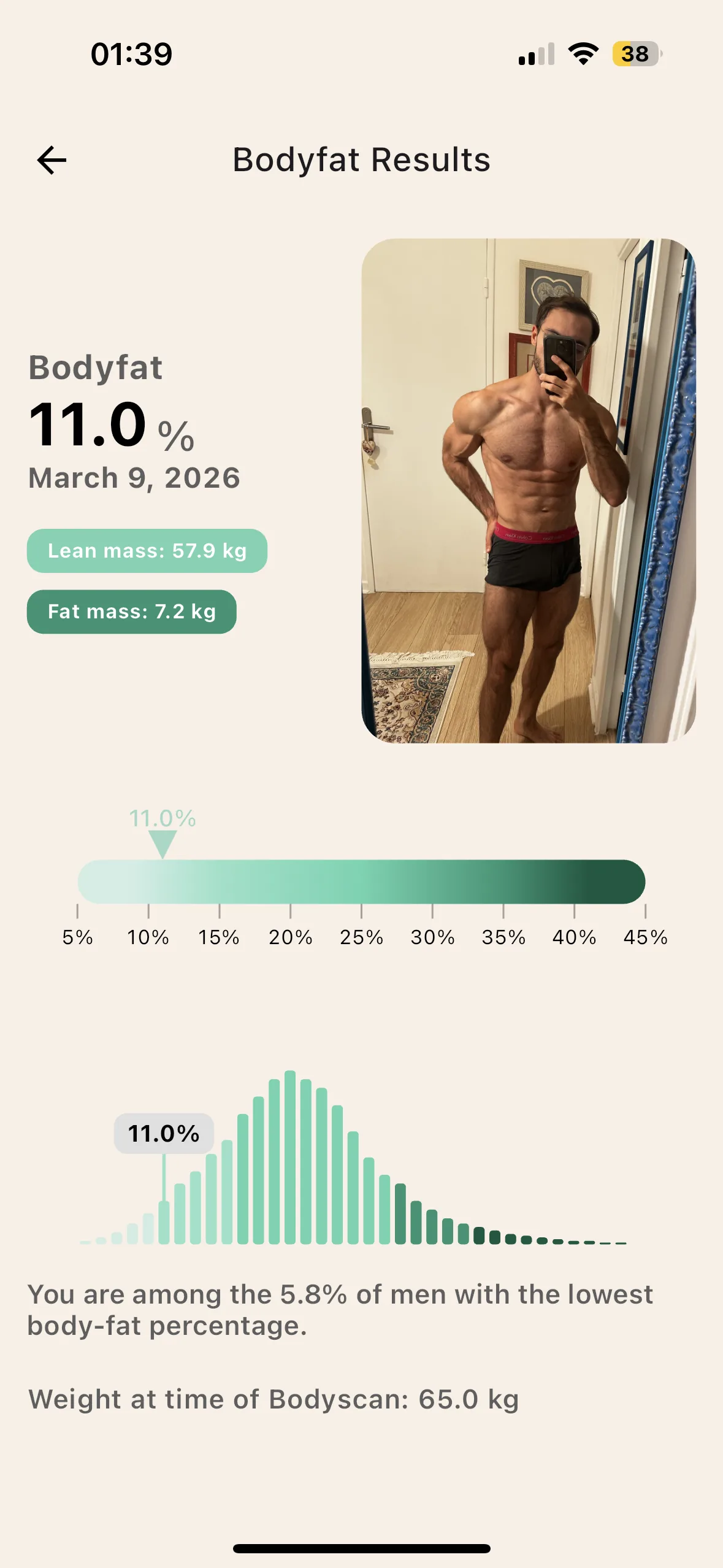
The right approach is to recalibrate the deficit continuously. Not one target number for 12 weeks, but a target that moves with your real body composition and real weekly TDEE. Lean does exactly that: at every weigh-in, BMR is recomputed on your lean mass (itself recomputed via bodyfat), metabolic adaptation is integrated multiplicatively, and the daily calorie target adjusts.
04 · Three profiles, three deficitsThe right deficit depends on your starting point
Three men, three compositions, three different goals. You see how the right deficit varies with bodyfat and activity, not with a universal rule.
Athletic profile
Average profile
Advanced recomp profile
05 · The three paces in detailSlow, moderate, aggressive: who, what for
The right deficit isn’t the fastest. It’s the one you can hold without breaking your metabolism or losing lean mass. Here’s the breakdown of the three paces.
Slow deficit
−10% of TDEEExpected loss: ~0.25 kg/week, about 1 kg/month. Minimal metabolic adaptation, manageable hunger, lean mass preserved.
Already-lean profiles (bodyfat < 15 % men, < 22 % women) targeting recomposition. Profiles ending a bulk. Profiles sensitive to restriction (sports career, fragile mental management).
No hormonal or muscle risk. The only risk: the loss being too slow to stay motivated.
Default for recomp profiles and second cut cycles. Combine with strength training to stimulate lean mass.
Moderate deficit (recommended)
−20% of TDEEExpected loss: ~0.5 kg/week, about 2 kg/month. Moderate metabolic adaptation (10 to 15% on average after 6 weeks), manageable hunger with high protein and fiber.
Standard cut on a profile with fat to lose (bodyfat 15 to 25 % men, 22 to 32 % women). Default mode for most "normal" weight-loss goals.
If the deficit extends past 12 weeks without a diet break, metabolic adaptation can exceed 20 %: fat loss stalls. Fix: recalibrate the TDEE and consider a refeed.
Default target for most new users. Lean automatically adjusts the daily kcal target based on the live calorie balance and the modeled metabolic adaptation.
Aggressive deficit
−25 to −30% of TDEEExpected loss: ~0.75 to 1 kg/week. Strong metabolic adaptation (up to 25 % in 8 weeks per Müller). Significant hunger. Risk of muscle loss if protein is insufficient.
Profiles with significant overweight (bodyfat > 28% men, > 35% women) who can tolerate a larger absolute deficit without muscle risk. Athletes in a short pre-competition phase (peak week).
Beyond −30 %, muscle loss near-guaranteed (Helms 2014), thyroid and sex hormones drop, gym performance collapses. Amenorrhea in women. Lethargy, poor recovery.
Short phases only (2 to 4 weeks max), followed by a return to moderate deficit or a diet break at maintenance. Never in "long-term" mode.
06 · How Lean recalibrates your deficitA deficit that moves with your body
A deficit computed at the start of a diet only holds at the start of the diet. After 2 to 3 weeks, your body has changed: lower weight, sometimes lower bodyfat, lower BMR, metabolic adaptation kicking in. The "−500 kcal/day" deficit you were holding becomes a "−300 kcal/day" deficit without you changing a thing. Fat loss slows, you panic, you cut more: that’s the under-eating trap.
Lean avoids that by recalculating everything, continuously:
1. BMR recalculated at every weigh-in
When you weigh 2 kg less, your mechanical BMR is lower. Lean recalculates it automatically. No need to touch the calculator.
2. Recurring AI BodyScan
During the cut, your lean mass can change (ideally stable, sometimes slightly down). Bodyfat updates, so does BMR.
3. Modeled metabolic adaptation
Each week in deficit, Lean estimates your adaptation coefficient. If you lose less than expected, the coefficient drops: your recomputed TDEE reflects your physiological reality.
4. Live calorie balance
Through the day, your target moves based on what you’ve already eaten and your real activity (steps, sessions). You see in real time how much you can still eat to stay on target.
07 · FAQEverything you want to know about calorie deficit
How to calculate your calorie deficit precisely?
Start from your real TDEE (BMR on lean mass + NEAT + EAT + TEF, ideally bodyfat-aware), then apply a deficit percentage based on your goal: 10% to preserve muscle, 20% for a standard cut, 25 to 30% for a short aggressive phase. Avoid round numbers like −500 kcal: too aggressive on small frames, too soft on large ones.
What calorie deficit to lose 1 kg per week?
One kilogram of body fat contains about 7,700 kcal. In theory, a daily 1,100 kcal deficit would yield 1 kg per week. In practice, metabolic adaptation slows fat loss by 15 to 25 % after a few weeks. To realistically target 1 kg/week, you need an initial deficit of 25 to 30 % of TDEE, held no longer than 2 to 4 weeks.
What calorie deficit for a cut without losing muscle?
The moderate deficit (-20 % of TDEE) is the best compromise. Combined with 1.8 to 2.2 g of protein per kg of lean mass and consistent resistance training, it yields fat loss of about 0.5 kg/week while preserving lean mass (Helms 2014). The slow deficit (-10 %) is even more protective but slower.
Calorie deficit too large: what are the risks?
Beyond 30 % of TDEE, risks compound: accelerated muscle loss, thyroid hormone drop (T3, T4), sex hormone drop (testosterone in men, estrogen in women up to amenorrhea), gym performance collapse, degraded sleep, adaptive metabolism strengthening and further slowing fat loss. You end up losing more muscle than fat.
How many kcal less per day to lose 5 kg?
It depends on the target pace. At a moderate deficit (-20 % TDEE, ~0.5 kg/week), 10 weeks for 5 kg of total weight. At a slow deficit (-10 %, ~0.25 kg/week), 20 weeks. Note these estimates assume an average metabolic adaptation; real-world pace slows over the weeks, which is normal and exactly why Lean recalibrates.
Why does my loss slow after a few weeks in deficit?
Three simultaneous causes. First: your BMR drops because you weigh less. Second: metabolic adaptation reduces your BMR by 5 to 20 % below the expected value. Third: your unconscious NEAT decreases (you move less without realizing). Overall, your real TDEE can fall 15 to 25 % below the starting TDEE. Fix: recalibrate the deficit as a percentage of the new TDEE, not as an absolute value.
Should you take a diet break during a cut?
Yes, as soon as the cut extends past 8 to 12 weeks or metabolic adaptation gets too strong (stalled loss despite deficit). A diet break means returning to maintenance (TDEE) for 1 to 2 weeks to let hormones recover and metabolism partially reset (Trexler 2014). Then resume the deficit, at a similar or gentler pace.
Calorie deficit men vs women: what’s the difference?
The principle (percentage of TDEE) is identical. But the absolute minimum threshold differs: in men, going below 1,500 kcal/day is rarely justified; in women, the hormonal threshold is around 1,200 to 1,300 kcal. Below that, risk of amenorrhea and thyroid disruption. Women in the luteal phase (pre-period) can retain 1 to 2 kg of water that masks fat loss: don’t panic.
Can you lose fat and gain muscle at the same time?
Yes, it’s body recomposition. Mostly possible for: (a) beginners in strength, (b) overweight profiles, (c) profiles ending a long break. Conditions: minimal deficit (-10 % TDEE max), high protein (~2 g/kg of lean mass), progressive resistance training, 7 to 9h of sleep. Weight loss is slow (~0.2 kg/week) but bodyfat drops faster than weight.
Is the 7,700 kcal = 1 kg myth true?
Theoretically yes: 1 kg of body fat contains about 7,700 kcal. Practically no: metabolic adaptation means a 7,700 kcal cumulative deficit over several weeks doesn’t produce exactly 1 kg of loss. The rule works at the start of a deficit, then drifts by 15 to 25 % after 6 to 8 weeks. That’s why static calculators get it wrong and Lean recomputes continuously.
Scientific sources
- Wishnofsky M. Caloric equivalents of gained or lost weight. Am J Clin Nutr. 1958 Sep-Oct;6(5):542-6. PubMed 13594881.
- Hall KD. What is the required energy deficit per unit weight loss? Int J Obes. 2008 Mar;32(3):573-6. PubMed 17848938.
- Müller MJ, Enderle J, Bosy-Westphal A. Changes in Energy Expenditure with Weight Gain and Weight Loss in Humans. Curr Obes Rep. 2016;5(4):413-23. PubMed 27739007.
- Helms ER, Aragon AA, Fitschen PJ. Evidence-based recommendations for natural bodybuilding contest preparation: nutrition and supplementation. J Int Soc Sports Nutr. 2014 May;11:20. PubMed 24864135.
- Trexler ET, Smith-Ryan AE, Norton LE. Metabolic adaptation to weight loss: implications for the athlete. J Int Soc Sports Nutr. 2014 Feb;11(1):7. PubMed 24571926.
- Aragon AA, Schoenfeld BJ, Wildman R, et al. ISSN position stand: diets and body composition. J Int Soc Sports Nutr. 2017 Jun;14:16. PubMed 28630601.
Your calorie deficit, recalibrated weekly
AI BodyScan, live calorie balance, modeled metabolic adaptation. No paper formula, no round number. Free download, 7 day trial on the annual plan.