TEF (Thermic Effect of Food). The complete guide to understanding the hidden caloric expenditure of digestion.
Digestion burns calories. 20 to 30 % of proteins, 5 to 10 % of carbs, 0 to 3 % of fats. All other apps ignore it. Lean calculates it in real time on every logged meal.
 The Lean Team · 10 min read · Updated May 28, 2026

 Free download
The TEF (Thermic Effect of Food) is the energy burned to digest your food. It is part of the equation TDEE = BMR + NEAT + EAT + TEF. It varies by macros: proteins 20–30 %, carbs 5–10 %, fats 0–3 %. On a standard post-training meal, Lean calculates 69 kcal of TEF where other apps show 0.
02 · DefinitionTEF, the 4th building block of TDEE
The TEF (Thermic Effect of Food) is the energy your body spends to process the food you eat: chewing, digesting, absorbing, metabolizing. It is also known as DIT (Diet-Induced Thermogenesis). It is the heat generated by your digestive system at every meal.
It fits into the fundamental metabolic equation:
TDEE = BMR + NEAT + EAT + TEF
The BMR (Basal Metabolic Rate) is your resting expenditure. The NEAT (Non-Exercise Activity Thermogenesis) covers your non-exercise daily expenditure. The EAT (Exercise Activity Thermogenesis) covers your workout sessions. And the TEF is the heat generated by digestion. Together, the four make up your true TDEE.
The metabolic adaptation acts as a multiplier on BMR during prolonged caloric deficit. Lean convention: 100 % = optimal, 90 % = 10 % adaptation. It does not enter the TDEE sum.
03 · Real impact69 kcal ignored on a post-training meal
A concrete example: you come back from a workout and eat 200 g of grilled chicken, 200 g of cooked rice, 30 g of avocado. Total: 54 g of proteins / 55 g of carbs / 12 g of fats = 537 kcal consumed.
Lean applies the scientific coefficients to this meal:
Proteins (54 g)
Carbs (55 g)
Fats (12 g)
Total TEF calculated by Lean: 54 + 18 + 2 = 74 kcal on this single meal. Competing apps show 0. Over a year, that is tens of thousands of kilocalories of ignored expenditure, which explains unexplained plateaus and deficits that don’t work.
04 · 3 profilesMore proteins = more TEF: the numbers
Three profiles on a 2,500 kcal/day diet. Only the macro split changes. The total TEF figures illustrate the enormous impact of dietary composition.
15 % proteins
25 % proteins
35 % proteins
05 · Why apps failFixed coefficient vs macro-specific calculation
When you set up MyFitnessPal or Yazio, you are asked for your activity level. A PAL coefficient is applied to your BMR. This coefficient is supposed to “encompass” everything, including digestion. In practice, it is calibrated on generic populations and does not reflect your daily macro composition at all.
The problem: this coefficient does not change on the Monday when you eat 50 % proteins versus the Sunday when you eat 20 % proteins. The TEF on these two days is radically different. The apps do not see it. Lean does.
Westerterp (2004, PMID 15507147) measured by indirect calorimetry that TEF estimation errors via fixed coefficient can reach 100 to 200 kcal per day depending on actual dietary composition. This is the magnitude that explains a deficit that “doesn’t work” over several weeks.
06 · MFP vs Lean0 kcal vs 74 kcal on the same meal
The same post-training meal: 200 g chicken, 200 g cooked rice, 30 g avocado = 537 kcal. Here is what each app does with this meal:
MyFitnessPal (and most apps)
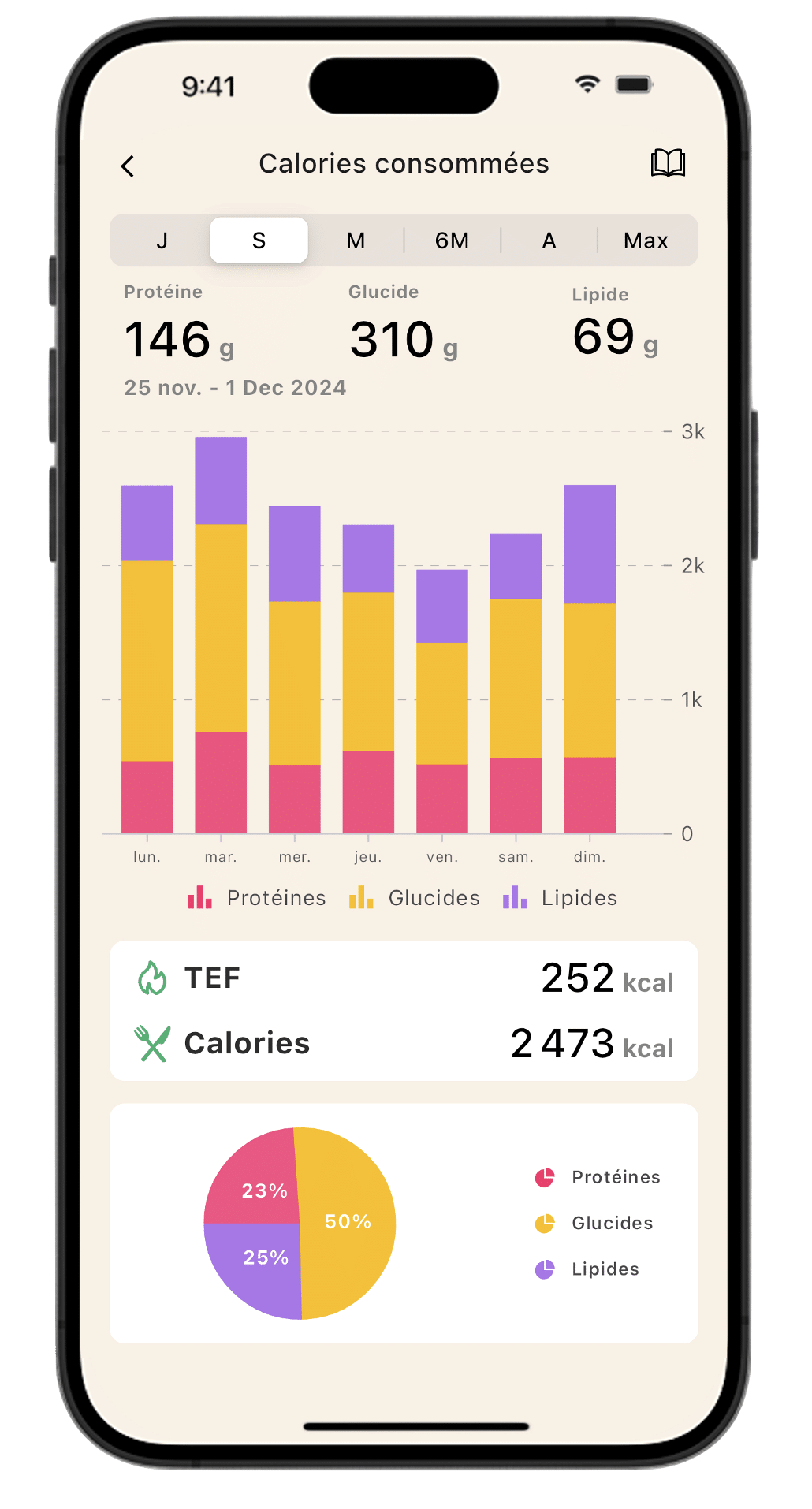
Lean
07 · BMR & TEFWhy your BMR affects your TEF value
TEF is calculated on ingested macros. But for this calculation to be integrated into a precise TDEE, the BMR used as the base must itself be accurate. And BMR depends directly on your actual lean mass.
The physiological reason: basal metabolism is primarily driven by muscle and organs (metabolically active tissue), not by fat mass. Two individuals at 80 kg with 12 % and 22 % bodyfat have a lean mass of 70.4 kg vs 62.4 kg, a BMR gap of about 170 kcal/day. If your TDEE is wrong from the start, your TEF ends up integrated into an already miscalibrated equation.
Concretely: Lean calculates your BMR on your actual lean mass via BodyScan AI, then integrates TEF on this exact BMR. The chain error that apps make occurs at two levels: BMR on total weight (wrong), then 0 kcal of TEF (also wrong). Lean corrects both.
Lean uses its proprietary patented model (not Harris-Benedict 1919, not Mifflin-St Jeor 1990) and indexes it on your lean mass via BodyScan AI. This BMR serves as the foundation for everything else, including TEF.
TEF is not a separate line you decide to activate or not. It is part of the equation TDEE = BMR + NEAT + EAT + TEF, integrated from the very first logged meal.
You lose 3 kg of fat in a month? Your BMR changes. And TEF integration into TDEE is automatically recalibrated in Lean. Other apps keep their constant since signup.
08 · BodyScan AIActual bodyfat: the foundation of Lean’s TEF calculation
For TEF to be integrated into a precise TDEE, the BMR must first be accurate. And for that, you need your actual bodyfat. This is where Lean's BodyScan AI comes in.
Most apps calculate BMR based on total weight (Harris-Benedict 1919, Mifflin-St Jeor 1990). Lean calculates your BMR on your lean mass estimated via bodyfat, using a patented proprietary model. This BMR then serves as the foundation for TEF integration into TDEE.
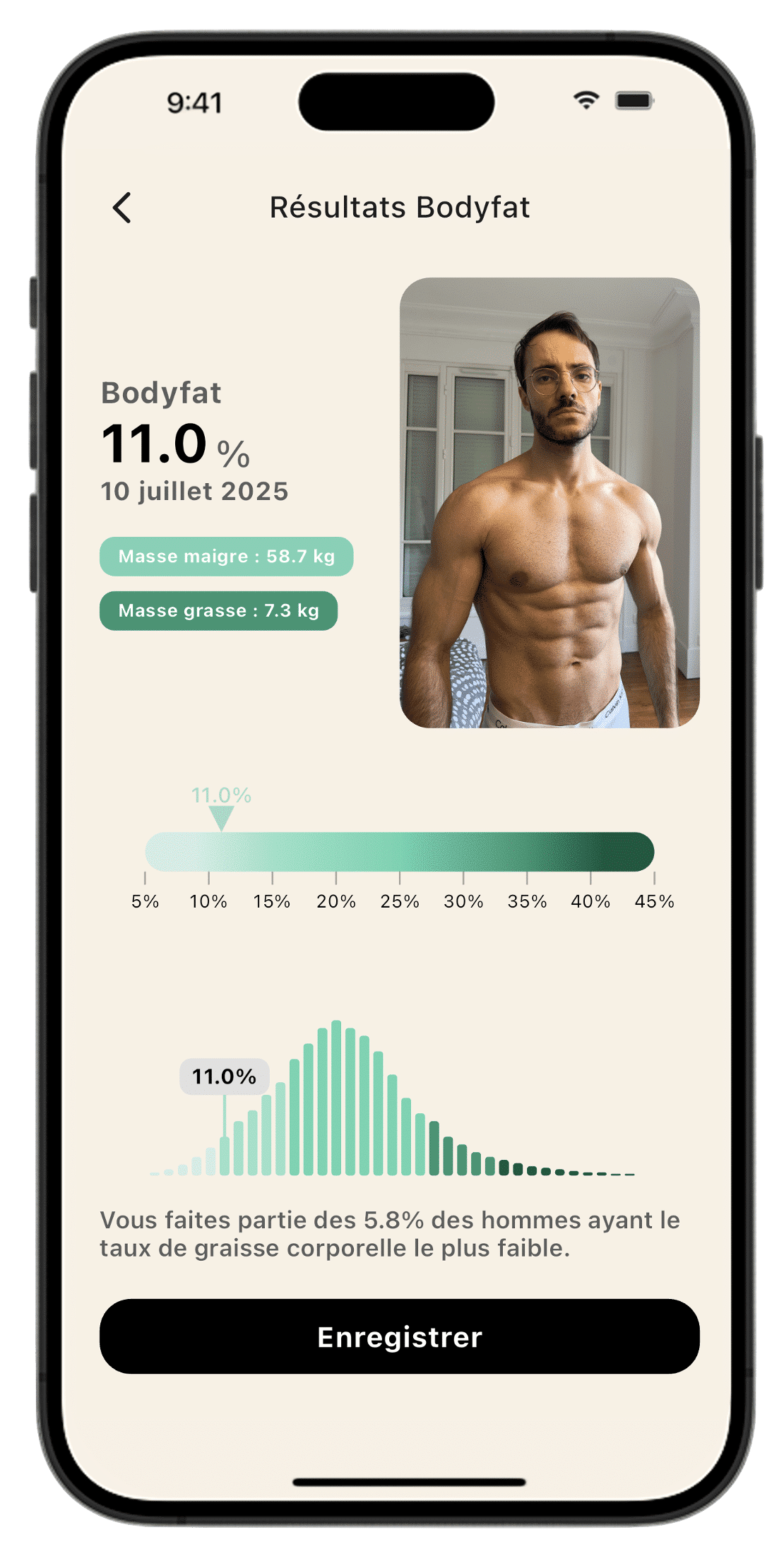
BodyScan AI: actual bodyfat in 5 seconds, from a photo
One photo, 5 seconds, and Lean knows your bodyfat with precision. This figure directly feeds your BMR calculation, which in turn serves as the foundation for TEF integration into your TDEE. This is the chain architecture that other apps do not offer.
09 · Lean & TEFReal-time calculation on every logged meal
Lean calculates TEF from every meal you log, and integrates it into your daily TDEE in real time. Here is the complete architecture:
You log via the USDA+OpenFoodFacts database, barcode scan, or AI photo scan of a dish. Lean immediately retrieves the grams of proteins, carbs and fats.
The Lean engine applies: P × 25 %, C × 8 %, F × 2 %. The result is calculated on the fly for each food item, then cumulated over the day.
The day’s cumulated TEF is added to BMR + NEAT + EAT to give your live TDEE. Your caloric balance adjusts with every logged meal.
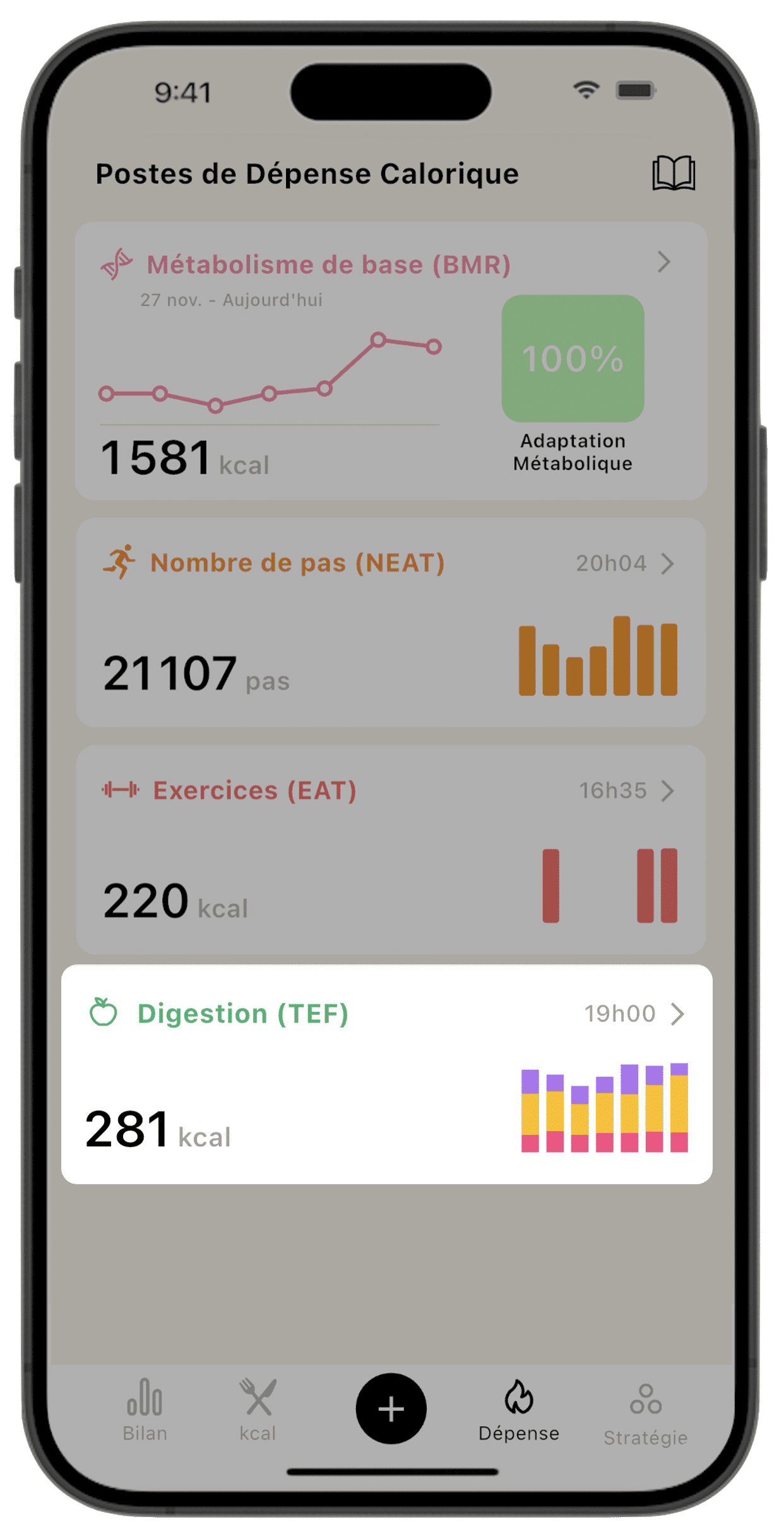
Lean’s Expenditure tab details every TDEE component: BMR, NEAT, EAT, TEF. You see exactly how much digestion contributes to your daily expenditure.
Lean uses the TEF-aware TDEE to calculate your goal and target deficit. A more protein-rich meal increases your TEF and therefore your actual TDEE, which Lean reflects automatically.
10 · TEF in LeanReal-time digestion tracking
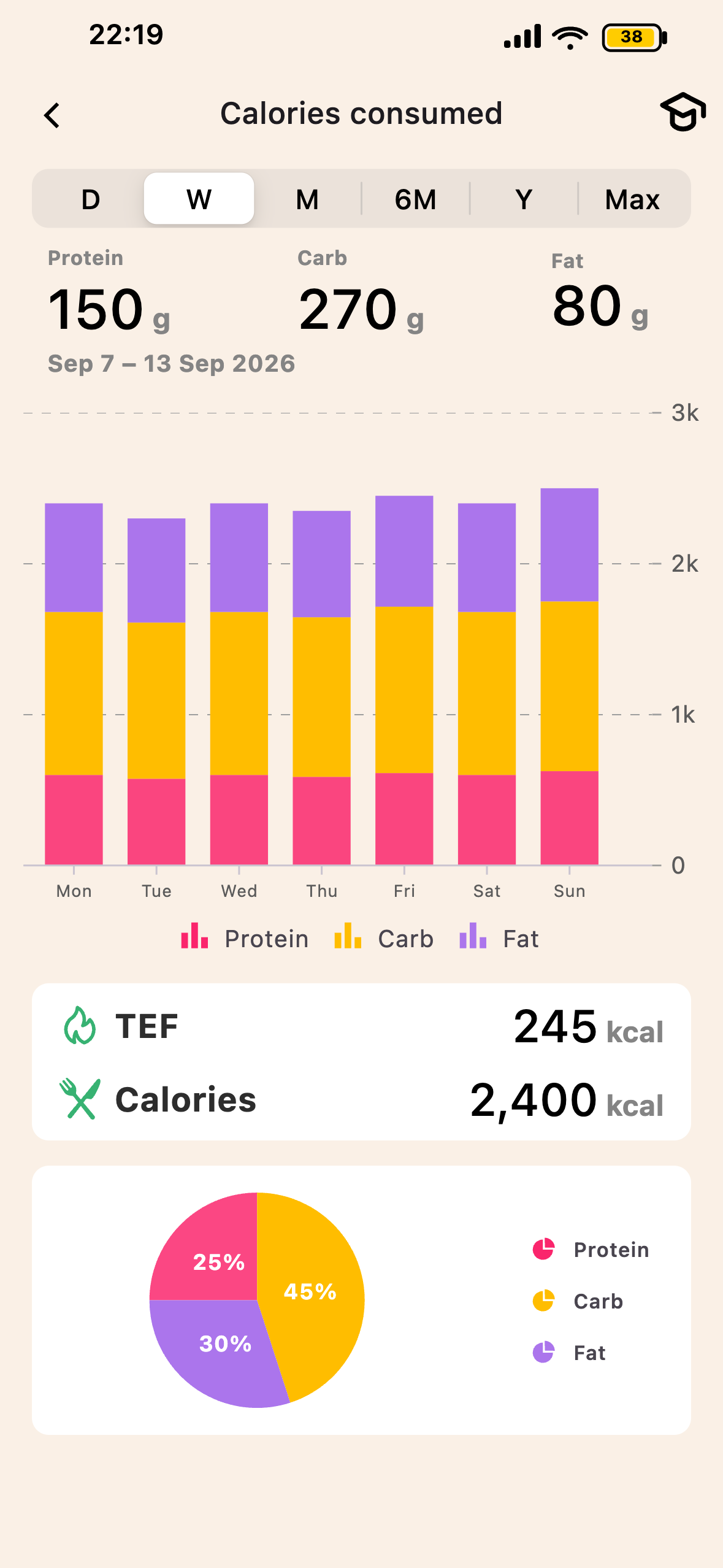
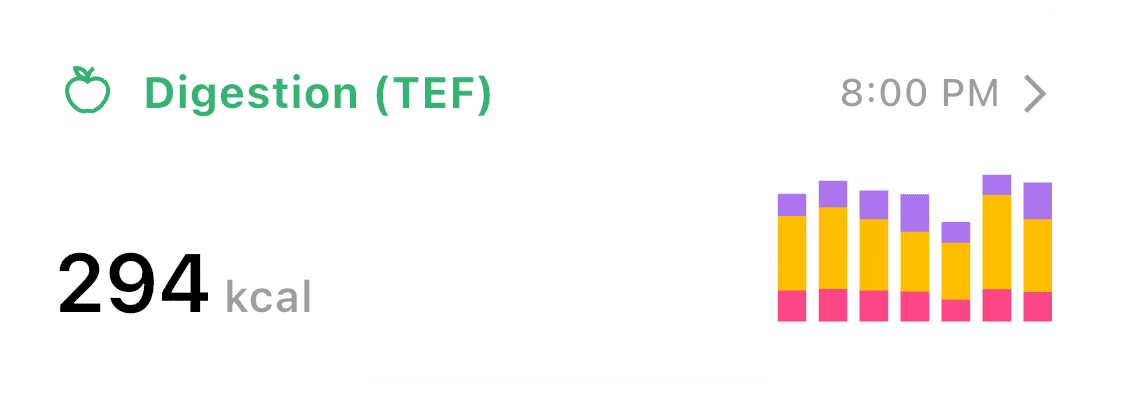
Lean’s Expenditure tab details every TDEE component in real time: BMR, NEAT, EAT, TEF. Click on TEF to see the breakdown per meal.
11 · StrategiesEating more proteins = burning more while digesting
The fundamental principle of TEF: every calorie of protein costs 25 % to digest, vs 2 % for fats. Eating more proteins = spending more at equal calories. This is the real metabolic advantage of a high-protein diet in a cut.
100 g of additional proteins (400 kcal) generate around 100 kcal of additional TEF. This is real expenditure, without physical effort, just by changing your dietary composition.
Every entry in Lean triggers the TEF calculation. A snack of 100 g of cottage cheese (18 g of proteins) generates ~18 kcal of TEF. Cumulated over 5 meals, that is real expenditure that other apps do not count.
Ultra-processed foods have a lower TEF because they are already partly “pre-digested” industrially (Barr 2010, PMID 20613941). A whole chicken breast has a higher TEF than a pre-hydrolyzed protein powder.
Fats have a TEF of 0 to 3 %. Increasing your fats does not boost TEF. It is the macro split that matters, not the gross caloric total.
12 · ScienceWhy proteins burn so much during digestion
The answer is biochemical. Proteins must be broken down into amino acids, which are then either integrated into protein synthesis (ATP cost), oxidized (Krebs cycle), or converted to glucose (gluconeogenesis, even higher cost). Nitrogen deamination (urea production) is itself energetically costly.
Proteins: TEF 20–30 %
Carbs: TEF 5–10 %
Fats: TEF 0–3 %
13 · GoalsTEF and strategy for cut, bulk or recomp
Once your precise TEF is known, the practical application is direct. Three goals, three levers.
Cut (fat loss)
Bulk (muscle gain)
Recomp (maintenance + building)
14 · Live TEFReal-time digestion tracking in Lean
Lean’s Expenditure tab details every TDEE component in real time: BMR, NEAT, EAT, TEF. The displayed TEF corresponds to your logged meals of the day, calculated on each macro.
15 · The PyramidLean Progression Pyramid
The Lean Progression Pyramid prioritizes the steps to reach your body composition goal. TEF plays a role at two levels: the precise caloric goal (TEF integrated into TDEE) and macronutrients (composition that determines the TEF level).
16 · FAQEverything you wonder about TEF
What is the thermic effect of food?
The TEF (Thermic Effect of Food), also called DIT (Diet-Induced Thermogenesis), is the energy spent to digest, absorb and metabolize food. It enters the equation TDEE = BMR + NEAT + EAT + TEF and represents on average 8 to 15 % of total caloric expenditure.
Why do proteins have the highest TEF?
Proteins require costly ATP-consuming biochemical processes: protein synthesis, transamination, deamination (urea production), and sometimes gluconeogenesis. This is why 20 to 30 % of protein calories are burned during digestion, vs 5 to 10 % for carbs and 0 to 3 % for fats.
Does MyFitnessPal calculate TEF?
No. MyFitnessPal, Yazio, Cronometer and most calorie apps do not integrate TEF into their expenditure calculation. They use a fixed activity coefficient (PAL) applied to BMR, supposed to “encompass” digestion. In practice, this coefficient does not reflect your daily macro composition.
How does Lean calculate TEF?
Lean applies scientific coefficients on every logged meal: P × 25 % + C × 8 % + F × 2 %. The result is integrated in real time into your daily TDEE. On a 537 kcal meal (54 g P, 55 g C, 12 g F), Lean calculates 74 kcal of TEF.
How many calories does TEF represent per day?
On a 2,000 to 2,500 kcal diet, TEF represents between 160 and 250 kcal depending on your macro composition. Over a year, that is 58,000 to 91,000 kcal of expenditure ignored by apps that do not calculate it.
Does TEF decrease in a caloric deficit?
Yes, proportionally: if you eat fewer calories, you digest less and absolute TEF decreases. But the percentage remains stable according to your macros. In a deficit, maintaining a high protein intake preserves the TEF/intake ratio, in addition to preserving muscle mass.
Is TEF the same thing as postprandial active metabolism?
Yes, both terms refer to the same reality: the energy burned by digestion. TEF (Thermic Effect of Food) is the most widely used English term. DIT (Diet-Induced Thermogenesis) or SDA (Specific Dynamic Action) are the equivalents in European and French literature.
Do processed foods have a lower TEF?
Yes. Barr & Wright (2010, PMID 20613941) measured that whole-food meals generate a TEF around 50 % higher than calorie-equivalent processed-food meals. Processed foods are already partly “pre-digested” industrially, which reduces digestive work and therefore TEF.
Scientific sources
- Westerterp KR. Diet induced thermogenesis. Nutr Metab (Lond). 2004;1(1):5. PubMed 15507147
- Acheson KJ. Protein choices targeting thermogenesis and metabolism. Am J Clin Nutr. 2011;93(3):525-534. PubMed 21235280
- Tappy L. Thermic effect of food and sympathetic nervous system activity in lean and obese subjects. Crit Rev Clin Lab Sci. 1996;33(6):435-444. PubMed 8701638
- Barr SB, Wright JC. Postprandial energy expenditure in whole-food and processed-food meals. Food Nutr Res. 2010;54. PubMed 20613941
- Levine JA. Non-exercise activity thermogenesis (NEAT). Best Pract Res Clin Endocrinol Metab. 2002;16(4):679-702. PubMed 12468415
Calculate your TEF on your actual macros
P × 25 % + C × 8 % + F × 2 %, on every logged meal. TDEE = BMR + NEAT + EAT + TEF. Patented proprietary model. Free download, 7-day trial on the annual plan.