NEAT calculator : how many calories do your steps really burn ? your real steps, your real body: zero checkboxes
Walking, posture, everyday movement: NEAT is the most variable block of your expenditure, up to 700 kcal/day of difference between two people of the same weight (Levine 2005). This calculator converts your real steps into kcal/day using your measured profile (weight, height, body fat), and places them within your non-exercise expenditure. Without ever asking you to tick a box.
 The Lean Team · 9 min read · Updated August 18, 2026

 Free download
NEAT (Non-Exercise Activity Thermogenesis) is everything you burn through non-exercise activity. Its measurable everyday part is your steps: roughly 0.03 to 0.06 kcal per step depending on your weight and height, meaning 250 to 450 kcal for 8,000 steps and 300 to 550 kcal for 10,000. On top of that comes a postural and movement share, up to +350 kcal/day standing vs sitting (Levine 2005), which cannot be declared in a menu: it is measured. Estimate the NEAT of your steps with the calculator below.
02 · CalculatorEstimate the NEAT of your steps in kcal/day
Enter your measurements: your body (weight, height, body fat) and your step average. Nothing else. The calculator converts your steps into kcal using a step cost adjusted to your profile, computes your BMR on your lean mass (370 + 21.6 × FFM, the same formula as our TDEE calculator), then places your NEAT within your non-exercise expenditure. It is an educational estimate with a transparent formula, not a measurement: the real value reads every day from your actual steps.
Your measurements
Educational estimate based on published values (energy cost of walking in MET, Ainsworth 2011; postural variability, Levine 2005). This calculator is not a diagnostic tool and does not replace medical advice.
Lean's AI BodyScan measures it in 5 seconds from a single photo: body fat, lean mass and fat mass, straight from your phone.
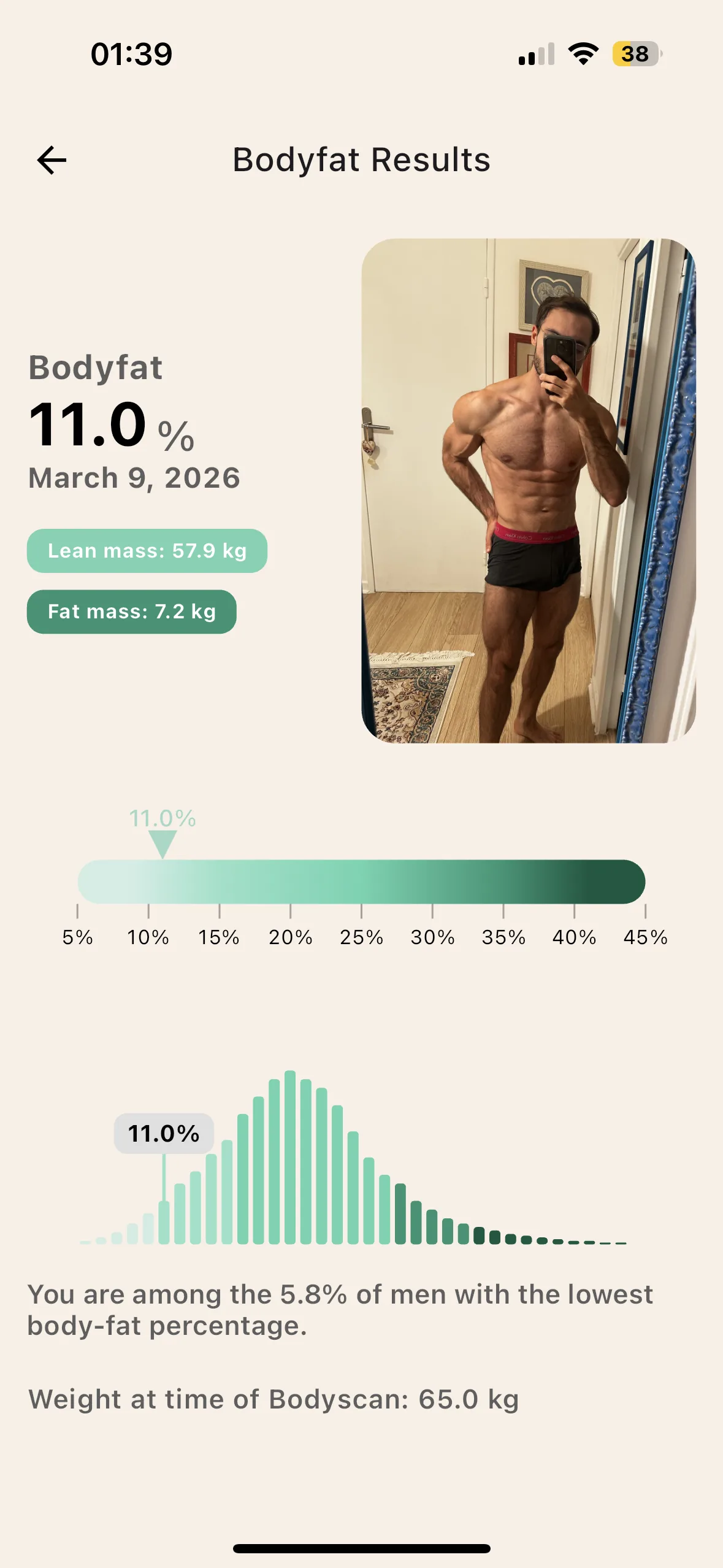
In the meantime, leave the slider on an approximate value: an approximate body fat beats a calculation that ignores your body composition entirely.
03 · The scienceWhy NEAT is the most underrated lever
Your NEAT can vary threefold. And it can be measured.
The term comes from James Levine, who defined NEAT (Non-Exercise Activity Thermogenesis) as all activity thermogenesis outside voluntary exercise: everyday walking, posture, movement, fidgeting (Levine 2002). His most striking measurement dates from 2005, in Science : fitted with posture sensors for 10 days, obese subjects stayed seated 2 h 30 longer per day than lean subjects of similar body size; adopting the postural allocation of lean subjects would represent about 350 kcal/day of additional expenditure. Between a profile walking 3,000 steps and one walking 15,000, the gap reaches 700 kcal/day. No other block of the TDEE varies this much from one person to another.
The cost of a step, on the other hand, can be quantified cleanly with METs (metabolic equivalents, Ainsworth 2011 compendium): walking at a moderate pace costs about 3.3 MET, which, brought back to cadence, gives 0.03 to 0.06 kcal per step depending on your weight and stride length. That is the formula of the calculator above: a step at 90 kg is « worth » 25 % more than a step at 70 kg, and no single flat rate can reflect that. In strength training, the irony is well known: your 23 hours outside the gym often weigh more in your expenditure than the session itself, and it is NEAT that carries them.
And the non-step component? Posture, movement, fidgeting: it is real, Levine quantified it. But it is impossible to declare honestly : nobody can say whether they are « sedentary / lightly active », and the answer would change every week. That is why this calculator does not ask you for it: it quantifies your steps, the measurable part of your NEAT, and nothing else. Lean captures the rest where it shows: in the continuous measurement of your activity and your real data, not in a box ticked on day one.
Where does NEAT sit in the equation? In Lean, expenditure breaks down into TDEE = BMR + NEAT + EAT + TEF. NEAT is its most variable block, the one questionnaires flatten into a frozen multiplier. Metabolic adaptation is the 5th block: a coefficient that modulates the BMR (100→0 % convention), never a term you add. And in a prolonged deficit, part of the slowdown runs precisely through a NEAT that drops without you noticing (Rosenbaum and Leibel 2010): fewer movements, fewer spontaneous steps, the lift without thinking about it.
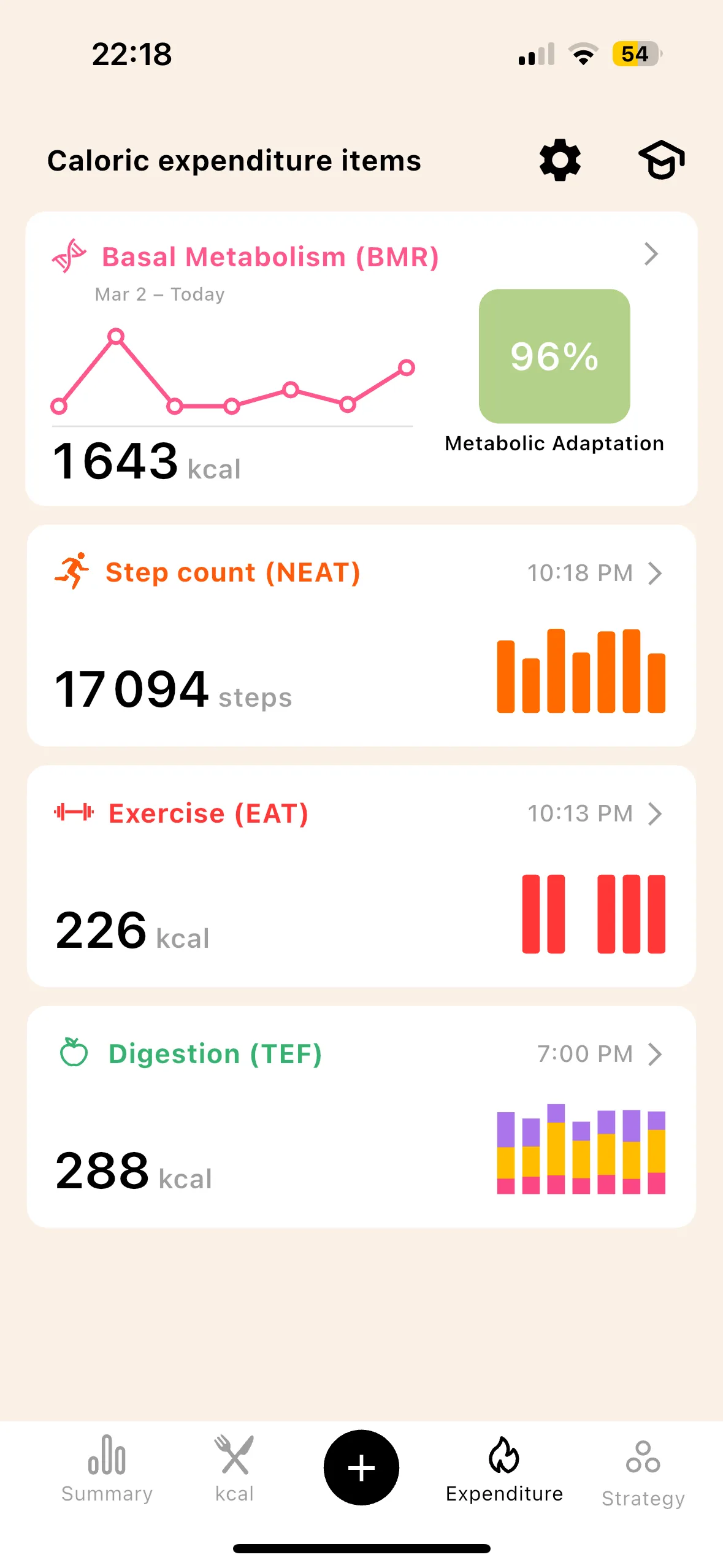
One last point, measured by the NEAT pillar on this site: watches and apps announcing 700 kcal for a 10,000-step day overestimate walking by 30 to 100 %. The real value for a 75 kg profile is around 350 to 400 kcal. If you build a deficit on inflated expenditure, your plateau is no mystery: it was written in advance.
04 · Three step volumesFrom 3,000 to 15,000 steps: what it really changes
Three profiles, three measured step volumes, three NEAT values. No labels: measurements only. The numbers come from the calculator on this page, you can reproduce them by entering the same parameters.
3,000 steps / day
8,000 steps / day
15,000 steps / day
05 · Continuous measurementHow Lean turns your steps into kcal, in real time
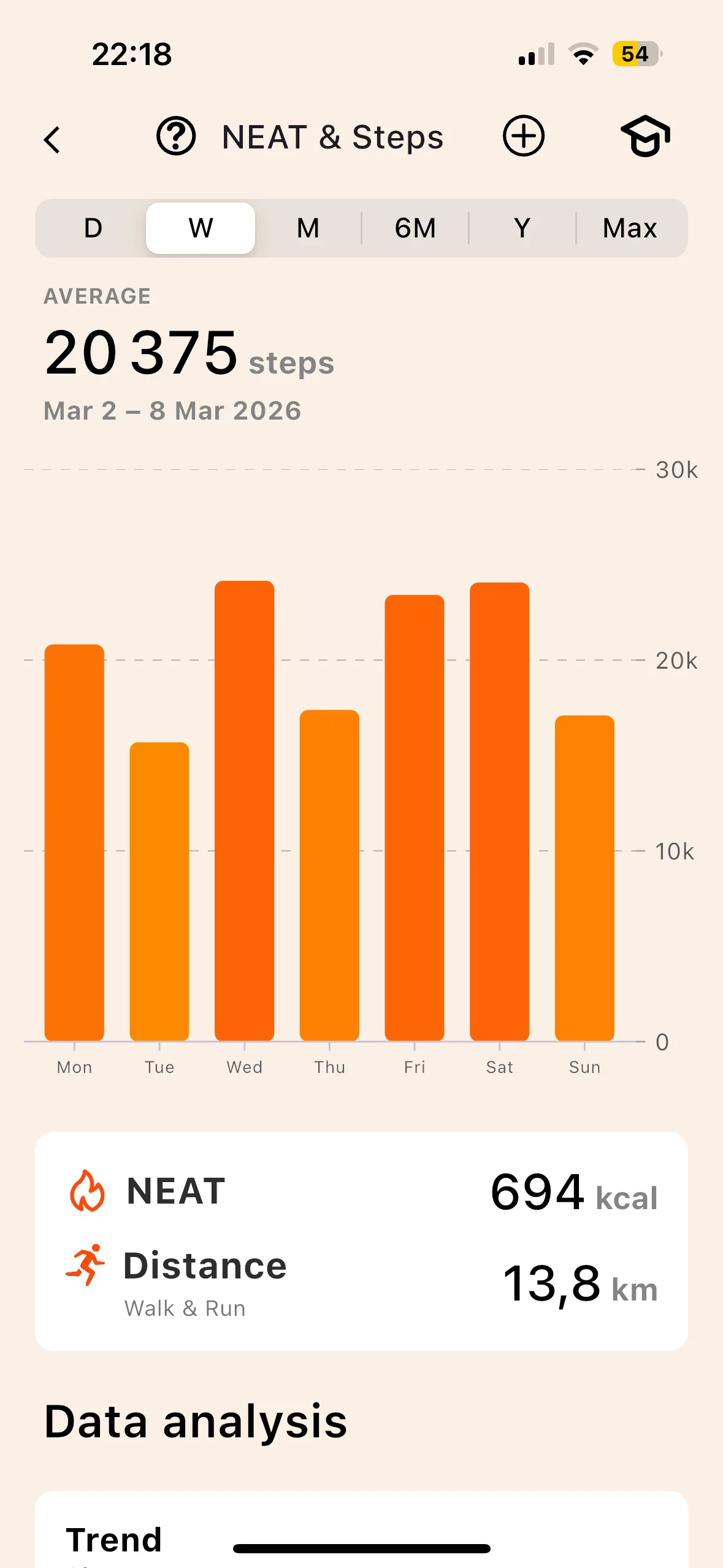
An online calculator, even an honest one, freezes your NEAT on a declared average. Yet your NEAT changes every day: 4,000 steps on a rainy Sunday, 14,000 on a market Saturday. That is exactly why Lean measures it instead of assuming it:
1. Native pedometer connected
Your steps are read continuously from your phone, with no manual entry. Every step is converted into kcal on YOUR measured profile (weight, height, lean mass), not on a generic flat rate.
2. NEAT separated from EAT
During a tracked workout, steps are neutralised on the NEAT side: your run counts in EAT, not twice. The boundary between blocks stays clean.
3. Live calorie balance
A big walking day raises your kcal target for the day, live. A couch Sunday lowers it. Your deficit stays constant, even when your NEAT does not.
4. NEAT monitored during a deficit
When cutting, NEAT drops without warning: fewer spontaneous steps, fewer movements. Lean sees it in your data, whilemetabolic adaptation (100→0 % coefficient on the BMR) is tracked separately.
06 · Myth vs reality10,000 steps is not a magic number
« You need 10,000 steps a day, otherwise it does not count »
The round number does not come from a laboratory: it comes from the marketing of a 1960s Japanese pedometer, the manpo-kei, literally « 10,000-step meter ». The slogan was good, it became a global norm, then a guilt-inducing threshold: below 10,000, failure; above, mission accomplished.
A continuum, not a threshold
The Tudor-Locke synthesis (2011) describes a continuum with no magic threshold: below 5,000 steps/day the volume is low, 7,500 to 9,999 is already a good level, 10,000 and above is a high volume. Benefits start well before 10,000 and do not stop at 10,000: every 2,000-step increment counts.
In energy terms, it is kcal, not steps, that make your balance: 10,000 steps are worth ~350 kcal for a 70 kg profile and ~500 kcal for a 100 kg profile. The right target is relative: your current average +2,000, held every day, beats a heroic 10,000 on Monday followed by three days at 3,000.
The practical consequence: set your step target from your real 7-day average, not from a cultural number. And count your steps in kcal adjusted to your profile, not at a flat rate: that is the whole difference between a theoretical deficit and a deficit that actually exists.
07 · FAQEverything you are wondering about NEAT and your steps
What is NEAT ?
NEAT (Non-Exercise Activity Thermogenesis) is the energy you burn through any physical activity outside exercise: walking, standing, cooking, carrying your groceries, fidgeting. It is the most variable block of energy expenditure: up to 700 kcal/day of difference between two people of the same weight according to Levine's measurements. In the equation TDEE = BMR + NEAT + EAT + TEF, it is the second block, and the only one that reads directly from a pedometer.
How do you calculate your NEAT ?
The measurable part is your steps: multiply your daily average by a cost of 0.03 to 0.06 kcal per step, adjusted to your weight and stride length (weight x stride x 0.000722). To place that NEAT within your expenditure, you also need a reliable BMR: it is computed on your lean mass (370 + 21.6 x FFM), therefore with your body fat. The posture and movement share cannot be declared honestly in a menu: it is measured continuously. That is why the calculator on this page only asks for measurements: your body and your steps.
How many calories for 10,000 steps of walking ?
Between 300 and 550 kcal depending on your profile. The range depends mostly on your weight and stride length: about 350 kcal for 70 kg, 400 kcal for 75 kg and 1m78, more than 500 kcal beyond 95 kg. Be wary of watches showing 700 kcal for the same day: the measured overestimation runs from 30 to 100 %.
How many calories does a single step burn ?
About 0.03 to 0.06 kcal, depending on your weight and height. The calculator's formula: step cost = weight x stride length x 0.000722, derived from the cost of moderate walking (3.3 MET, Ainsworth 2011 compendium). It looks tiny, but at 8,000 or 12,000 steps a day, that is hundreds of kcal daily, every day of the year.
Does NEAT include strength training ?
No. Your sessions (strength training, running, cycling) fall under EAT (Exercise Activity Thermogenesis), a separate block of the TDEE. That said, NEAT is crucial in strength training: your 23 hours outside the gym often burn more than your session itself. Many lifters overestimate their session and ignore their NEAT, when it is NEAT that makes the difference between two people on the same programme.
Why does my NEAT drop during a calorie deficit ?
It is one of the forms of metabolic adaptation: in a prolonged deficit, the body unconsciously reduces spontaneous movement. You fidget less, you walk more slowly, you take the lift without thinking. This drop can cancel part of your deficit with no fault in your discipline. The counter: an explicit, tracked step target, so that NEAT stays a choice, not a variable you endure.
How can you increase your NEAT without doing more exercise ?
Anchor steps in existing habits: get off one stop earlier, take phone calls while walking, stairs by default, a 10-minute walk after each meal. Aim for your current average plus 2,000 steps, held every day, rather than one big unsustainable target. Every 2,000-step increment is worth roughly 80 to 120 kcal depending on your build: three habits are enough to change your expenditure.
Do you really need 10,000 steps a day ?
No, it is not a scientific threshold: the number comes from the marketing of a 1960s Japanese pedometer. The literature (Tudor-Locke 2011) describes a continuum: below 5,000 steps the volume is low, 7,500 to 10,000 is already a good level, and benefits continue beyond. The right target is set from your real 7-day average, not from a round number.
Does my smartwatch overestimate my walking calories ?
Often, yes. Measured overestimations of walking expenditure run from 30 to 100 % depending on the device: a 10,000-step day displayed at 700 kcal is more like 350 to 400 kcal for a 75 kg profile. If you eat those phantom calories, your deficit disappears. A MET-based calculation adjusted to your weight and height, like the one on this page and in Lean, stays closer to published values.
Does this calculator give an exact measurement of my NEAT ?
No. It estimates the step part of your NEAT, from measurements you provide (weight, height, body fat, step average) and published values for the cost of walking. It deliberately does not include the posture and movement share: it varies too much to fit in any box. Your real NEAT changes every day with your steps; that is why Lean measures it continuously through your pedometer instead of freezing it. And in any case, neither this page nor the app replaces medical advice.
Scientific sources
- Levine JA. Non-exercise activity thermogenesis (NEAT). Best Pract Res Clin Endocrinol Metab. 2002 Dec;16(4):679-702. PubMed 12468415.
- Levine JA, Lanningham-Foster LM, McCrady SK, et al. Interindividual variation in posture allocation: possible role in human obesity. Science. 2005 Jan;307(5709):584-6. PubMed 15681386.
- Ainsworth BE, Haskell WL, Herrmann SD, et al. 2011 Compendium of Physical Activities: a second update of codes and MET values. Med Sci Sports Exerc. 2011 Aug;43(8):1575-81. PubMed 21681120.
- Tudor-Locke C, Craig CL, Brown WJ, et al. How many steps/day are enough? For adults. Int J Behav Nutr Phys Act. 2011 Jul;8:79. PubMed 21798015.
- Rosenbaum M, Leibel RL. Adaptive thermogenesis in humans. Int J Obes (Lond). 2010 Oct;34 Suppl 1:S47-55. PubMed 20935667.
Your NEAT, measured continuously
Native pedometer connected to HealthKit and Google Fit, kcal adjusted to your profile, calorie balance that moves with your steps. The most variable expenditure of your day, finally counted properly. Free download, 7-day trial on the annual plan.