Macro calculator : protein, carbs, fat in the right order, on your real measurements
Fixed percentages like « 40/40/20 » have a hidden flaw: they split calories they do not even know. The right method has an order: first your protein (on your lean mass), then your fat (the hormonal floor), and carbs take the rest of YOUR real expenditure, computed from your measurements and your steps. That is what this calculator does, sources included.
 The Lean Team · 8 min read · Updated August 27, 2026

 Free download
The three-step method, the one used by the references of the field (Helms 2014, Kerksick 2018): the protein first, on your lean mass; the fat second, as a floor (20 to 30 % of your calories, it carries your hormones); the carbs last, taking all remaining calories to fuel your training. For a 75 kg man at 15 % body fat who is cutting, that gives about 172 g of protein, 168 g of carbs and 50 g of fat. Calculate your exact split below.
02 · CalculatorCalculate your macro split in grams
Your measurements, your steps, your goal: the calculator rebuilds your non-exercise expenditure (BMR on lean mass + NEAT from your steps + TEF, the same formulas as our TDEE calculator), applies your goal, then splits in order: protein on your lean mass, fat at 25 % of calories, carbs on the rest. Your sessions (EAT) add on top: on training days, carbs go up. Body fat unknown? Go through our body fat calculator.
Your measurements
Educational estimate based on published recommendations (Helms 2014; Morton 2018; Kerksick 2018). This calculator is not a diagnostic tool and does not replace medical advice.
Lean's AI BodyScan measures it in 5 seconds from a single photo: body fat, lean mass and fat mass, straight from your phone.
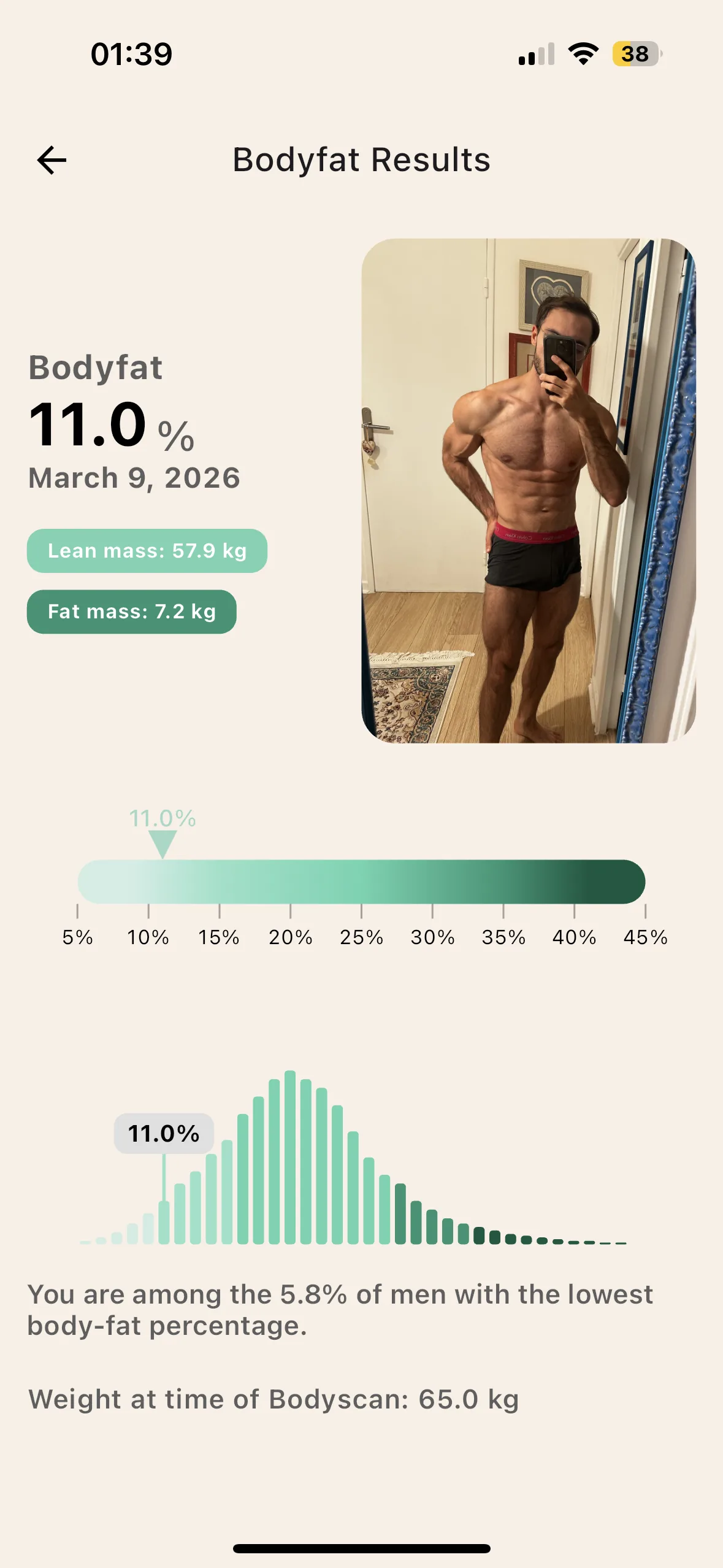
Two options: our tape measure calculator (2 minutes, free), or the BodyScan photo above. Meanwhile, leave the slider on an approximate value: an approximate body fat beats a guesstimated split.
03 · The scienceWhy the order of macros matters more than their percentages
One macro is fixed, one is protected, one adjusts. In that order.
Fixed-percentage splits, the famous « 40/40/20 », have two structural flaws. First, they apply to a calorie total they do not compute: 40 % of a wrong expenditure is still wrong. Second, they treat the three macros as interchangeable, when they have neither the same role nor the same urgency.
The hierarchy that reaches consensus among the references of the field (Helms 2014 for contest preparation, Kerksick 2018 for the ISSN review) comes in three steps. Protein first : it is set in grams on your lean mass, not as a percentage, because its role (building and protecting muscle) does not depend on your calorie total. Fat second : it carries your hormonal production; below 20 % of calories long term you are playing with fire, hence a 20-30 % floor. Carbs last : everything that remains. Not « leftovers » in a dismissive sense: they are your training fuel, and it is precisely because they are the adjustment variable that they absorb the deficit when cutting and the surplus when bulking.
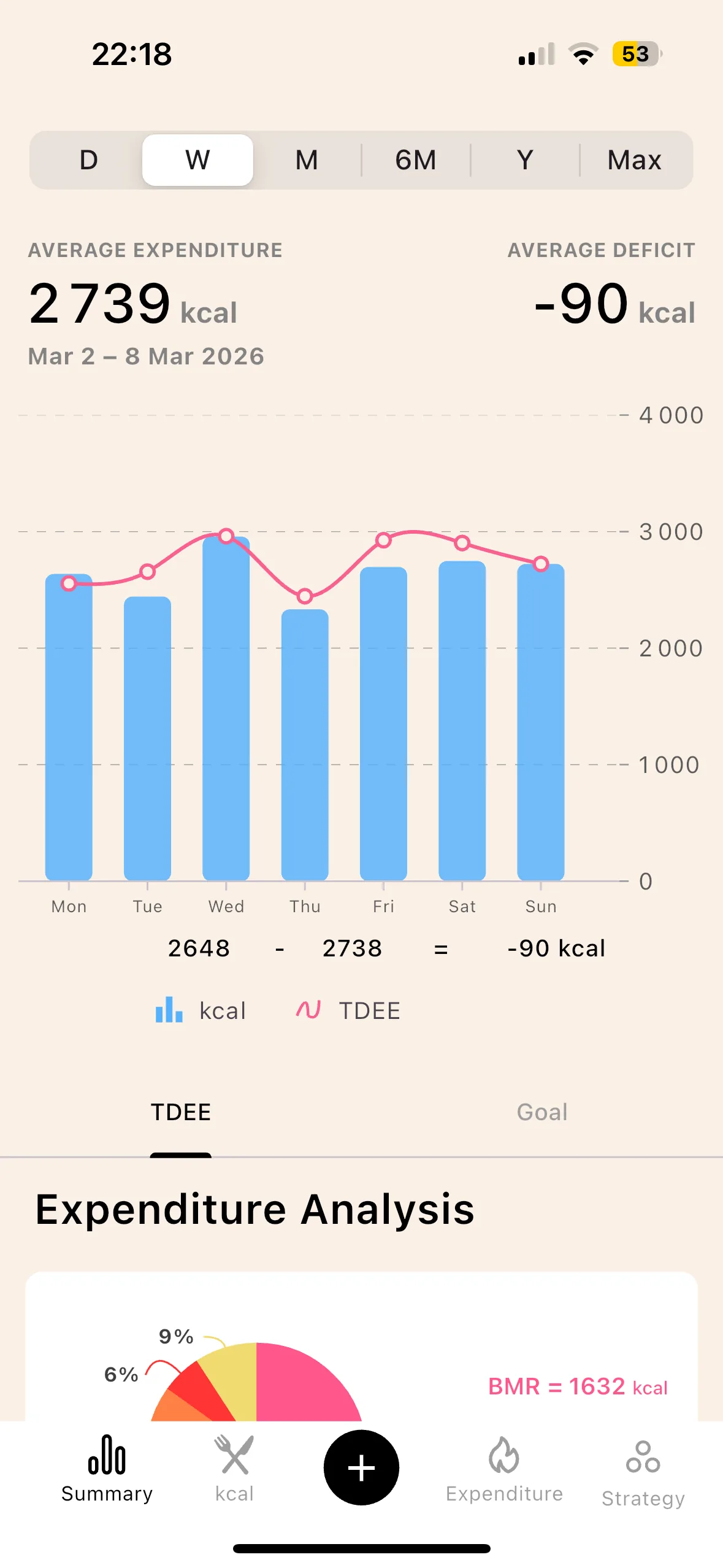
This calculator adds the brick missing everywhere else: the starting calorie total is rebuilt from your measurements (BMR on lean mass, NEAT on your real steps, TEF), not from an activity box ticked on an optimistic day. The same formulas as our TDEE calculator, so the consistency is verifiable from page to page.
Where does this fit in the equation? The macros you eat also determine the TEF (4th brick of TDEE = BMR + NEAT + EAT + TEF): protein burns 20 to 30 % of its calories in digestion, carbs 5 to 10 %, fat almost nothing. A protein-rich split slightly raises your expenditure, and Lean counts this effect on your actually logged macros.
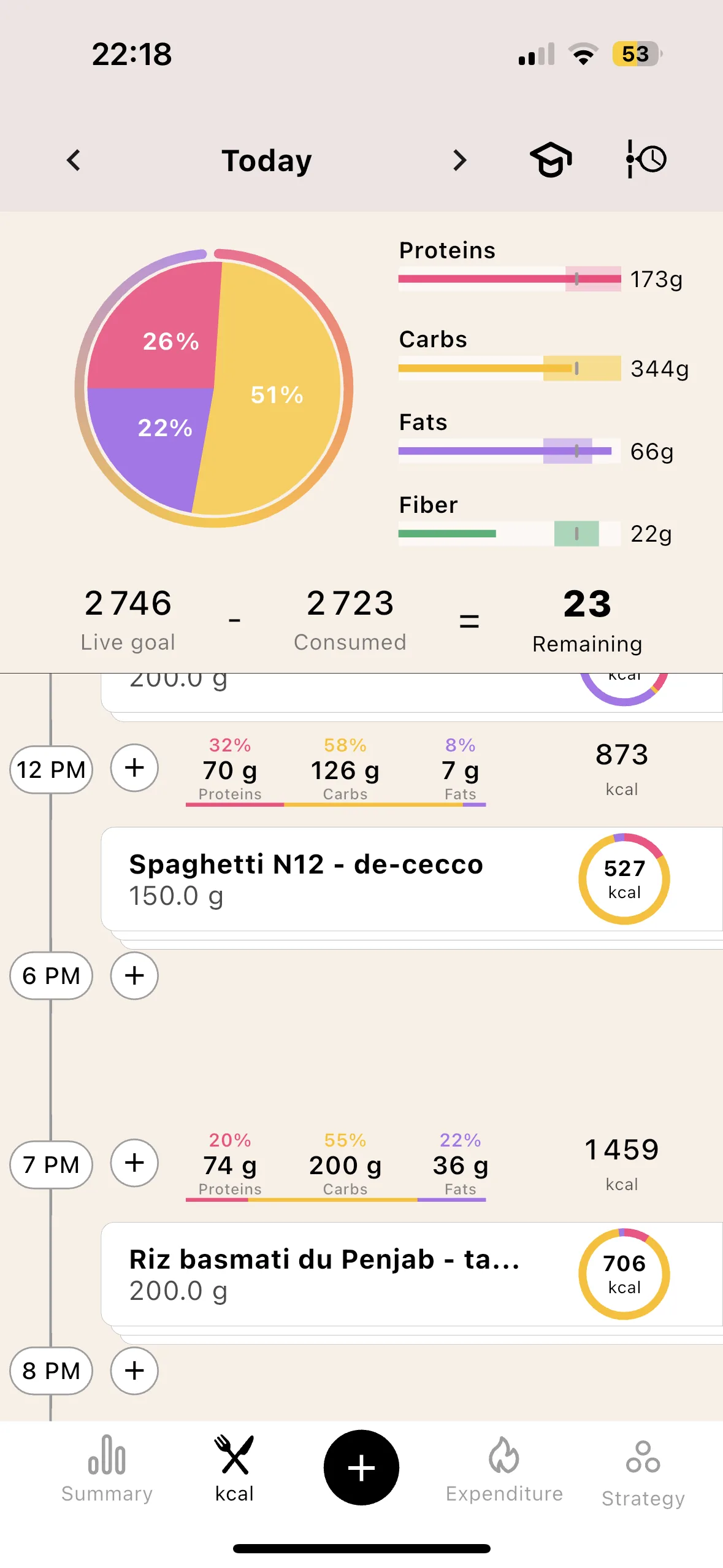
One last note of honesty: the precision of your split depends on that of your expenditure, hence your body fat and your steps. It is a solid starting estimate, to adjust on your real results over the weeks: the perfect number does not exist, the measured trajectory does.
04 · Three worked profilesThe same bodies, from body fat to macros
The profiles from our body fat and proteincalculators, carried through: their full split. Reproduce every number by entering the same parameters above.
She cuts cleanly
The lean athlete cutting
He builds cleanly
05 · In practiceLiving with your macros without turning them into a religion
A split is only useful if it survives real life. The four rules that prevent 90 % of dropouts:
1. Protein as the absolute priority
Hit your protein every day, even when the rest slips: one source at every meal. Carbs and fat tolerate daily approximation, muscle does not.
2. Carbs around your sessions
Place most of your carbs before and after training: performance in the session, recovery afterwards. On off days they naturally come down.
3. Fat without hunting it
Cooking oil, eggs, fatty fish, nuts: the 20-25 % floor fills effortlessly in a normal diet. Just watch it does not collapse in an aggressive cut.
4. Precision on the trend, not the day
A day at ±20 g changes nothing; a week consistently off does. Look at your 7-day average, and adjust in small 10-15 g steps.
06 · Myth vs realityThe « 40/40/20 » and the fear of carbs
« There is a magic split, and carbs make you fat »
The « 40/40/20 » (or the low-carb variant of the moment) promises a universal split. But a percentage means nothing without the total: 40 % protein for a 55 kg person at maintenance and for a 100 kg man cutting are two unrelated realities. As for carbs « making you fat »: at equal calories and protein, comparative studies show no systematic low-carb advantage for fat loss (ISSN review, Kerksick 2018). The deficit drives the loss, not the war on one macro.
Grams ranked on YOUR expenditure
The sequence that holds: a calorie total rebuilt from your measurements, protein fixed on your lean mass, a fat floor for your hormones, and carbs taking the rest, placed around your sessions. Your split changes when your body or your goal changes, not when fashion does.
The low-carb choice remains available as a personal preference (satiety, digestive comfort): as long as protein and calories are in place, it is a matter of taste, not physiology. This calculator gives the balanced version; feel free to shift carbs toward fat if you stick to it better.
The practical consequence: pick the split you can hold for 12 weeks, not 12 days. Adherence beats optimization, which is precisely the first floor of the Progression Pyramid in the app: adherence > calorie target > the rest.
07 · FAQEverything you wonder about macros
How do you calculate your macros ?
In order: first compute your expenditure from your measurements (lean mass, real steps), apply your goal (deficit, maintenance or surplus), then split: protein in grams on your lean mass, fat at 20-30% of calories, and carbs take everything left. That is exactly what this page's calculator does, formulas on display.
What is a good macro split for cutting ?
There is no magic percentage: when cutting, protein goes up (2.3 to 3.1 g per kilo of lean mass, Helms 2014), fat holds its 20-25% floor, and carbs absorb the deficit. If your carbs drop below ~1 g/kg, your deficit is probably too aggressive: raise the target rather than break your split.
Is the 40/40/20 valid ?
It is a mnemonic convenience, not a scientific recommendation. Two problems: percentages mean nothing without the calorie total, and they disconnect protein from the lean mass it must feed. That said, for some profiles the 40/40/20 happens to land near the right answer: this calculator tells you whether that is your case.
Do carbs make you fat ?
No: a calorie surplus makes you fat, whatever macro carries it. At equal calories and protein, low-carb vs high-carb comparisons show no systematic difference in fat loss (Kerksick 2018). Carbs even play a key training role: performance, recovery, and keeping intensity in a deficit.
Should some days have more carbs ?
The simple, robust version: add your session calories as carbs on training days, and stay on your base on off days. More sophisticated « cycling » (planned high/low days) can help some people's adherence, but creates no metabolic magic: the weekly total remains the judge.
What is the minimum fat per day ?
The practical marker: do not stay below 20% of your calories long term (Helms 2014), i.e. about 0.5 to 0.6 g per kilo of body weight for most profiles. Fat carries hormonal production and the absorption of fat-soluble vitamins: it is a health floor, not an optimization variable.
Why are my sessions not in the calculation ?
Because they vary too much from day to day to live inside an average. The calculator gives your non-exercise base (BMR + NEAT + TEF); your sessions (EAT) add on top, as carbs, on the days they happen. That is more precise than a multiplier smoothing your week, and it is exactly how the app counts: every tracked session adds to the day it exists.
Do I have to weigh all my food ?
At the start, weighing the main sources (starches, meats, fats) for 2-3 weeks calibrates your eye: afterwards, scanning and estimates cover most meals, with an occasional recalibration weigh. Gram-level precision is only needed on protein and at the very end of a cut.
Do my macros change if my weight changes ?
Yes, doubly: your weight and composition move (hence lean mass and protein), and your expenditure moves with them (hence calories and carbs). Recompute every 3-4 weeks, or let the app do it continuously: that is one of its roles, BMR recalculated on measured body fat and a target adjusted daily.
Does this calculator give an exact prescription ?
No: a solid starting point, based on published consensus and your measurements. The individual optimum adjusts on your real results (weight, body fat, performance) over the weeks. And as always: with any condition or medical doubt, seek professional advice before changing your diet.
Scientific sources
- Helms ER, Aragon AA, Fitschen PJ. Evidence-based recommendations for natural bodybuilding contest preparation: nutrition and supplementation. J Int Soc Sports Nutr. 2014;11:20. PubMed 24864135.
- Kerksick CM, Wilborn CD, Roberts MD, et al. ISSN exercise & sports nutrition review update: research & recommendations. J Int Soc Sports Nutr. 2018;15(1):38. PubMed 30068354.
- Morton RW, Murphy KT, McKellar SR, et al. A systematic review, meta-analysis and meta-regression of the effect of protein supplementation on resistance training-induced gains in muscle mass and strength. Br J Sports Med. 2018;52(6):376-384. PubMed 28698222.
- Phillips SM, Van Loon LJ. Dietary protein for athletes: from requirements to optimum adaptation. J Sports Sci. 2011;29 Suppl 1:S29-38. PubMed 22150425.
- Ainsworth BE, Haskell WL, Herrmann SD, et al. 2011 Compendium of Physical Activities: a second update of codes and MET values. Med Sci Sports Exerc. 2011;43(8):1575-81. PubMed 21681120.
Your macros, counted effortlessly
Three counters filling with every logged food, an expenditure moving with your steps, a target continuously recalculated on your measured body fat. This page's split, alive in your pocket. Free download, 7-day trial on the annual plan.