Basal metabolic rate. Everything you need to know to calculate it precisely: BMR explained.
Basal metabolic rate (BMR) is the foundation of your TDEE and any successful cut. But it is only accurate if you know your real lean mass. Here’s why.
 The Lean Team · 11 min read · Updated May 26, 2026

 Free download
Basal metabolic rate (BMR) is the energy your body spends at rest. It accounts for 60 to 75 % of your total expenditure (TDEE). Its accuracy depends on real lean body mass, so on body fat. Harris-Benedict 1919 and Mifflin-St Jeor 1990 estimate it without body fat, margin of error 200 to 500 kcal/day. Lean measures your body fat via AI BodyScan then applies a proprietary patented model that computes your BMR on real lean body mass. Just want your number? Use the dedicated calculator.
02 · DefinitionBMR, the first building block of TDEE
The BMR (Basal Metabolic Rate), or basal metabolic rate, is the minimum energy your body burns at rest to keep your vital functions running: breathing, blood circulation, brain, kidney and liver function, maintaining body temperature. Measured fasted, lying down, in thermal neutrality. It is the fixed cost of your body, independent of what you do during your day.
In the canonical equation of total daily energy expenditure, BMR is the first building block:
TDEE = BMR + NEAT + EAT + TEF
Concretely, your BMR represents 60 to 75 % of your TDEE for most adults (the rest splits between NEAT, EAT and TEF). It’s by far the first expenditure item. If you’re off by 150 kcal on your BMR, your TDEE is off by 150 kcal. Your deficit is off by 150 kcal. Your cutting plan is off by 150 kcal. Everything starts from there.
Metabolic adaptation then comes as a BMR multiplier coefficient in prolonged caloric deficit (Lean convention: 100 % = optimal, 90 % = 10 % accumulated adaptation, meaning BMR reduced by 10 %). It does not into the TDEE sum: it modulates the BMR.
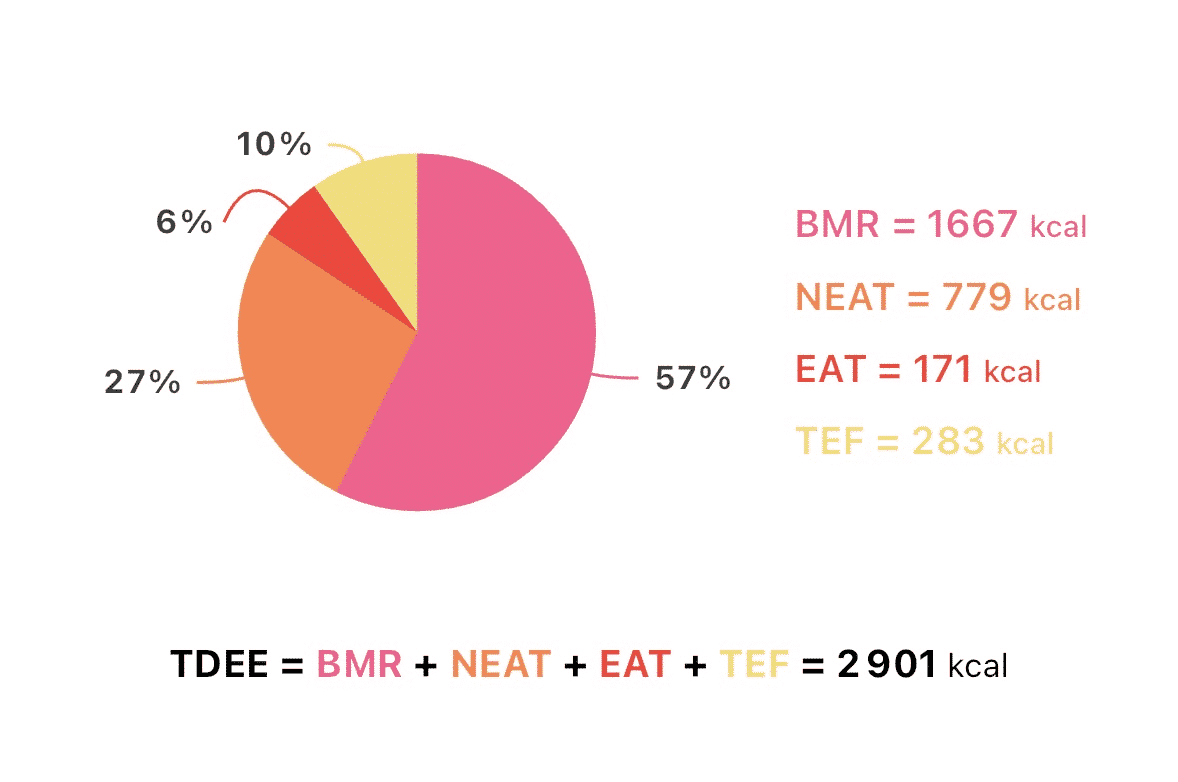
Typical TDEE breakdown: BMR represents 57 % of total expenditure.
03 · BMR enginesWhich organs burn what at rest?
Your basal metabolic rate is not an abstract average. It corresponds to the sum of each organ's energy needs. Here is the distribution measured in the physiological literature:
What this table tells you immediately: muscles account for 30 % of BMR, against only 3 % for fat. Gaining muscle mass directly increases your basal metabolic rate. Losing muscle in a poorly managed cut makes it drop. This is the most underestimated mechanism in long-term weight management.
Key consequence: a higher BMR indirectly boosts your NEAT and EAT. Concrete example: a strongman at 1 800 kcal BMR burns about 0.08 kcal per step, versus 0.02 kcal for a 50 kg woman. The same activity produces a very different metabolic result depending on starting lean mass.
04 · HistoireFour BMR formulas, 105 years of evolution
Four equations have dominated the scientific literature on BMR calculation for a century. Each reflects an era, a sample, an intention. Here is what they actually say and their limitations.
Harris-Benedict
The great ancestor. Estimates BMR from weight, height, age and sex. Still used by default on many online calculators and some consumer apps.
+ Cited everywhere, comparable from one calculator to another.
− Calibrated on a century-old population. Overestimates BMR by 5 to 10 % on modern profiles.
Mifflin-St Jeor
Recalibrated on a US population in the late 1980s. Considered the "modern reference without body fat" by clinical dietitians. Accurate to within ±10 % on the average profile.
+ More accurate than Harris-Benedict on 70 % of profiles.
− No body fat input. Margin of error 200 to 400 kcal on muscular or sedentary profiles.
Lean-mass equations
Family of equations that rely on lean body mass (FFM) instead of total weight. Typical public form: 370 + 21.6 × FFM (kg). More scientifically accurate, but requires knowing your body fat.
+ Improved accuracy on all profiles, including muscular and sedentary.
− Requires precise body fat measurement (bioimpedance, DEXA or AI BodyScan). Historically poorly accessible.
Lean patented proprietary model
Relies on real lean body mass measured by AI BodyScan, integrates a metabolic adaptation function in deficit, applies a fine age correction, recalibrates week after week via weigh-in and BodyScan. Not a paper formula: a model that learns from your data.
+ Accuracy ±3 % on muscular, sedentary, menopausal, postpartum profiles. Continuous recalibration.
− Requires an initial AI BodyScan (5 seconds, free in Lean) and regular weight data.
05 · The leverWhy body fat changes everything about BMR
Two men of 80 kg don’t have the same BMR. Muscle burns 3 times more than fat at rest.
Lean body mass (organs + muscles + bones + water) is the metabolic engine. Fat mass, on the other hand, is almost inert energetically. Concretely: 1 kg of muscle burns about 13 kcal/day at rest, 1 kg of fat about 4 kcal/day (Heymsfield, Müller, Hall). The ratio is 3 to 1.
Take two men of 80 kg at 180 cm. The first is at 12 % body fat (athletic, lean mass 70.4 kg). The second at 28 % (sedentary, lean mass 57.6 kg). On BMR calculated via a lean-mass equation, the gap is on the order of 275 kcal/day. Yet Mifflin-St Jeor assigns them the same number: 1 780 kcal. This is the structural error that goes unnoticed for months of failed cuts.
Worse: in prolonged deficit, your BMR drops not only because you weigh less (Hall 2008, Müller 2015). It also drops because your body activates metabolic adaptation : 5 to 25 % less depending on the deficit and its duration. Without body fat AND without modeled adaptation, you’re flying blind.
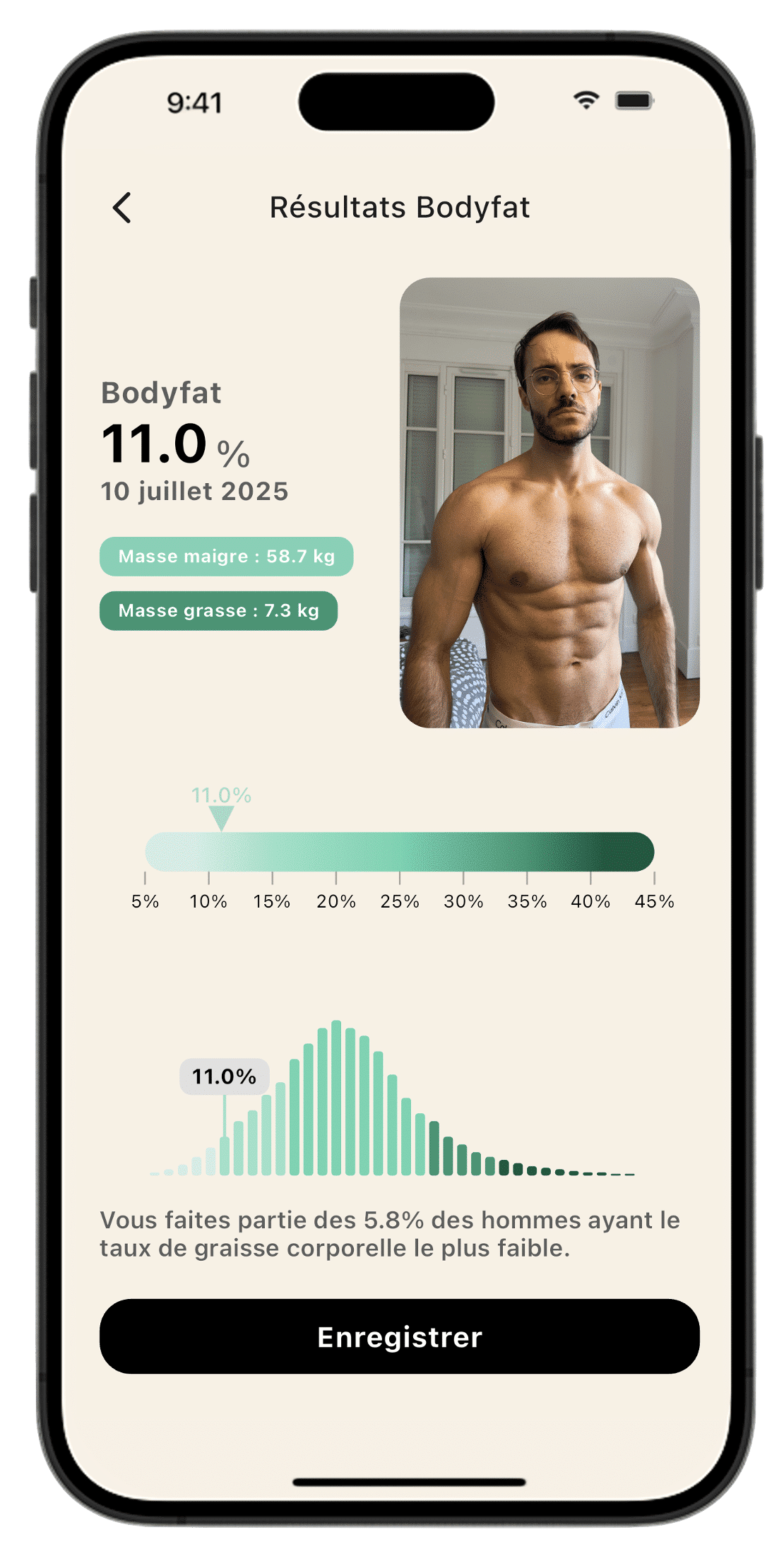
AI BodyScan: bodyfat result 11 %, accuracy within 2 %. Photo, 5 seconds.
The scientific approach to compute a more accurate BMR when you have body fat relies on lean body mass (FFM, Fat-Free Mass). The public form of this equation, cited since the 1980s in physiological literature, gives about 370 + 21.6 × lean body mass (kg). The Lean patented proprietary model goes further: it integrates a metabolic-adaptation function, body water, glycogen, and recalibrates via the AI BodyScan at every weigh-in.
06 · Three profiles, three truthsThe Mifflin vs Lean gap grows with your body composition
Three men with different body types, calculations compared. The numbers come from the three formulas on 80 kg / 180 cm / 32 years, adjusting only bodyfat. You immediately see where Harris-Benedict and Mifflin-St Jeor go wrong.
Athletic profile
Average profile
Sedentary profile
07 · Le moteur LeanHow Lean calculates your BMR (patented proprietary model)
Lean uses a patented proprietary model to calculate your BMR. The main input is not your weight: it is your real lean body mass, derived from your body fat measured by AI BodyScan. Fat mass is ignored in the metabolic engine calculation, because it’s metabolically inert.
Four pillars of the Lean model:
- AI BodyScan : photo, 5 seconds, DEXA-grade accuracy on 10 000+ users. Lean derives your real lean body mass from it.
- Patented proprietary model: applies a function on your real lean mass integrating fine age correction, body water and glycogen. Not a paper formula: a model that learns from your data.
- Modeled metabolic adaptation : convention 100 % = optimal, 90 % = 10 % adaptation. The coefficient modulates BMR in prolonged deficit (never added in the TDEE sum).
- Continuous recalibration: at each weigh-in, at each BodyScan, BMR is recalculated. You don't compute it once and for all: it lives with you.
Lean also uses the 7-day rolling weight average (not today’s weight) to smooth out water and glycogen fluctuations. This prevents a salt-heavy meal the night before from artificially spiking or dropping your BMR.
That is why Lean refuses to give you a calorie goal until your AI BodyScan is done. Not by whim. By consistency: without body fat, BMR is a statistical average. With it, it is your BMR.
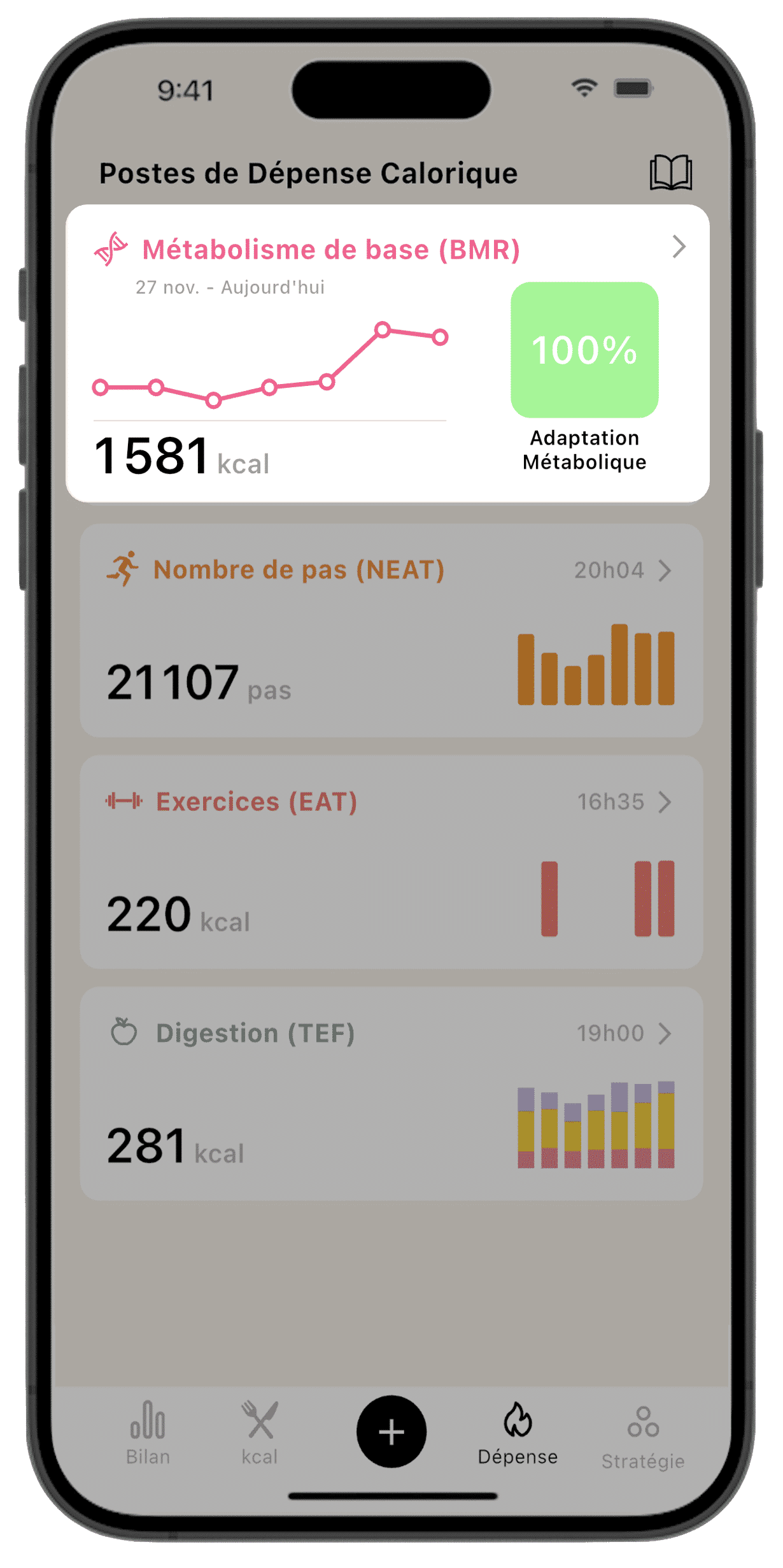
Lean BMR: calculated on your real lean mass, recalibrated at each weigh-in.
08 · BodyScan IAMeasure bodyfat in 5 seconds for an accurate BMR
Without real body fat, even the best lean mass equation is useless. Lean solves this problem with AI BodyScan: one front-facing photo, 5 seconds of processing, accuracy within 2 body fat points. No external device, no impedance scale, no DEXA session.
BodyScan male
Optimal conditions for an accurate BodyScan:
- Natural or diffuse light, no shadow cast on the body
- Normal breathing, do not suck in the belly, no abdominal contraction
- Same conditions for each scan (same time, same light, same camera distance)
- Not right after a workout (muscle pump skews the measurement)
- Camera distance: approximately 2 metres, whole body in frame
09 · Metabolic adaptationThe 5th component that modulates everything
Metabolic adaptation is not in the TDEE sum. It is a BMR multiplier coefficient triggered in prolonged caloric deficit. Lean convention:
- 100 % : no adaptation, optimal BMR
- 90 to 98 % : mild to moderate adaptation, BMR down 2 to 10 %
- Below 90 %: return to maintenance recommended (diet break or maintenance week)
This phenomenon, measured by Hall (2008) and Müller (2015), explains fat loss plateaus. Your body does not “resist” weight loss by magic: it simply lowers its BMR to compensate for the deficit. Without modelling this coefficient, your calculated TDEE becomes increasingly optimistic over time.
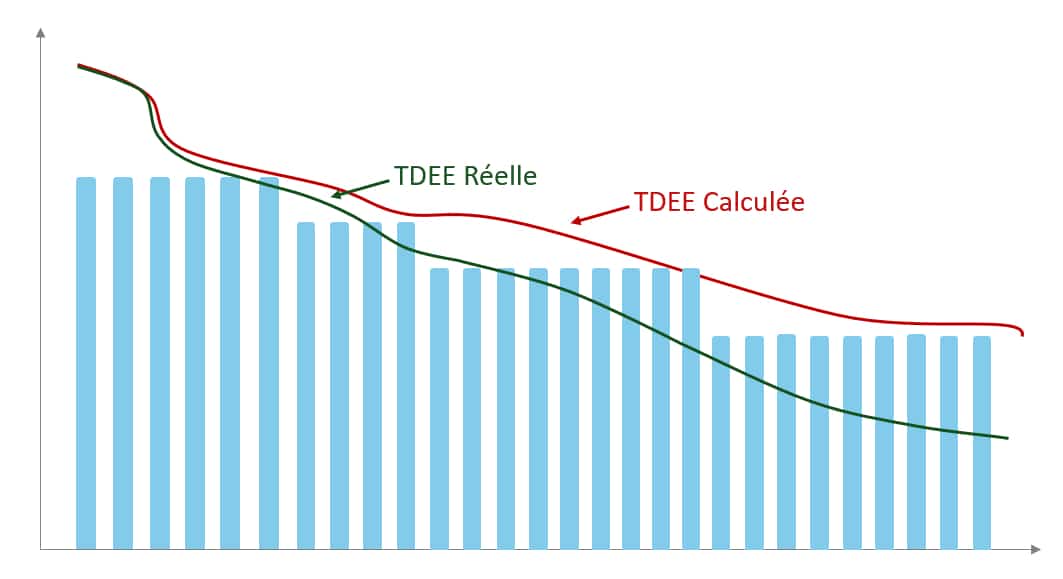
Real TDEE (measured) vs TDEE calculated without adaptation. The gap widens after 4 to 6 weeks of deficit.
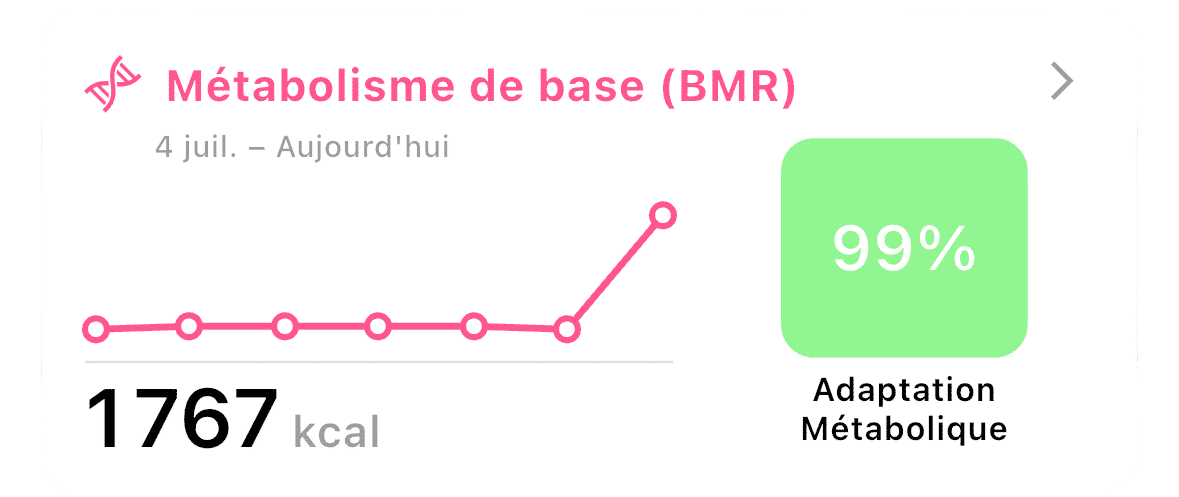
Weekly BMR tracking with metabolic adaptation coefficient in Lean.
10 · Suivi BMR dans LeanTrend analysis, 7-day weight, continuous bodyfat
Lean does not calculate your BMR once and for all. It updates it at every weigh-in and every BodyScan, with three dedicated screens:
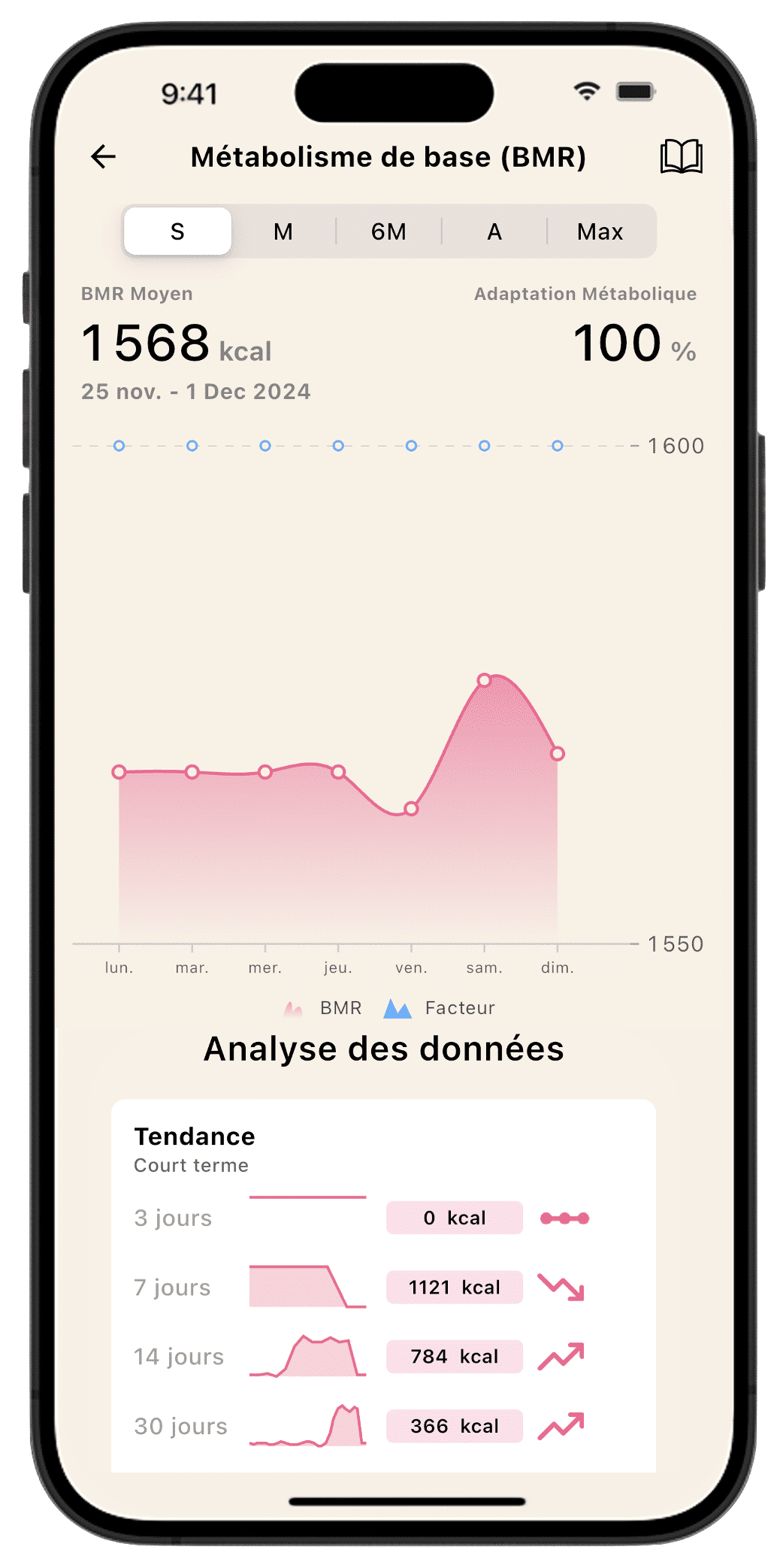
BMR trend: weekly chart, you see the adaptation forming in real time.
Daily weigh-ins in Lean use the 7-day rolling average to smooth out natural water and glycogen fluctuations. A variance of 1 to 2 kg from one day to the next is normal and does not reflect real body composition. It is this average that feeds the BMR recalculation, not the raw morning weight.
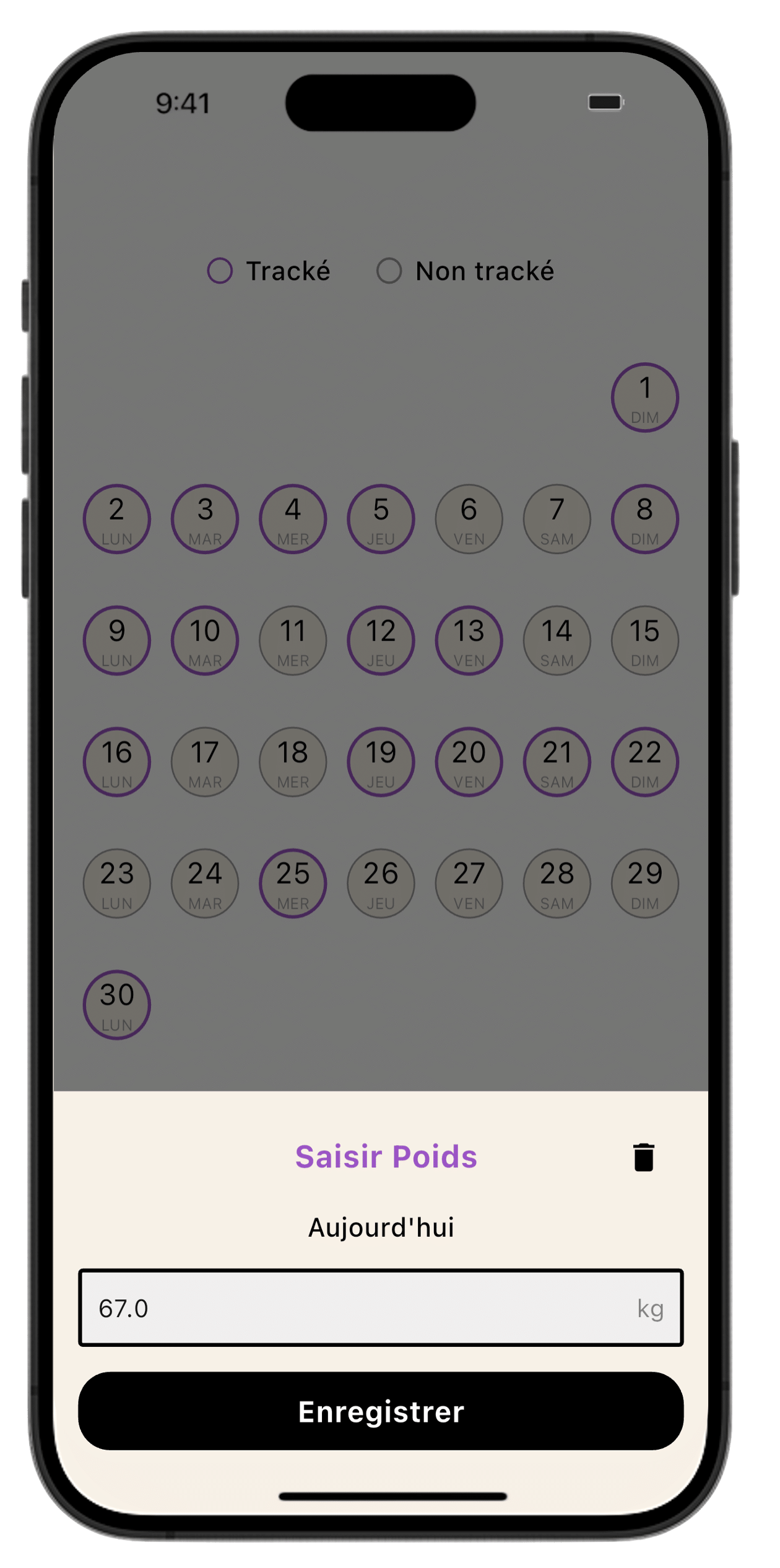
Moyenne 7 jours automatique
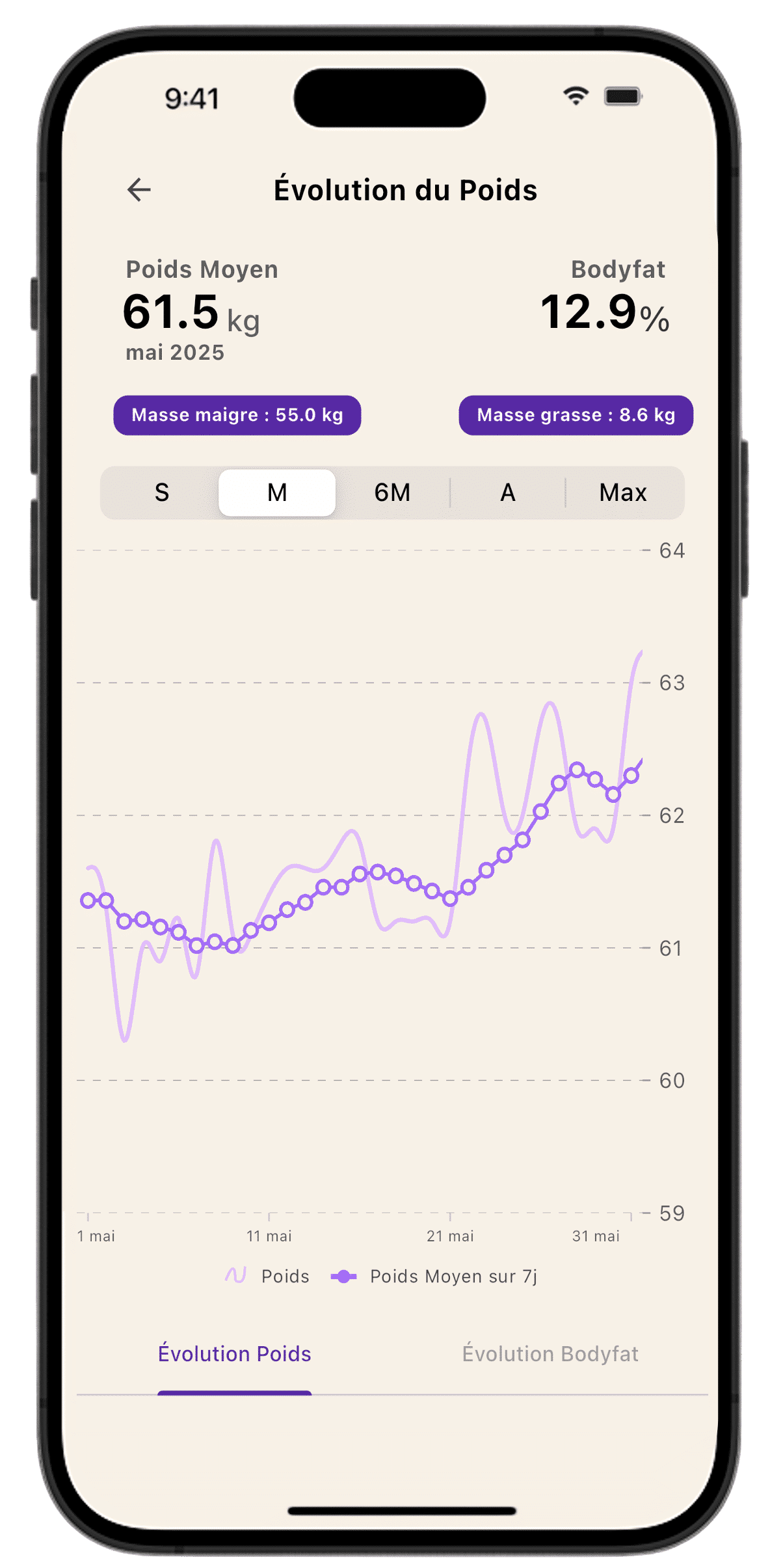
Poids + bodyfat : gras ou muscle ?
11 · TDEE completTotal calorie expenditure from your BMR
Once your BMR is precise, the three other TDEE components stack on top:
- NEAT (Non-Exercise Activity Thermogenesis): your steps and non-exercise activities. Lean measures it via the built-in pedometer.
- EAT (Exercise Activity Thermogenesis): your tracked sport sessions. Lean lets you record the intensity and type of session for accurate tracking.
- TEF (Thermic Effect of Food): energy spent on digestion. Calculated automatically based on logged macros.
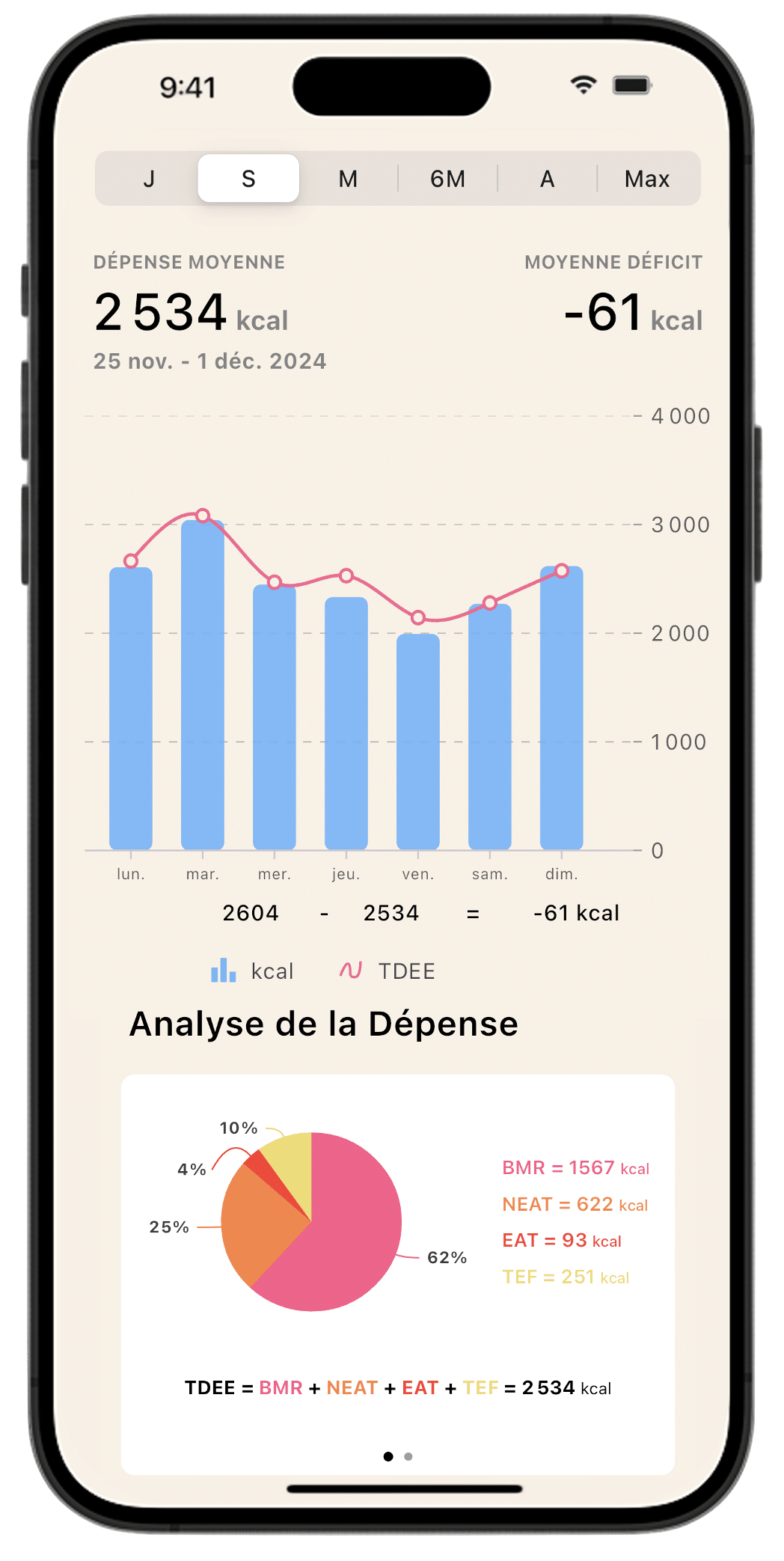
TDEE = BMR + NEAT + EAT + TEF in real time

Gym session: intensity → precise EAT
12 · StrategiesBMR and action plan according to your goal
Once your accurate BMR is known, practical application is direct. Three cases, three calculation levers.
Cut (fat loss)
Bulk (muscle gain)
Maintenance / recomp
13 · TutorialsHow to use Lean for your BMR
Two videos to get started concretely:
Full tutorial: counting calories with Lean, A to Z.
How to double your caloric expenditure by optimizing each TDEE component.
14 · La pyramideBMR at the base of the Lean Progression Pyramid
In the Lean philosophy, BMR isn’t the top of the game plan, it’s the base. The Progression Pyramid prioritises what really matters for a successful cut: adherence > calorie goal > steps. And behind the calorie goal is your TDEE, thus your BMR.
As long as your BMR is wrong, the whole plan is wrong. That’s why Lean refuses to give a target without AI BodyScan. That’s also why recomputing your BMR at every weigh-in (so continuously) is the only way to avoid the plateau.
15 · FAQEverything you wonder about basal metabolic rate
What is basal metabolic rate?
Basal metabolic rate, or BMR (Basal Metabolic Rate), is the minimum energy your body burns at rest to keep its vital functions running (heart, brain, kidneys, liver, breathing, body temperature maintenance). It is measured fasted, lying down, in thermal neutrality. It represents 60 to 75 % of your total expenditure (TDEE) for most adults.
How is BMR calculated exactly?
There are four families of equations. Harris-Benedict 1919 and Mifflin-St Jeor 1990 compute from weight, height, age and sex (fast but inaccurate on muscular or sedentary profiles). Lean-mass equations (public form 370 + 21.6 × FFM) compute from real lean body mass (more accurate but require body fat). The Lean patented proprietary model relies on real lean body mass measured by AI BodyScan, integrates metabolic adaptation, and recalibrates week after week.
Which is the most accurate formula for BMR?
The most accurate formula is based on real lean mass. Without body fat, Mifflin-St Jeor 1990 remains the best public approximation (±10% on 70% of profiles). With body fat, a lean-mass equation such as 370 + 21.6 × FFM is more accurate. The patented proprietary Lean model refines further by integrating metabolic adaptation and continuous recalibration.
What theoretical model does Lean use for BMR?
Lean uses a proprietary model developed by the Lean R&D team, patented in 2024. It relies neither on Harris-Benedict 1919 nor on Mifflin-St Jeor 1990: it calculates from the real lean mass measured by AI BodyScan, with a fine age correction, a modelling of body water and glycogen, and a metabolic adaptation coefficient. The model recalibrates continuously at every weigh-in and every BodyScan.
Why does my BMR drop when I lose weight?
For two reasons. First, a physical reason: you weigh less, so you have less lean mass to maintain, so mechanical BMR drops. Second, a physiological reason: your body activates metabolic adaptation in prolonged caloric deficit, which slows your BMR by 5 to 25 % below the expected value (Hall 2008, Müller 2015). Without modelling adaptation, you underestimate the real BMR drop over a long cut.
What are the optimal conditions for a BodyScan?
For an accurate measurement: natural or diffuse light without shadow on the body; normal breathing, no abdominal contraction; same conditions at each scan (same time, same light, same camera distance of about 2 metres); avoid scanning right after a gym session (the pump temporarily swells muscles and skews the measurement). Consistency of conditions matters as much as the quality of a single scan.
Is BMR different between men and women?
Yes. At equivalent weight, height and age, women have on average 8 to 12 % less lean body mass than men (hormonal and morphological difference). Their BMR is therefore structurally lower, on the order of 150 to 250 kcal/day. The two classic formulas integrate a different sex constant. On Lean, it’s the measured lean mass that speaks, regardless of sex.
How often should one recompute BMR?
Lean recommendation: one BodyScan per week and minimum two weigh-ins per week. This is the pace that gives the algorithm sufficient data to recalibrate your BMR continuously without statistical noise. Lean recalculates automatically at each weigh-in and each BodyScan, using the 7-day rolling average to smooth out water and glycogen fluctuations. If your body composition has been stable for 4 to 6 weeks, your BMR stays stable too.
BMR vs resting metabolic rate (REE): what’s the difference?
BMR (Basal Metabolic Rate) is measured fasted, lying down, in thermal neutrality. REE (Resting Energy Expenditure) is measured at rest but in slightly less strict conditions. In practice, REE ≈ BMR + 3 to 10 %. Consumer apps and online calculators often mix the two terms. Lean uses BMR.
Can BMR be increased naturally?
Yes. The only serious lever is increasing lean mass (strength training + sufficient protein intake). Each kilo of muscle gained adds about 13 kcal/day to your BMR. Caffeine, cold baths, "metabolism-boost" diets: transient effects of a few dozen kcal over a few hours, negligible compared to 1 kg of muscle that pays 365 days a year.
At what age does BMR start to drop?
The idea of a linear decline from age 25 is a myth. The Pontzer study (Science 2021, 6 500 subjects) showed that BMR adjusted for lean mass remains stable from 20 to 60, then begins to decline by about 0.7 % per year. What changes with age in practice is lean mass decreasing (sarcopenia) if muscle is not maintained. It is sarcopenia that drives BMR down, not age directly.
Which BMR for which goal (cut, bulk, maintenance)?
BMR doesn’t change according to the goal: it’s a physiological data point of your body. What changes is the target caloric intake. Cut: TDEE − 20 % (so BMR + NEAT + EAT + TEF − 20 %). Bulk: TDEE + 10 to 15 %. Maintenance/recomp: TDEE ± 0. In all cases, the initial error on BMR propagates to the caloric target. That’s why BMR accuracy is non-negotiable.
Scientific sources
- Mifflin MD, St Jeor ST, Hill LA, Scott BJ, Daugherty SA, Koh YO. A new predictive equation for resting energy expenditure in healthy individuals. Am J Clin Nutr. 1990 Feb;51(2):241-7. PubMed 2305711.
- Harris JA, Benedict FG. A Biometric Study of Human Basal Metabolism. Proc Natl Acad Sci USA. 1918 Dec;4(12):370-3.
- Frankenfield DC. Bias and accuracy of resting metabolic rate equations in non-obese and obese adults. Clin Nutr. 2013;32(6):976-82. PubMed 23631843.
- Müller MJ, Bosy-Westphal A. Adaptive thermogenesis with weight loss in humans. Obesity. 2013 Feb;21(2):218-28. PubMed 26399868.
- Hall KD. What is the required energy deficit per unit weight loss? Int J Obes. 2008;32(3):573-6. PubMed 17848938.
- Pontzer H, Yamada Y, Sagayama H, et al. Daily energy expenditure through the human life course. Science. 2021;373(6556):808-812. PubMed 34385400.
- Heymsfield SB, Smith B, Wong M, et al. Multicomponent density model: a parsimonious approach to assessing body composition. Obesity Reviews. 2015. PubMed 33442121.
Compute your BMR on your real body fat
AI BodyScan in 5 seconds. Patented proprietary model. Continuous recalibration. No 1919 or 1990 formula. Free download, 7-day trial on the annual subscription.
 FR
FR