All Lean comparisons. One formula that changes everything against the major calorie apps.
Every traditional tracker (MyFitnessPal, Yazio, Cronometer, Lifesum, FatSecret) calculates your calorie expenditure with a 1919 or 1990 formula, without bodyfat or adaptation. Here is the line-by-line, honest comparison, no marketing spin.
 The Lean Team · 9 min read · Updated May 22, 2026

 Free download
None of the 5 major calorie apps (MyFitnessPal, Yazio, Cronometer, Lifesum, FatSecret) calculates the 5 components of TDEE. They all stop at a weight-height-age BMR formula, plus a static activity coefficient chosen at sign-up. Lean is the only one to calculate BMR on real bodyfat via AI BodyScan, NEAT on measured steps, EAT per sport and MET, TEF per ingested macros, and metabolic adaptation automatically week after week.
First finding
TDEE = BMR + NEAT + EAT + TEF. Plus metabolic adaptation that modulates BMR. No other app calculates the 5.
Why the calorie calculation is broken everywhere
You download a calorie app. You enter your weight, height, age, gender. The app asks you to check an activity box (sedentary / lightly active / active / very active). And it gives you a daily calorie expenditure, your TDEE. This TDEE becomes your reference to slim down, gain muscle, maintain. The problem is that this TDEE is almost always wrong by 300 to 800 kcal. Not out of malice. Out of scientific laziness.
The root cause? All these apps use a formula from 1919 (Harris-Benedict) or its repainted version from 1990 (Mifflin-St Jeor) to estimate your basal metabolic rate. These formulas depend only on weight, height, age and gender. Not on bodyfat. Yet fat mass spends very little energy compared to lean body mass. Two men of 80 kg, one at 10 % bodyfat, the other at 30 %, do not have the same metabolism. But MFP, Yazio, Cronometer, Lifesum, FatSecret give them the same value.
Then the activity coefficient multiplies this wrong BMR by an almost random number. Next comes metabolic adaptation, totally ignored. Last comes TEF (digestion), locked at a flat 10 % instead of being calculated on ingested macros. Four cascading approximations. The final TDEE has nothing to do with your reality.
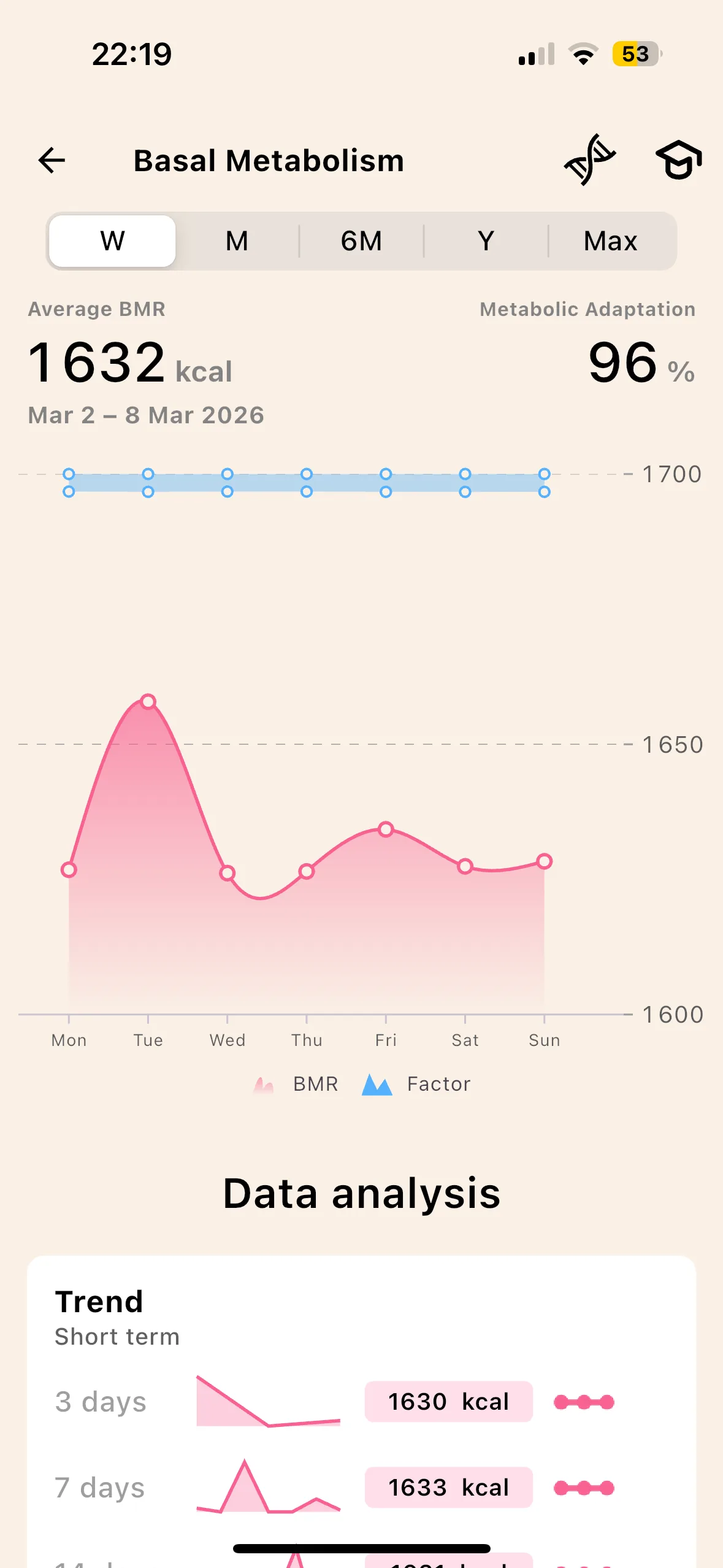
Lean started from scratch with another obsession : calculate each component precisely, not approximate it. The BMR is calculated via a proprietary patented model that depends on lean body mass. The lean body mass, itself calculated from bodyfat. The bodyfat, measured every week via a simple photo (AI BodyScan). NEAT comes from real steps (HealthKit / Google Fit), not from a static box. EAT comes from the MET of each sport, weighted by effective time. TEF is calculated based on your macros. Adaptation is adjusted week after week according to your cumulative deficit.
Lean vs the 5 major apps, criterion by criterion
Six criteria that actually describe the precision of a tracker. None of them is about price.
Lean
 MyFitness
Pal
 Yazio
Yazio
 Cronometer
 Lifesum
 FatSecret
Honest read. Cronometer remains very solid on TEF calculation by macros (heritage of its rigorous micronutrition philosophy) and offers per-session tracking finer than other competitors. But none of the 5 calculates metabolic adaptation, and none bases its BMR on real bodyfat. The AI meal scan remains a general weak point : MFP offers a limited camera mode, FatSecret only offers the barcode.
What Lean does differently
Three method pillars. No magic coefficient, no static box, no flat estimate.
BMR on lean mass, not your weight
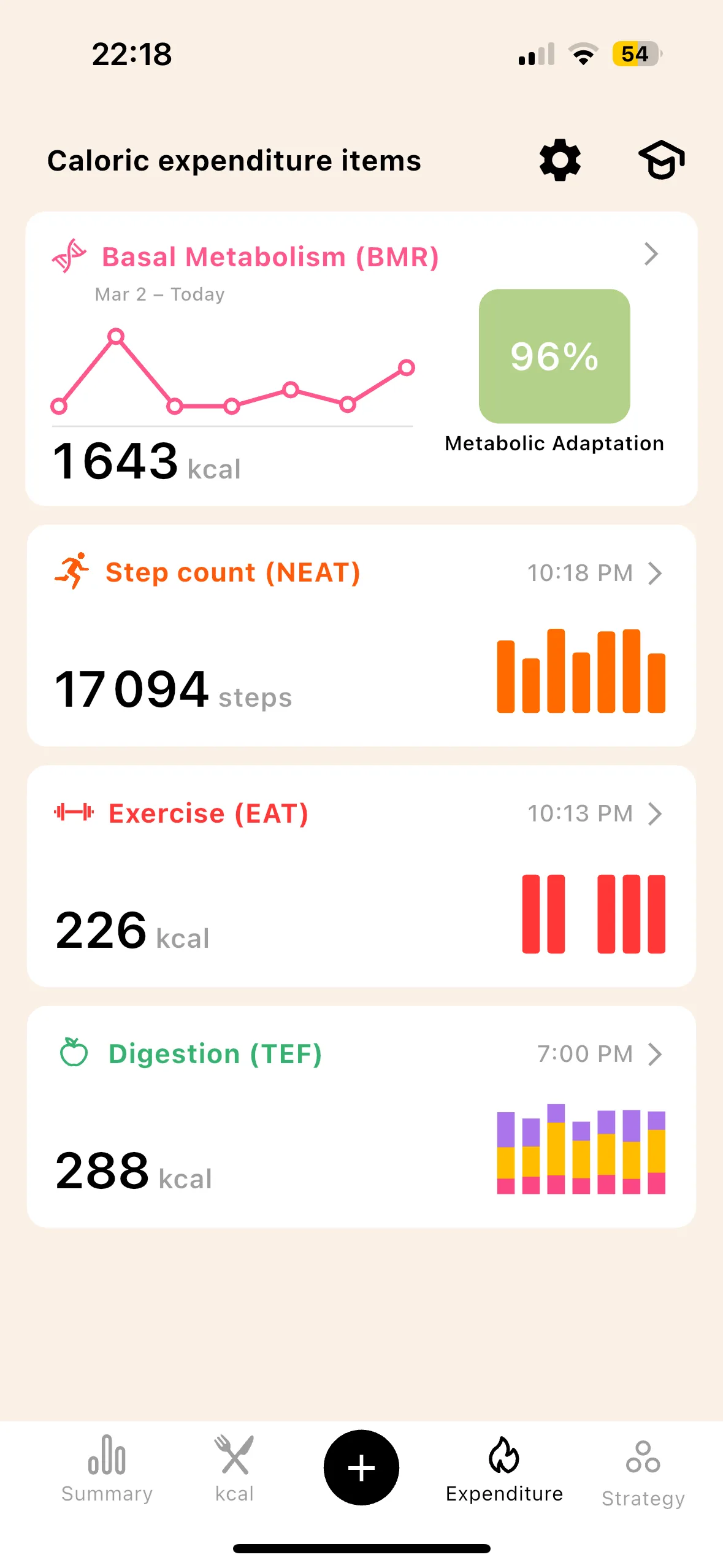
BMR via patented proprietary model, based on real lean mass derived from bodyfat measured weekly via BodyScan AI. One photo, 5 seconds.
BMR is the first building block of TDEE and the first mistake competitors make. Lean rejects Harris-Benedict, rejects Mifflin-St Jeor, and applies a patented proprietary model based on lean mass as the main variable. To measure this lean mass without a 100 € DEXA scan every week, the app uses AI BodyScan : one photo of you in underwear, a model trained on a DEXA reference bank, your bodyfat estimated in seconds. Repeated every week. BMR readjusts automatically.
NEAT, EAT, TEF: measured, not estimated
NEAT, EAT, TEF calculated separately, from measured data. No activity box to tick.
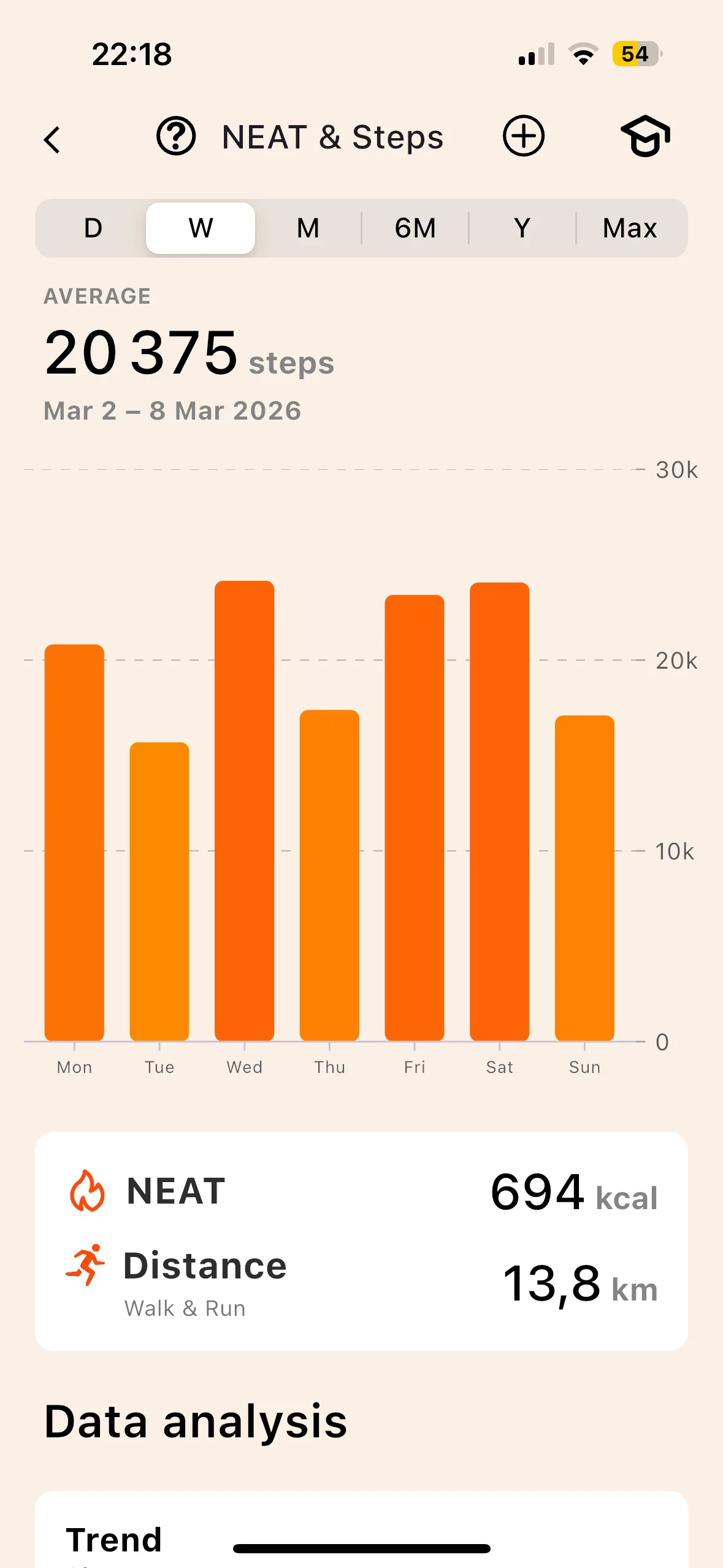
NEAT. Your real steps, pulled from HealthKit (iOS) or Google Fit (Android), cross-referenced with your BMR. No self-reporting, no rough estimate. EAT. For every workout, you pick the sport (lifting, running, tennis, swimming, etc.) and Lean applies its MET (Metabolic Equivalent Task) over effective time (not total time with breaks, the error every smartwatch makes 100 % of the time). TEF. Protein costs 20 to 30 % in digestion, carbs 5 to 10 %, fat 1 to 3 %. Lean computes your TEF from the exact composition of your macros, not a flat 10 %.
Metabolic adaptation: the brick no one calculates
Automatic metabolic adaptation. First consumer app to do it, to our knowledge. Patented proprietary model.
When you are in a prolonged deficit, your body shifts into energy-saving mode. Your BMR drops, your NEAT drops, your TDEE drops. For a deficit of −500 kcal/day, adaptation reaches 10 to 15 % within 4 to 6 weeks. That is the main reason behind plateaus no one can explain. Lean adjusts your TDEE downward week after week based on your cumulative deficit, without asking. When adaptation reaches 10 to 15 %, the app can suggest a return to maintenance to reset your BMR before going back into a deficit.
The 5 alternatives to examine
Each card opens a full 1v1 comparator: honest table, scorecard where the competitor wins when it wins, and a detailed list of the gaps.
Lean vs MyFitnessPal
The historical standard of calorie counting. Massive community database, Mifflin-St Jeor 1990, 4-box activity coefficient.
Where Lean wins : BMR on real bodyfat, automatic metabolic adaptation, unlimited AI meal scan vs a noisy database and a weight-only BMR.
See the comparison →
Lean vs Yazio
Polished ergonomics, meal plans, strong European audience. TEF estimated by food category, without a bodyfat model.
Where Lean wins : AI BodyScan, measured NEAT on steps, EAT per sport MET, metabolic adaptation vs a static activity coefficient.
See the comparison →
Lean vs Cronometer
Reference of micronutrients, rigorous NCCDB food database, endorsed by dietitians. Stays on Mifflin-St Jeor 1990 without bodyfat on TDEE.
Where Lean wins : BMR on real bodyfat via AI BodyScan, automatic metabolic adaptation, NEAT on real steps vs an activity coefficient locked at signup.
See the comparison →
Lean vs Lifesum
Scandinavian lifestyle app, pre-built diets (keto, vegan, paleo), daily nutrition score. Simplistic TDEE calculation.
Where Lean wins : scientific precision replaces lifestyle recipes. BMR on bodyfat, 5 TDEE components calculated separately, auto adaptation.
See the comparison →
Lean vs FatSecret
Free basic app, large community catalog, standard barcode scan. No scientific ambition on TDEE.
Where Lean wins : complete scientific method on the 5 TDEE components vs a purely declarative food journal.
See the comparison →
Lean vs Noom
Behavioral coaching, daily lessons, green/yellow/red food classification, human coaches. TDEE engine on Mifflin-St Jeor 1990, without body fat or adaptation.
Where Lean wins: BMR on real body fat, automatic metabolic adaptation, NEAT on real steps against behavioral coaching sitting on a simplistic TDEE calculation.
See the comparison →
Lean vs Foodvisor
Pioneer of AI photo scanning of a meal, solid French food database, optional nutrition coaching. TDEE engine on Mifflin-St Jeor 1990, with no body fat and no adaptation.
Where Lean wins: AI photo scanning too, but backed by a TDEE recomposed continuously (BMR on real body fat, NEAT on real steps, metabolic adaptation) where Foodvisor stops at the plate.
See the comparison →Frequently asked questions
Why a comparison hub and not just one page?
What does Lean do differently from MyFitnessPal and Yazio ?
Which apps are compared in this hub?
Will other comparators be added?
How does Lean calculate metabolic adaptation without a public formula ?
Does Lean work on Android as well as iPhone ?
Get Lean, Stay Lean
iOS and Android. The BodyScan AI works from a single photo. No skinfold calliper, no bioimpedance scale, no DEXA.
Internal links
- Cross comparisons: MyFitnessPal or Yazio, Foodvisor or Lifesum · 12 head-to-heads between competitors.
- Free online TDEE calculator · same logic as the app, no sign-up.
- Understand TDEE in detail (BMR, NEAT, EAT, TEF, adaptation).
- How to count your calories properly · practical guide.
- NEAT: expenditure from steps and non-exercise activity.
- TEF: digestion burns calories.
- Alternative to MyFitnessPal : 5 apps compared.