Total Daily Energy Expenditure (TDEE). The complete guide to calculating your true caloric expenditure and achieving your cut.
TDEE is the only metric that matters for losing fat accurately. But 99 % of apps calculate it wrong. Here is why, and how Lean gets it right.
 The Lean Team · 13 min read · Updated May 27, 2026

 Free download
TDEE (Total Daily Energy Expenditure) is your total caloric expenditure: TDEE = BMR + NEAT + EAT + TEF. BMR is the foundation (57–75 % of TDEE), calculated on true lean mass. NEAT (steps + activity), EAT (exercise), TEF (digestion) are added. Metabolic adaptation modulates BMR during prolonged deficit (multiplier coefficient, never added to the sum). Lean is the first app to calculate all 5 components with precision. Want your number directly? Use the TDEE calculator.
02 · DefinitionTDEE, the sum of 4 components
The TDEE (Total Daily Energy Expenditure), or total energy expenditure, is the energy your body burns in a complete day. Not just at rest: everything from waking up to falling asleep, from your training session to the morning market. TDEE is the only metric that allows you to calculate a real caloric deficit and therefore manage your body composition goal.
It breaks down into four building blocks that add up:
TDEE = BMR + NEAT + EAT + TEF
Themetabolic adaptation acts additionally as a BMR multiplier coefficient during prolonged caloric deficit. Lean convention: 100 % = optimal, 90 % = 10 % adaptation (BMR reduced by 10 %). It does not enter not the TDEE sum: it modulates BMR before it enters the sum.
This calculation seems simple. In practice, 99 % of apps get it wrong on at least two components. Here is where and why.
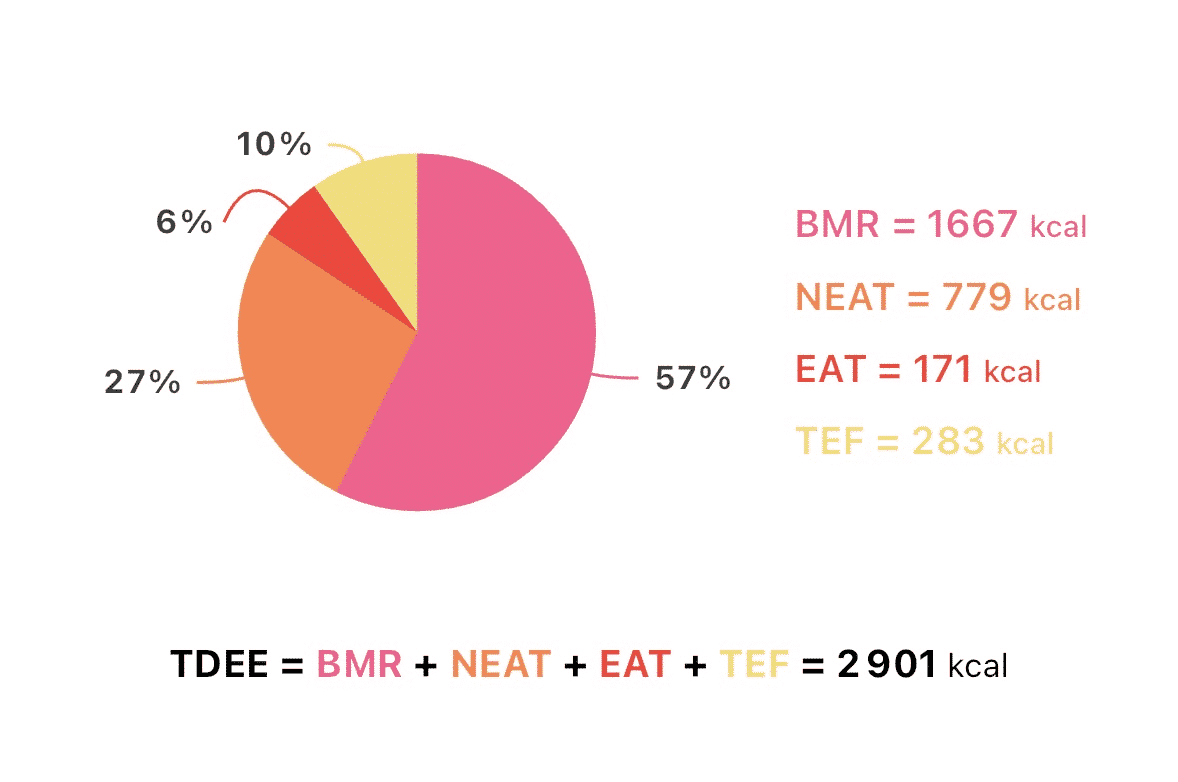
Typical TDEE breakdown: BMR represents 57 % of total expenditure.
03 · Why apps failMifflin-St Jeor without bodyfat, estimated NEAT, averaged EAT
Most nutrition apps calculate TDEE via an activity multiplier applied to BMR (sedentary ×1.2, moderately active ×1.55, etc.). This is a rough approximation that accumulates three structural errors:
- BMR Error : Harris-Benedict 1919 and Mifflin-St Jeor 1990 ignore bodyfat. At 80 kg, an athlete at 12 % body fat and a sedentary person at 28 % receive the same number (1 780 kcal with Mifflin). The real difference is 275 kcal.
- NEAT Error: the activity multiplier makes no difference between a desk worker at 2,000 steps/day and a gym teacher at 18,000 steps. NEAT can vary by 300 to 2,000 kcal depending on lifestyle.
- EAT Error : connected watches overestimate calories burned by up to 2× depending on activity type (Lee 2020). An app that uses these values without correction incorporates the bias.
Result: a caloric target of « 500 kcal deficit » can in reality be a 200 kcal deficit or a 100 kcal surplus. Impossible to know without measuring the 4 components separately.
04 · BMRThe foundation: true lean mass via AI BodyScan
The BMR (Basal Metabolic Rate), or basal metabolic rate, is the energy your body burns at rest. It represents 57 to 75 % of TDEE depending on activity level. It is the heaviest component, therefore the most critical to calculate accurately.
The problem with classic formulas is simple: they calculate BMR from weight, height, age and sex, without considering bodyfat. Yet muscle burns 3× more than fat at rest (approximately 13 kcal/kg vs 4 kcal/kg). Two men at 80 kg with bodyfats of 12 % and 28 % have a BMR difference of approximately 275 kcal/day, or more than 10 000 kcal over 90 days of cutting.
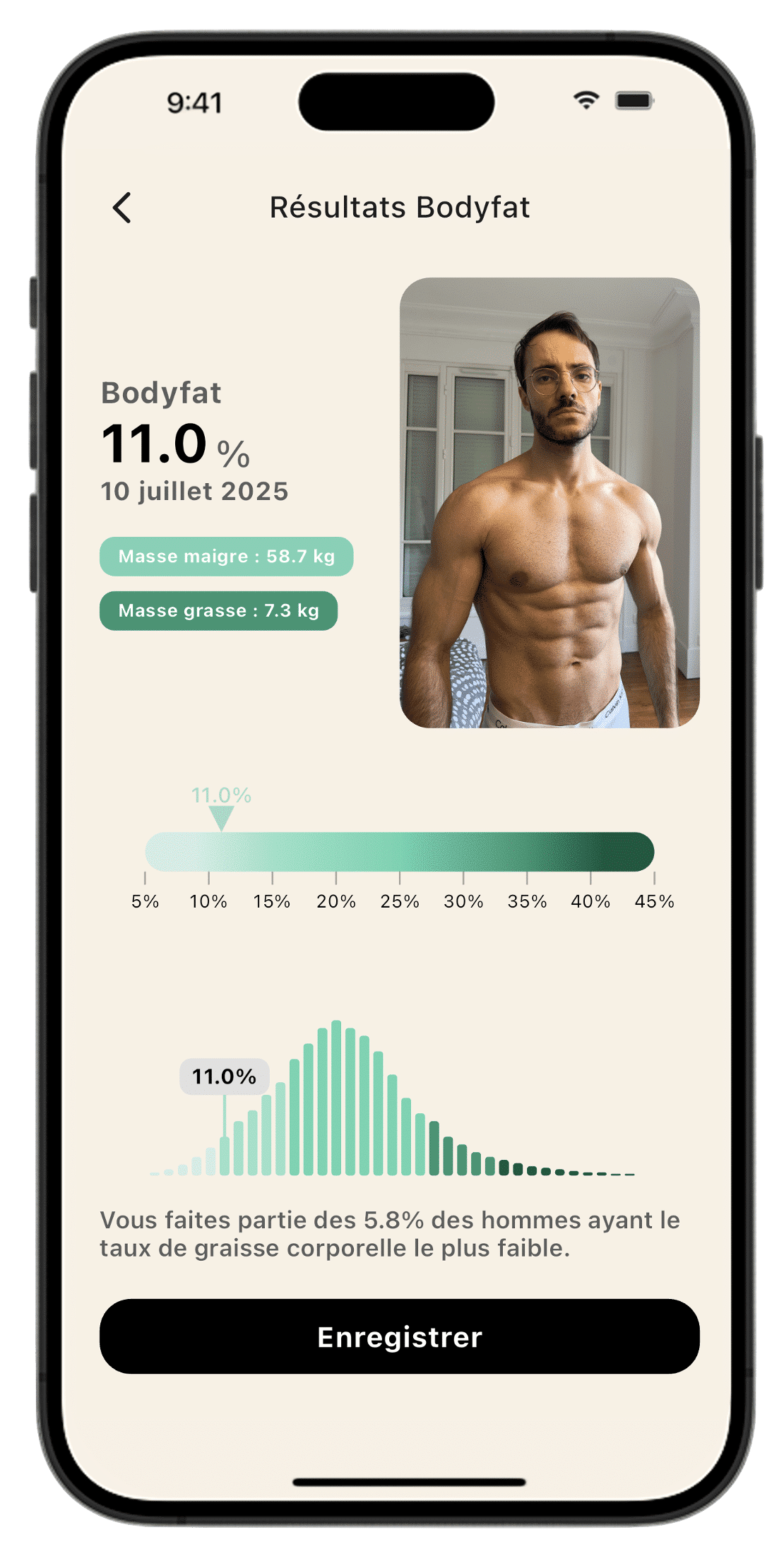
AI BodyScan : bodyfat 11 %, 2-point precision. Photo, 5 seconds.
Lean solves this problem via AI BodyScan : a front-facing photo in 5 seconds gives bodyfat to ±2 %. Lean derives lean mass from it, then applies its proprietary patented model to calculate BMR on this true lean mass. Not Harris-Benedict 1919, not Mifflin-St Jeor 1990: a model that learns from your data, recalibrated with each weigh-in and each BodyScan.
05 · NEATSteps + daily activity outside of exercise
The NEAT (Non-Exercise Activity Thermogenesis) is the energy expenditure linked to everything you do outside of exercise: walking, climbing stairs, fidgeting, cooking, doing chores. It is the most variable component of TDEE: it can represent 300 to 2 000 kcal/day depending on lifestyle (Levine 2004).
On average, NEAT represents 27 % of TDEE in active adults. It is the most powerful lever to increase expenditure without additional muscular effort: 5 000 more steps per day = approximately 200 kcal more burned without touching your workout program.
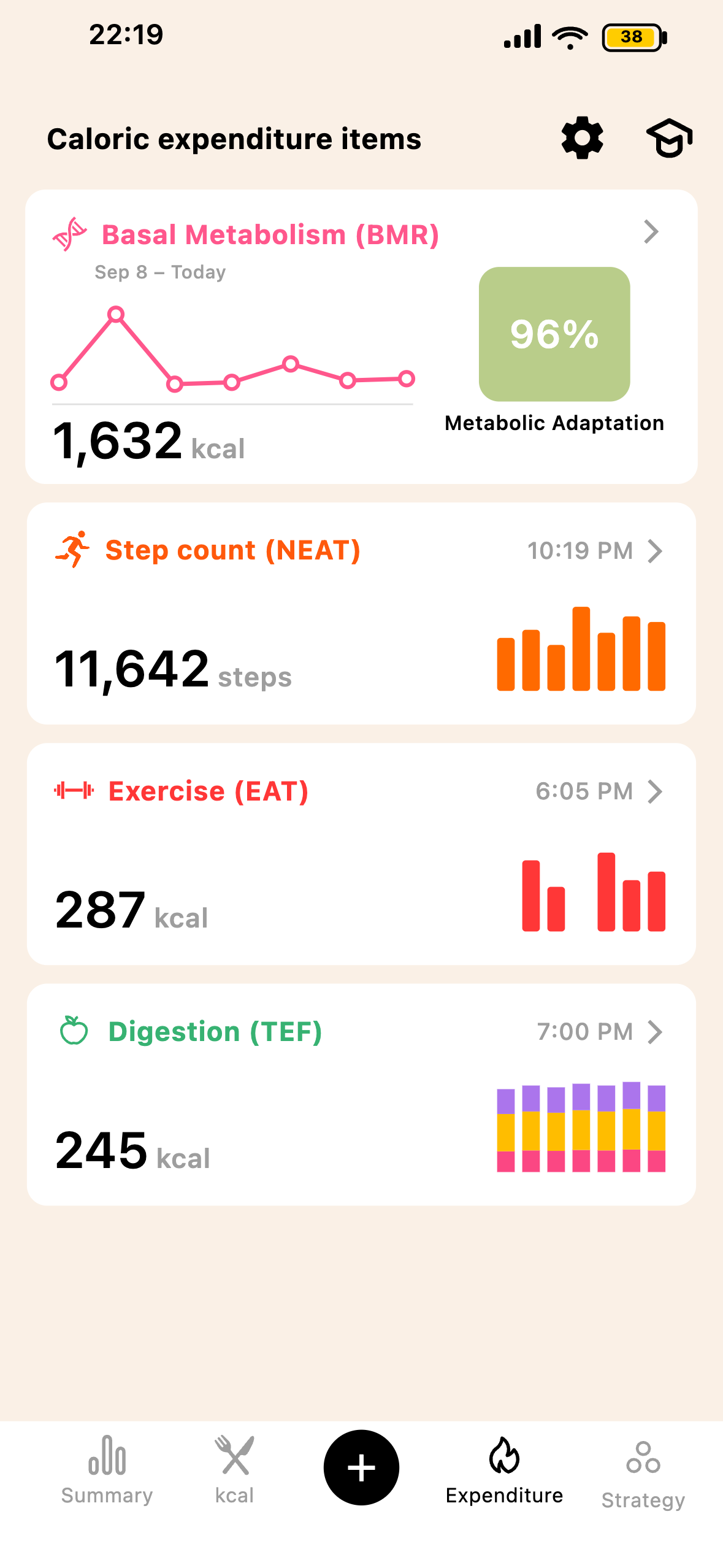
Lean measures NEAT via the built-in pedometer : every step counts, converted to kilocalories based on your body mass and estimated speed. Not a global activity multiplier: a daily measurement that adds to your TDEE in real time.
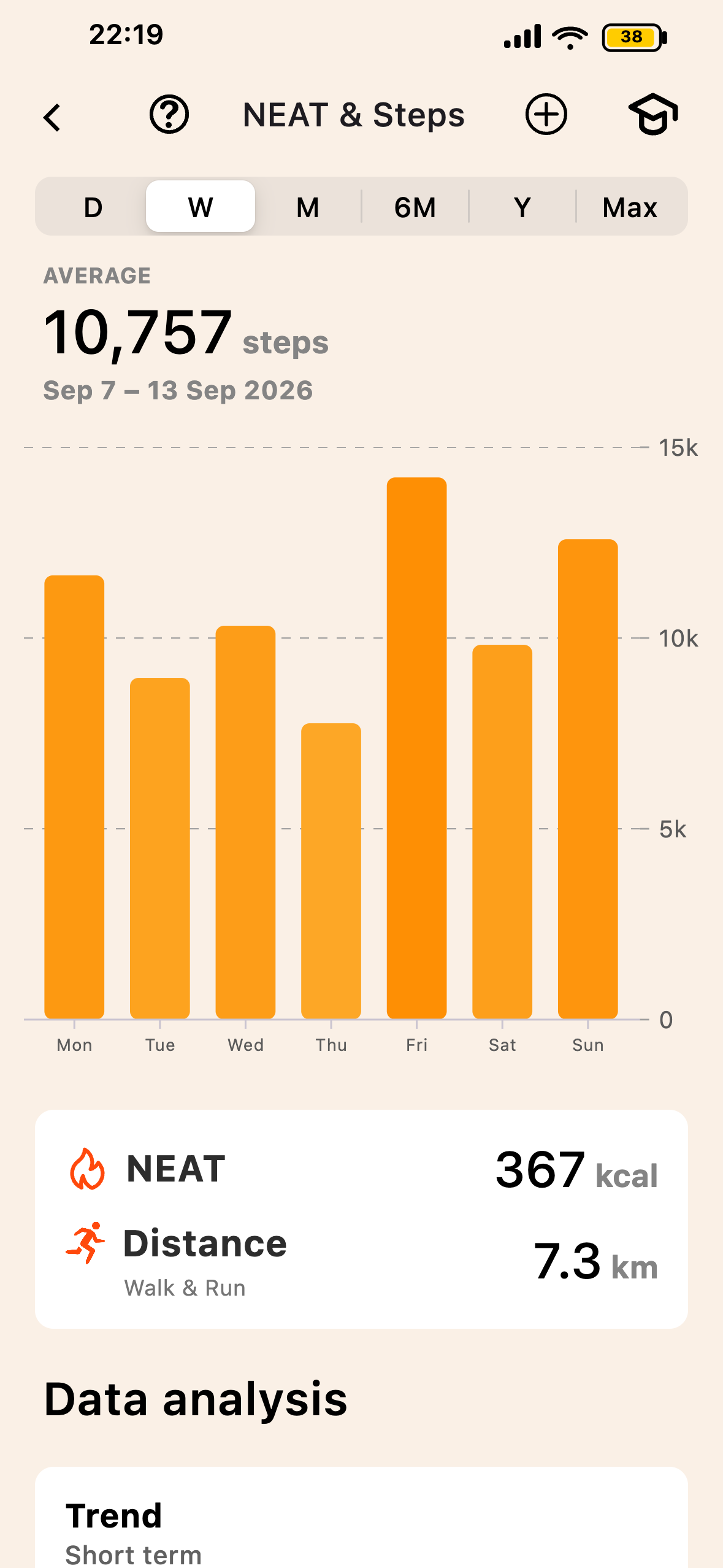
NEAT in Lean : daily steps measured, converted to kcal to the nearest step.
06 · EATTraining sessions, MET calculation
TheEAT (Exercise Activity Thermogenesis) is the caloric expenditure from exercise sessions. It represents on average 6 % of TDEE, but can reach 15–20 % in athletes training 5 times per week.
The classic problem: connected watches overestimate EAT by up to a factor of 2 depending on activity type (Lee 2020, 7 devices measured). An app that uses calories shown by Apple Watch during weight training can overestimate your EAT by 300 kcal per session, creating a hidden 300 kcal surplus you do not see.
Lean calculates EAT from the MET (Metabolic Equivalent Task) : a coefficient per sport type, multiplied by your body mass and session duration. You log the type and intensity of your session, Lean calculates the real expenditure without relying on biased watch data.
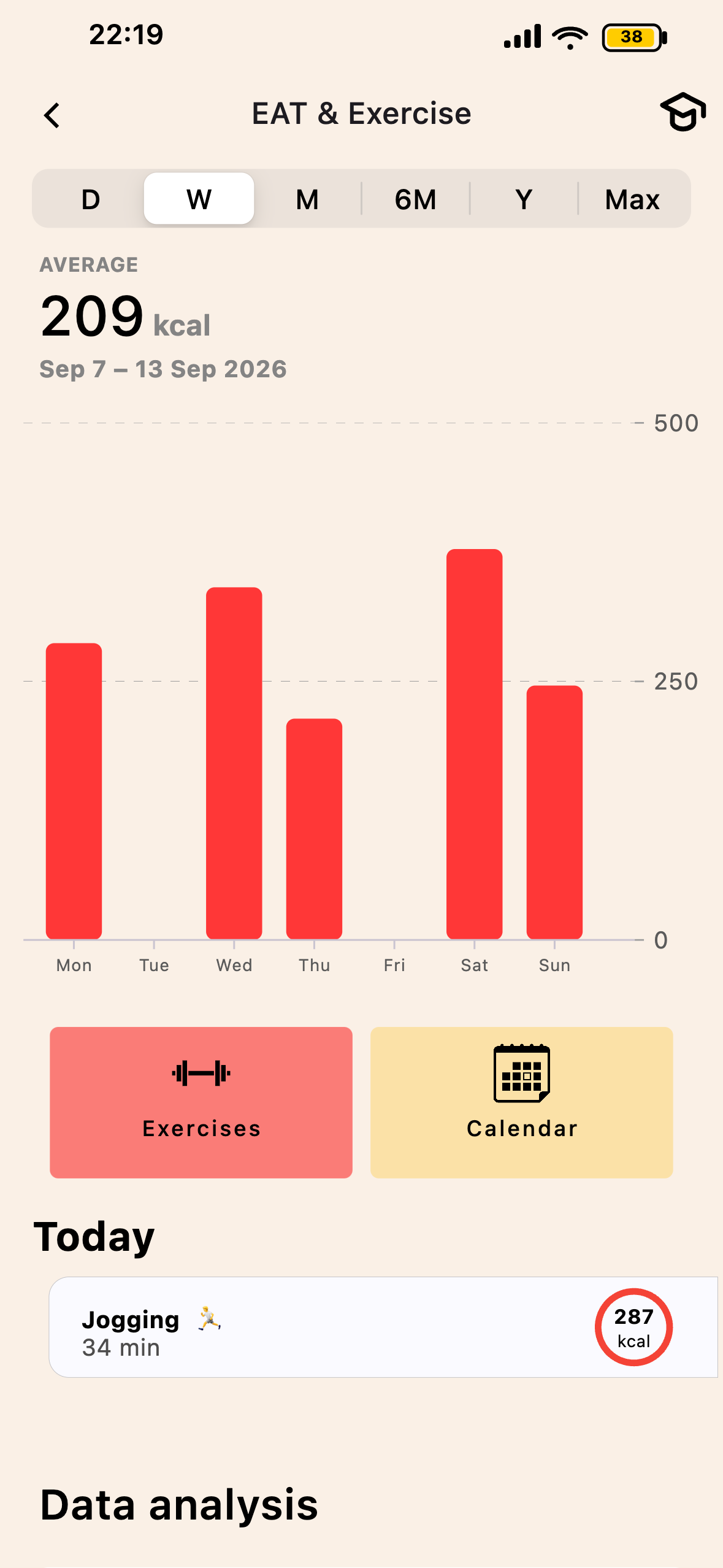
EAT in Lean : sport type + intensity → real expenditure in kcal.
07 · TEFThermic effect of food, calculated on macros
The TEF (Thermic Effect of Food) is the energy spent on digestion, absorption and metabolization of food. It represents on average 10 % of calories consumed, but varies significantly depending on macronutrient composition:
A protein-rich meal burns more during digestion than an identical meal in kcal but rich in fat. Lean calculates TEF automatically on the logged macros (proteins × 0.25 + carbs × 0.075 + fats × 0.02), and adds it to the live TDEE. Not a global 10 % approximation: a calculation per meal.
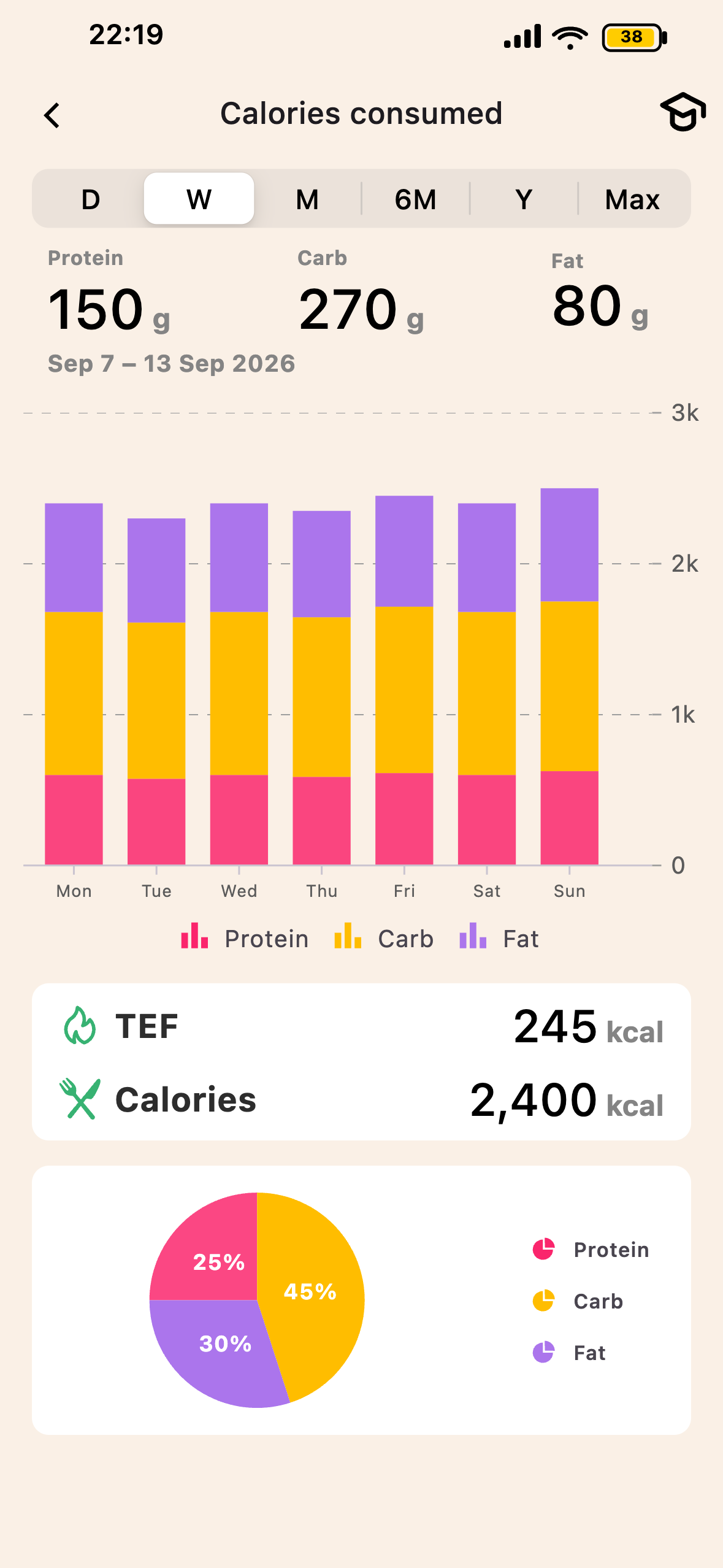
TEF in Lean : calculated on the macros of each meal, not a fixed average.
08 · Metabolic adaptationThe 5th component that skews everything without modeling
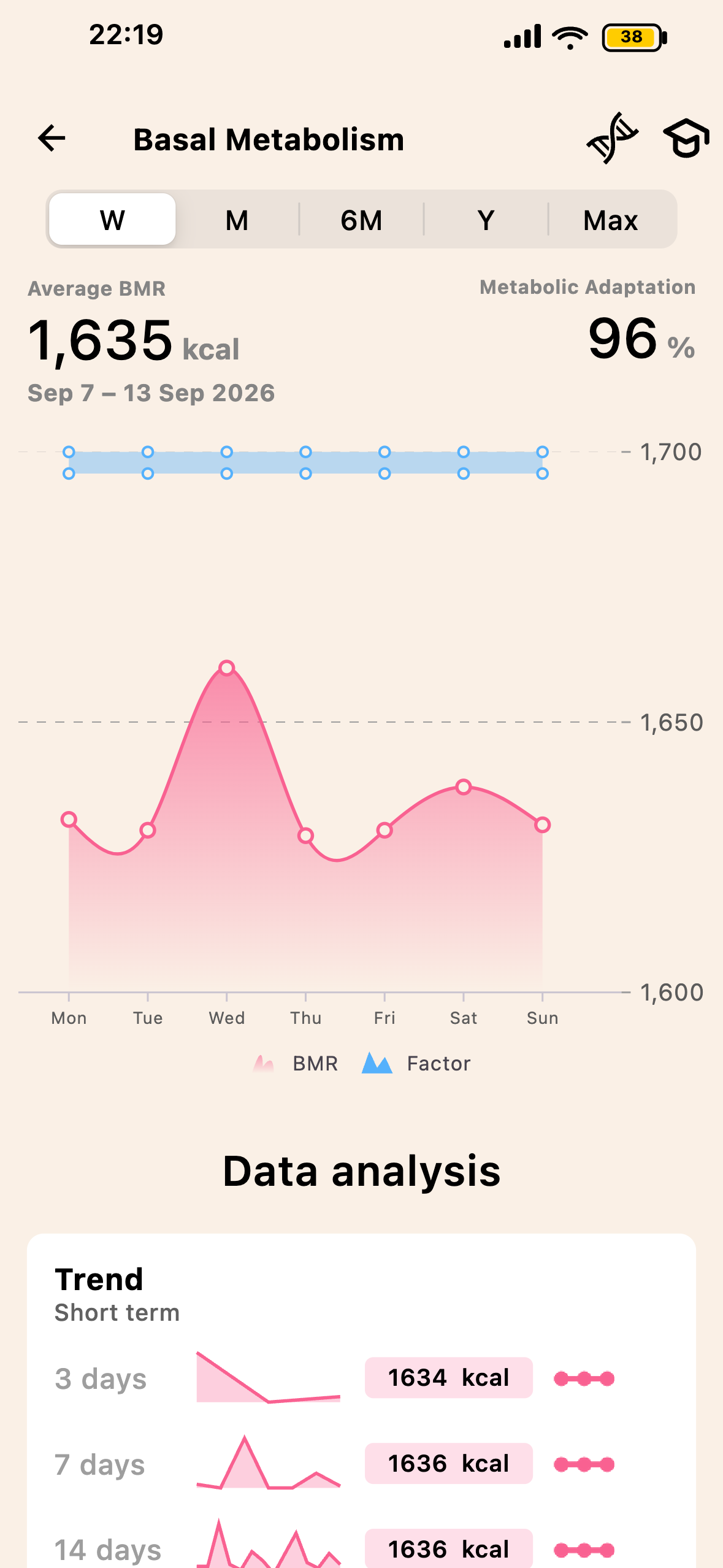
Metabolic adaptation does not enter the TDEE sum. It is a BMR multiplier coefficient that triggers during prolonged caloric deficit. Your body reduces its BMR to compensate for the deficit. This phenomenon, documented by Hall (2008) and Müller (2015), explains cutting plateaus.
Lean convention:
- 100 % : no adaptation, optimal BMR
- 90 to 98 % : mild to moderate adaptation, BMR reduced by 2 to 10 %
- Below 90 % : return to maintenance recommended (diet break or maintenance week)
Without modeling this coefficient, your « calculated » TDEE becomes increasingly optimistic over weeks of deficit. You think you are at −500 kcal, but in reality you are at −200 kcal after 6 weeks of adaptation. Lean is the first app in the world to model this coefficient in real time.
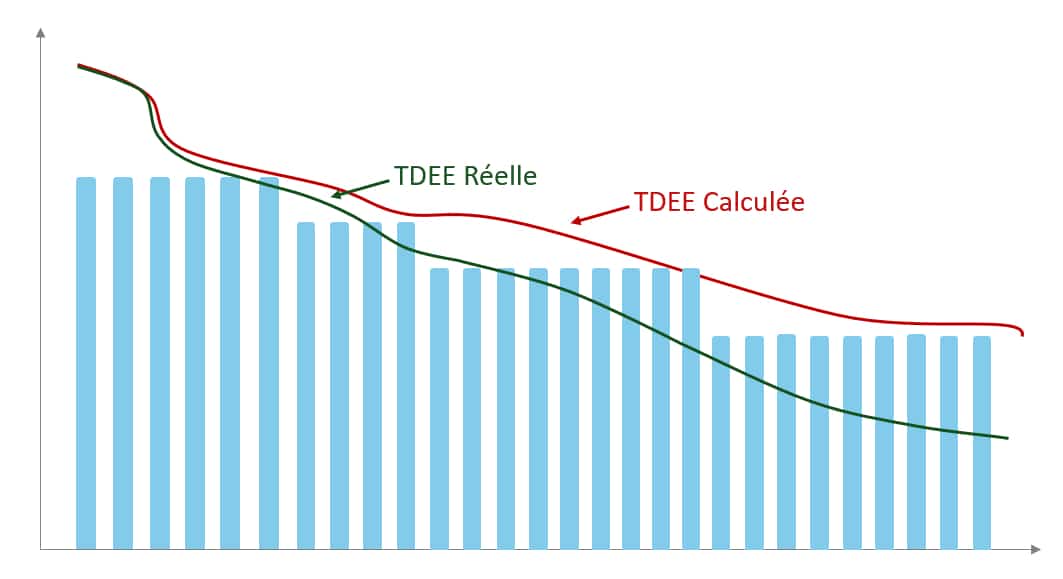
Real (measured) TDEE vs TDEE calculated without adaptation. The gap widens after 4 to 6 weeks of deficit.
09 · AI BodyScanWhy bodyfat changes everything
Bodyfat is the hidden variable in the entire TDEE equation. Without it, BMR is a statistical average. With it, it is yours. Lean measures bodyfat via AI BodyScan : a front-facing photo, 5 seconds of processing, precision of approximately 2 bodyfat points. No external device, no DEXA session.
Why this is critical for TDEE:
- BMR calculated on true lean mass < Harris-Benedict or Mifflin-St Jeor when bodyfat is high. The difference can reach 183 kcal/day for a sedentary profile at 28 % bf.
- In the opposite direction, Lean BMR is higher by 93 kcal/day for an athlete at 12 % bf, because Mifflin underestimates muscle mass.
- Metabolic adaptation is modeled on the real BMR. If the starting BMR is wrong, the adaptation coefficient is wrong. Everything propagates.
AI BodyScan male
10 · TDEE tracking in LeanThe 4 components in real time
The Lean « Expenditure » screen displays your live TDEE, broken down component by component. You see where your day stands, which component carried the most weight, where you can act. Lean does not give you a fixed number decided at the start of the day: it recalculates continuously as your steps, session and meals accumulate.
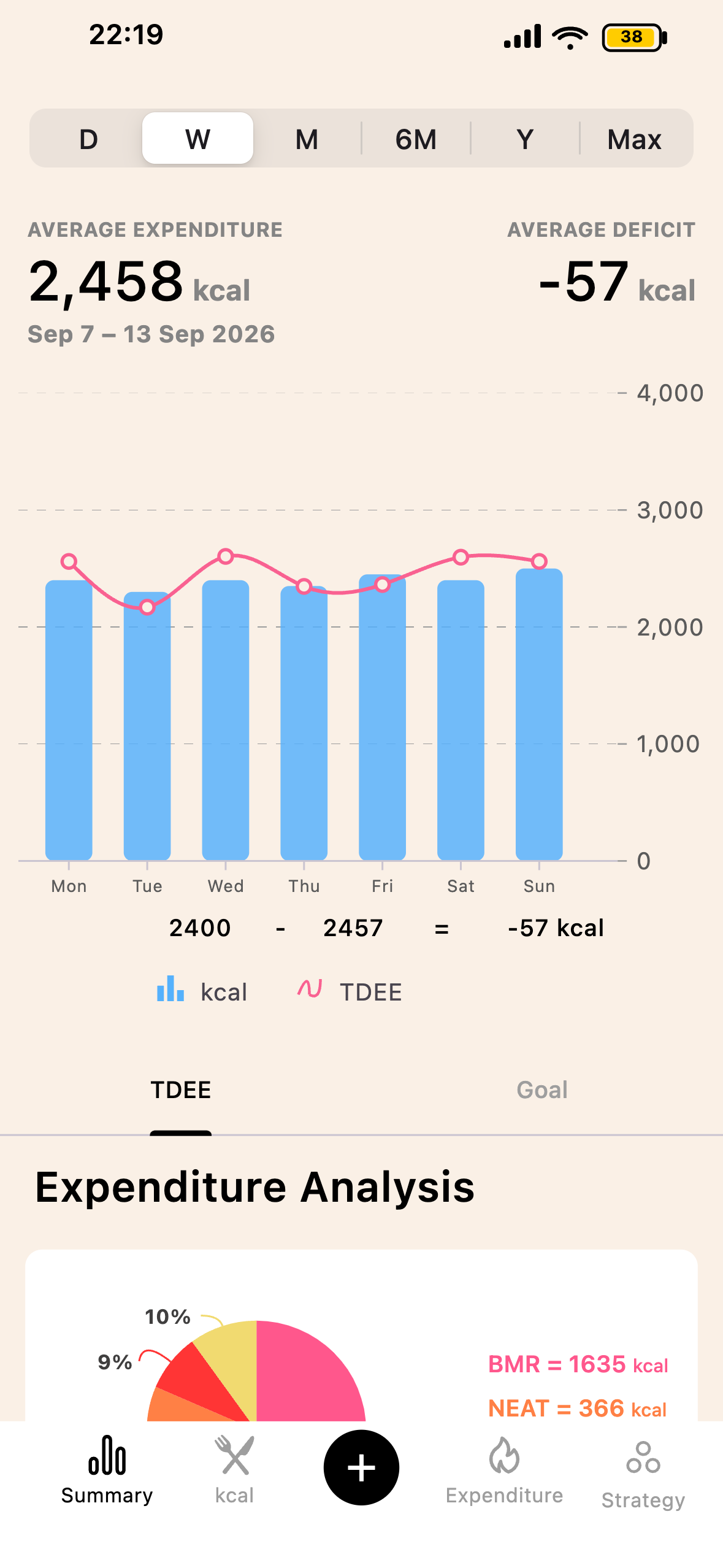
11 · StrategiesTDEE and target according to cut, bulk or recomp
Once your precise TDEE is known, practical application is straightforward. Three goals, three levers.
Cut (fat loss)
Bulk (muscle gain)
Maintenance / recomp
12 · The PyramidLean Progression Pyramid
In Lean’s philosophy, TDEE is not the top of the action plan. The Progression Pyramid prioritizes what truly matters for a successful cut: adherence > caloric target (= precise TDEE) > steps / NEAT. TDEE is at level 2: if you do not track regularly, optimizing macros to the nearest percent is pointless.
13 · TutorialsHow to use Lean for your TDEE
Two videos to get started concretely:
Full tutorial: counting calories with Lean, from A to Z.
How to double your caloric expenditure by optimizing each TDEE component.
14 · FAQEverything you wonder about TDEE
What is TDEE?
TDEE (Total Daily Energy Expenditure) is your total daily caloric expenditure. It groups the 4 components: BMR (basal metabolic rate, 57–75 % of TDEE), NEAT (steps and activity outside exercise), EAT (exercise sessions), TEF (thermic effect of food). Metabolic adaptation modulates BMR during prolonged deficit, without entering the sum.
What is the TDEE formula?
The canonical equation: TDEE = BMR + NEAT + EAT + TEF. BMR is ideally calculated on true lean mass (known bodyfat). Metabolic adaptation is a BMR multiplier coefficient applied during prolonged deficit (100 % = optimal, 90 % = 10 % adaptation), never added to the sum.
Why is my calculated TDEE different from the real one?
Three main reasons. First: BMR is calculated without bodyfat (Harris-Benedict or Mifflin-St Jeor), error of 200 to 500 kcal/day for atypical profiles. Second: NEAT is estimated by a global multiplier, not measured per step. Third: EAT is taken from a connected watch biased by up to 2× (Lee 2020). Unmodeled metabolic adaptation further widens the gap over weeks.
What proportion of TDEE does BMR represent?
On average, BMR represents 57 to 75 % of TDEE depending on activity level. The more active you are, the larger the share of NEAT and EAT, and therefore the smaller the relative share of BMR. But it is always the heaviest component: a 10 % error on BMR propagates directly to the caloric target.
How to increase your TDEE without additional exercise?
The most effective lever is NEAT: walk more. 5 000 additional steps per day represent approximately 200 kcal of additional expenditure (varies with body mass and speed). Over 30 days, that is the equivalent of 800 g of extra fat burned, without touching the weight training program.
Does TDEE change every day?
Yes. BMR is relatively stable (varies mainly with body composition and metabolic adaptation). But NEAT fluctuates daily according to your activity, EAT according to your sessions, and TEF according to your meals. On a rest day without exercise, your TDEE can be 400 to 700 kcal lower than a day with a session and 15 000 steps.
How long does it take for metabolic adaptation to kick in?
The first adaptive changes appear from the first two weeks of deficit (decrease in « spontaneous » NEAT, motor energy savings). Measurable BMR reduction is significant after 4 to 6 weeks of sustained deficit, and can reach 5 to 25 % during long cuts (Hall 2008, Müller 2015). This is why Lean models this coefficient continuously.
TDEE vs daily caloric expenditure: the same thing?
Yes, TDEE and total daily caloric expenditure refer to the same reality. « TDEE » is the English scientific term (Total Daily Energy Expenditure), « total caloric expenditure » or « total energy expenditure » are the French translations. « TDEE » is used universally even in French-language scientific literature.
Scientific sources
- Mifflin MD, St Jeor ST, Hill LA, et al. A new predictive equation for resting energy expenditure in healthy individuals. Am J Clin Nutr. 1990;51(2):241-7. PubMed 2305711.
- Harris JA, Benedict FG. A Biometric Study of Human Basal Metabolism. Proc Natl Acad Sci USA. 1918;4(12):370-3.
- Levine JA. Non-exercise activity thermogenesis (NEAT). Best Pract Res Clin Endocrinol Metab. 2002;16(4):679-702. PubMed 12468415.
- Lee JM, Kim Y, Welk GJ. Validity of consumer-based physical activity monitors. Med Sci Sports Exerc. 2014;46(9):1840-8. PubMed 24777201.
- Hall KD. What is the required energy deficit per unit weight loss? Int J Obes. 2008;32(3):573-6. PubMed 17848938.
- Müller MJ, Bosy-Westphal A. Adaptive thermogenesis with weight loss in humans. Obesity. 2013;21(2):218-28. PubMed 26399868.
- Frankenfield DC. Bias and accuracy of resting metabolic rate equations in non-obese and obese adults. Clin Nutr. 2013;32(6):976-82. PubMed 23631843.
Calculate your TDEE on your real bodyfat
AI BodyScan in 5 seconds. 4 components measured separately. Metabolic adaptation modeled. No formula from 1919 or 1990. Free download, 7-day trial on the annual plan.