How to calculate your real daily calorie burn. The complete guide: BMR, NEAT, EAT, TEF, and the 5th brick 95 % of people ignore.
If you track your calories without tracking your expenditure with the same rigor, you are flying blind. This guide teaches you how to calculate every component of your TDEE, with the sources, the traps and the numbers.
 The Lean Team · 25 min read · Updated August 16, 2026

 Free download
Your daily calorie expenditure is calculated by adding 4 components: TDEETotal Daily Energy Expenditure. Your total energy expenditure over 24 hours. = BMRBasal Metabolic Rate. Energy burned at rest. Calculated on lean mass, so on actual body fat. + NEATNon-Exercise Activity Thermogenesis. Expenditure from steps and daily activities outside of sport. + EATExercise Activity Thermogenesis. Expenditure from your workouts, calculated via MET. + TEFThermic Effect of Food. Energy spent on digestion. Depends on the macros you eat.. BMR must be calculated on your lean mass (so your actual body fat, not your weight), NEAT on your actual steps, EAT on effective exercise time, TEF on your macros. The 5th brick, metabolic adaptation, modulates your BMR downward in a prolonged deficit: Lean is the only app that calculates all 5.
You are going to understand why you plateau
How do you lose fat, get lean and stay lean? It is 2026 and you are still bombarded with contradictory answers: intermittent fasting, keto, carnivore, sugar-free, 10,000 steps a day, no wait, 15,000. No wonder you are drowning.
Here is the key nobody puts front and center: all these diets are just tactics. Implementations of a theory scientifically established for decades: energy balance. Once you understand it, you see behind the curtain, and you stop taking part in diet clan wars.
Among Lean users, the same pattern keeps coming back: years of classic mistakes before finally landing on the right theory. Once applied, a few years are enough to transform a physique, no exceptional genetics required.
One non-negotiable golden rule before starting: principle number 1 is adherence. Extreme, ultra-rigid diets that wreck your social life or your mental health: banned. A method you cannot sustain for 12 months is a bad method, whatever its theoretical purity.
Deficit, maintenance, surplus: energy balance
Your body burns energy every day: that is your TDEE (Total Daily Energy Expenditure), your total daily energy expenditure. It also takes energy in, through food. Comparing the two gives three possible states, and only three.
Calorie deficit
You eat less than you burn. Your body taps into its reserves: you lose weight.
Maintenance
You eat as much as you burn. Your weight is stable, your metabolism recovers.
Calorie surplus
You eat more than you burn. Your body stores the excess: you gain weight.
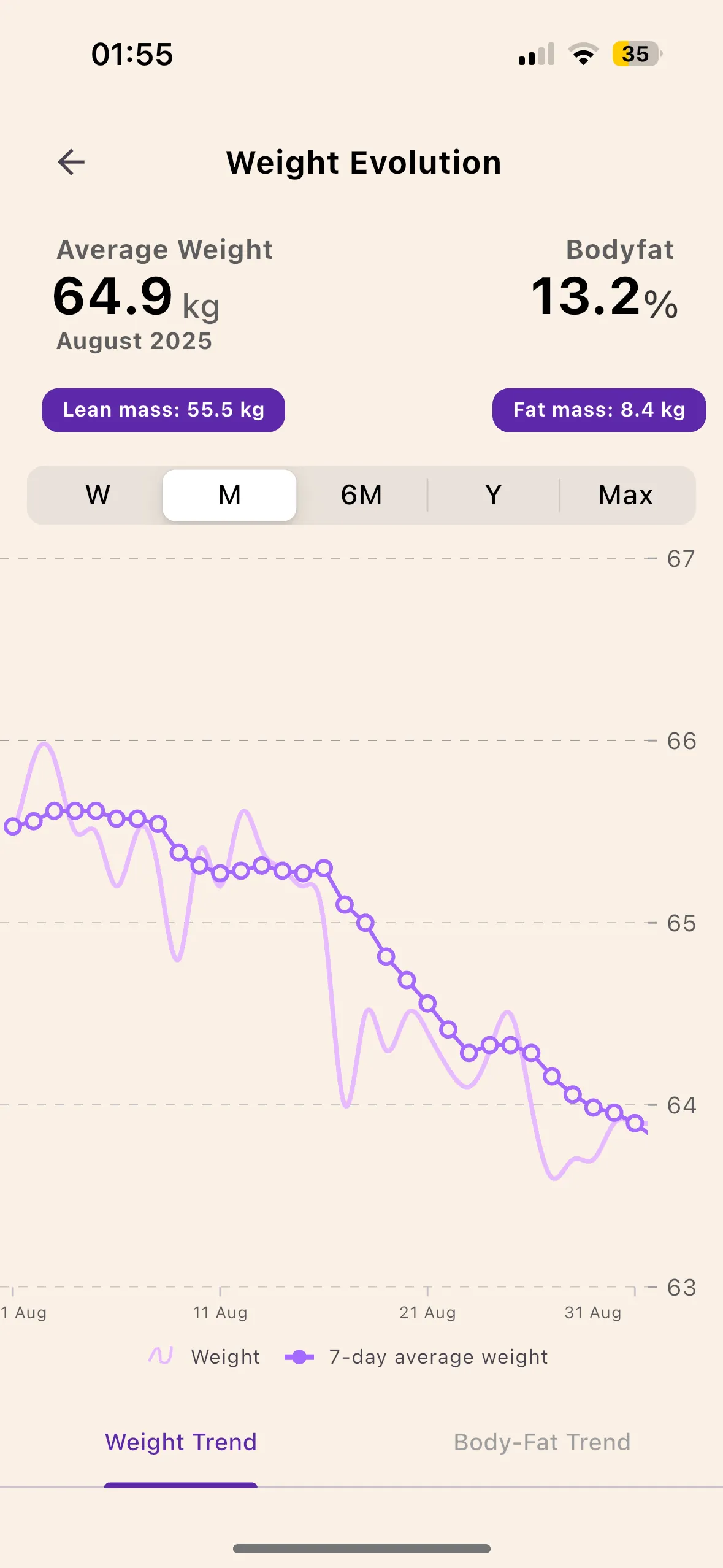
When you are in a deficit, your body draws on its reserves in a precise order. First, glycogen, a form of glucose stored in your muscles and liver, depleted very quickly. Then come fat stores, broken down into fatty acids and used as fuel. Only in a very severe, prolonged deficit does the body significantly break down muscle protein.
That settles a stubborn myth: no, a deficit does not “eat your muscles” from day one. A reasonable deficit, with enough protein and resistance training, makes you lose fat, not muscle.
Deficit, maintenance, surplus: nothing new. The real key to the theory lies elsewhere : in the precise calculation of your expenditure. If you do not track your expenditure as well as your calories, everything else is useless.
A 300 kcal error is enough to cancel everything
Here is the scenario blocking millions of people. You want a deficit of about 250 kcal. You think your TDEE is 2,500 kcal, so you set yourself at 2,250 kcal per day, cleanly, every day. But because the calculation was wrong, your actual TDEE is 2,200 kcal.
That is the real problem. Not your willpower, not your evening carbs, not your fasted cardio: a simple estimation error, invisible, that turns your theoretical deficit into an actual surplus. Calculating your TDEE precisely is what will unlock everything. You can get a first estimate with the Lean online TDEE calculator, then read on to understand each brick.
What is TDEE made of? Four expenditure components that add up, detailed in the pillar dedicated to total daily energy expenditure :
Basal metabolic rate
The energy your body burns at complete rest: organs, brain, circulation. The biggest component, and the one almost everyone gets wrong.
Non-exercise activity
Walking, standing, typing, fidgeting. Dominated by your steps. The most underrated lever in your whole expenditure.
Exercise / sport
Your workouts, calculated via their MET and effective effort time. Much smaller than what your watch shows you.
Thermic effect of food
The energy spent digesting. Depends on macros: protein costs far more to digest than fat.
Metabolic adaptation
It does not add to the 4 components: it modulates your BMR downward when you stay in a deficit, like a coefficient. Lean convention: a score that starts at 100 % (optimal) and goes down. Part 5 is entirely devoted to it, it is the final boss.
The equation is simple to write: TDEE = BMR + NEAT + EAT + TEF. It is much less simple to calculate correctly, because each component has its trap, its dominant error spread across 99 % of tools, and its real method. That is the program for the five parts that follow: four components to add up, one multiplicative brick to monitor.
BMR: your basal metabolism, calculated on your lean mass
The BMR (Basal Metabolic Rate) is your basal metabolism: the energy burned at complete rest. Lying down for 24 hours without moving, the energy consumed by your organs, brain, liver and circulation is your BMR: 60 to 75 % of total expenditure for most people. If your BMR is wrong, your whole TDEE is wrong. The concept is detailed in the basal metabolic rate pillar.
In Lean, your BMR lives on screen: continuously recalculated, with your adaptation score displayed right next to it.
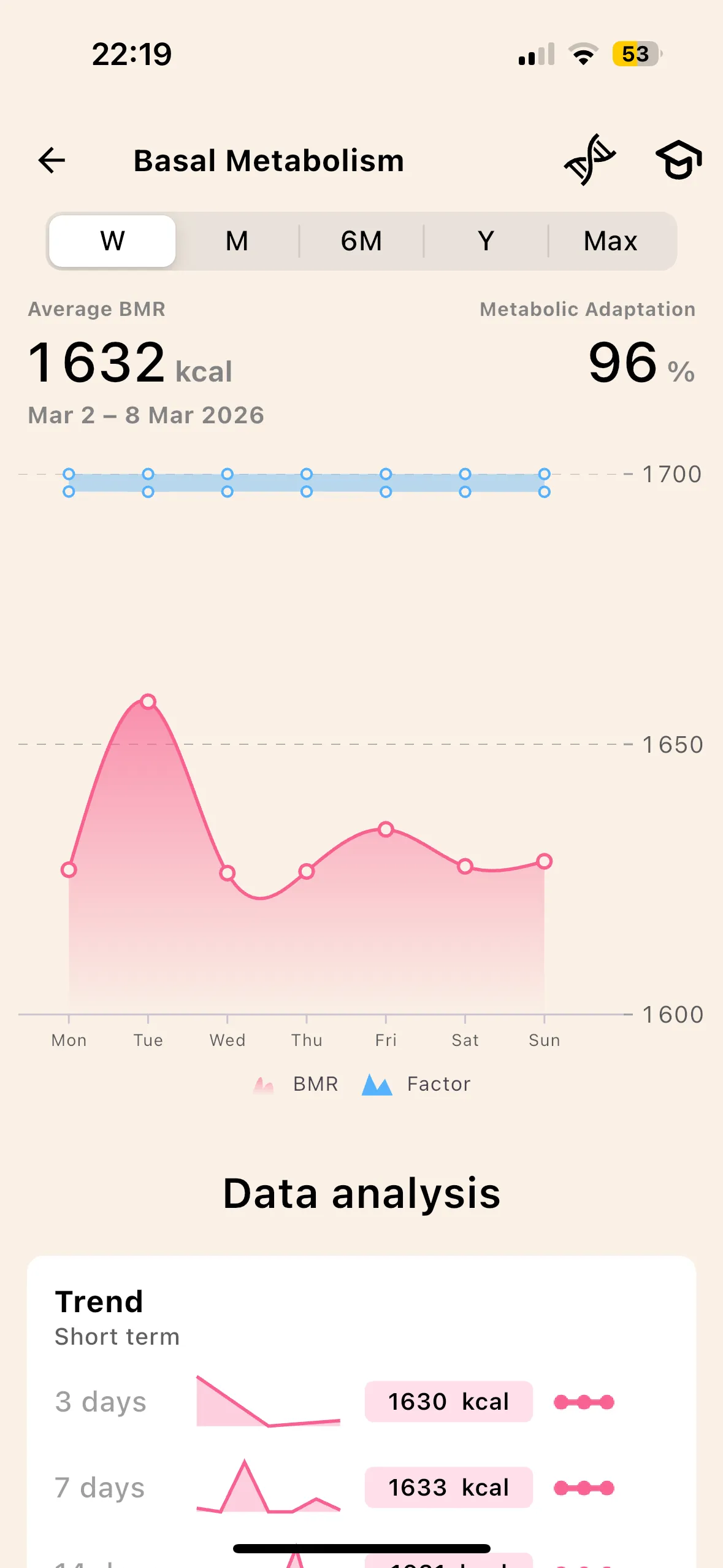
The dominant error: weight-based formulas, including one from 1919
The first trap in this guide: using the wrong equation. The most used in the world is called Harris-Benedict: social media, coaches, tracking apps, even some dietetics schools. Yet we have known for more than 20 years that it is outdated.
Context: 1919. Harris and Benedict took 239 men and women, all from the same city (Boston, USA), laid them down with a mask measuring oxygen consumption, and extracted a general law from weight, height, age and sex. Brilliant for the era, but: a tiny sample, subjects whose lifestyles and hormonal profiles were very different from ours, and still-imprecise calorimetry. Since then, many studies have shown that Harris-Benedict overestimates basal metabolism. Mifflin-St Jeor, published in 1990 on a more modern sample (PubMed 2305711), corrects part of the aim, but keeps the structural flaw of the whole family: it only knows your weight, height, age and sex. Frankenfield 2013 (PubMed 23631843) measured its accuracy against reference indirect calorimetry: correct in lean subjects, it drops to 75 % acceptable predictions in overweight subjects. Neither 1919 nor 1990 can serve as the foundation for a precise deficit.
What science has settled: fat mass burns almost nothing
Since the work of the 1980s, we have known that metabolism follows lean mass : your weight minus your fat mass. Liver, brain, heart and kidneys are huge consumers, and muscle is the first adjustable component, while adipose tissue burns almost nothing. A formula that only sees weight treats 1 kg of fat like 1 kg of muscle: that is exactly its error.
Concretely: take a man of 1m80, 120 kg, 30 % body fat. A weight-based formula like Harris-Benedict gives him a BMR of about 2,500 kcal. A calculation on his actual lean mass gives about 2,000 kcal. A 500 kcal gap, the equivalent of an entire meal, on the very first component of TDEE alone.
Estimated BMR. The weight-based formula overestimates by 500 kcal because it counts fat mass as active tissue.
The real method: weight, body fat, lean mass
Your lean mass is derived from your weight and your body fat: lean mass = weight × (1 − bodyfat). At 15 % body fat for 80 kg, your lean mass is 80 × 0.85 = 68 kg. That is what your BMR must be calculated on. Some uncertainty remains from the body fat measurement, but you massively reduce the error compared to a weight-based formula. You can run the calculation online with the Lean basal metabolic rate calculator.
So the new challenge becomes: determining your body fat accurately and simply. Four techniques exist, only one is recommendable day to day:
- Skinfold calipers. All over YouTube, very imprecise: handling errors, poor reproducibility. Forget it for driving a BMR calculation.
- Bioimpedance scales. The resistance-to-body-fat relationship is a gigantic approximation, and your hydration shifts the result by several points from one day to the next. Lean users all tell the same story: a high-end scale showing 6 or 7 % to people visibly at 15 or 18. A scale is for weighing yourself, period.
- The DEXA scan. The current reference: very low intensity X-rays measure your complete body composition. But it is expensive, hard to access, and you would need to redo it every week. Unrealistic as a routine.
- The AI scan. The workable method today: models trained on huge databases of people who took DEXA scans. One photo, your body fat estimated in seconds, every week.
That is exactly what the AI BodyScan in Lean does: one photo, 5 seconds, your body fat estimated, and your BMR automatically recalculated behind it via a proprietary patented model built on actual lean mass. It is the first criterion separating Lean from classic trackers in the Lean vs MyFitnessPal comparison.
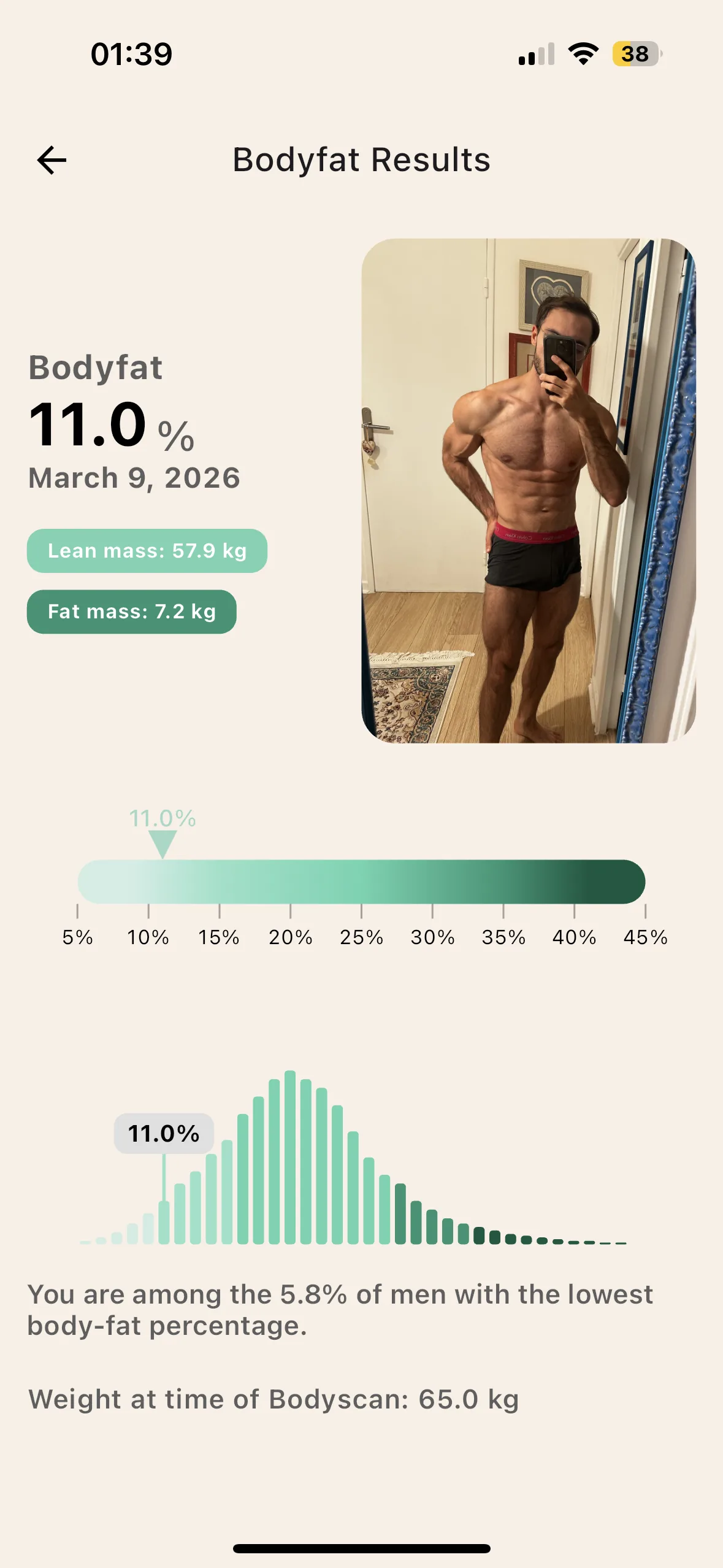
Two traps close this pillar: apps that calculate your BMR without ever asking your body fat, and apps that simulate everything else with a coefficient applied to that already-wrong BMR. That second trap deserves its own part: NEAT.
NEAT: your non-exercise expenditure, dominated by your steps
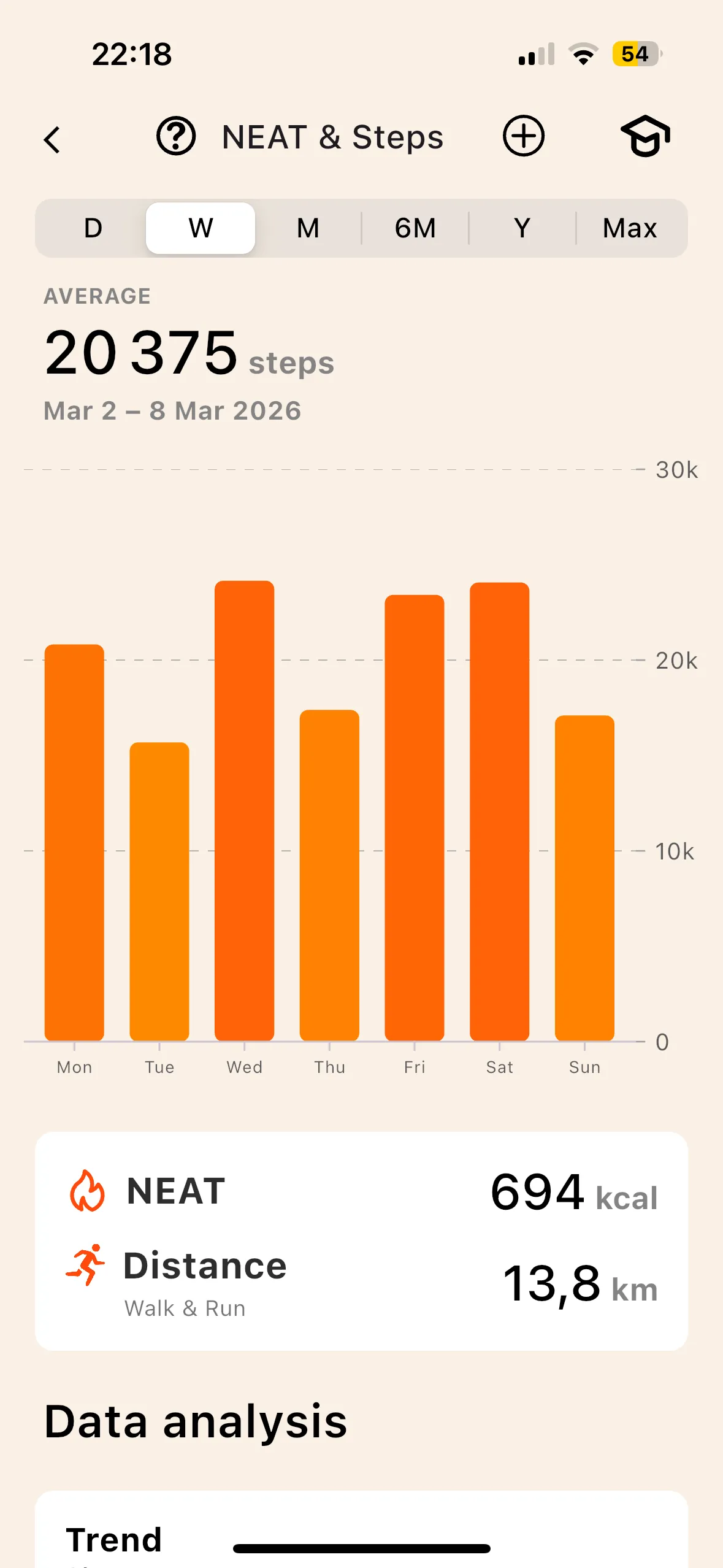
Your NEAT (Non-Exercise Activity Thermogenesis) covers all non-exercise expenditure: walking, standing, typing. The concept was formalized by Levine (PubMed 12468415): at equal body size, NEAT can vary by several hundred kcal per day from one individual to another. His 2005 study in Science (PubMed 15640470) shows that posture and time spent standing structurally distinguish lean people from overweight people. It is the second-largest TDEE component for most people, all the detail is in the NEAT pillar.
The NEAT / EAT boundary: MET and the threshold of 3
To separate non-exercise from exercise, you need the METsMetabolic Equivalent of Task. Measures the intensity of an activity as a multiple of resting expenditure. 1 MET = rest. (Metabolic Equivalent of Task): the intensity of an activity, as a multiple of your resting expenditure. The Compendium of Physical Activities (Ainsworth 2011, PubMed 21681120) catalogs the MET of hundreds of activities. The scientific convention sets the boundary at MET = 3 : at or below, NEAT; above, EAT.
Fun detail: walking lands exactly on the boundary. Below 5 km/h it counts as NEAT; above, as EAT. Since we almost always walk under 5 km/h in daily life, the approximation is very solid: NEAT is the expenditure tied to your step count. And it gets truer the more you walk.
The dominant error: the activity coefficient ticked once and for all
How do almost all apps handle your NEAT? They do not calculate it. At sign-up, one question: “sedentary, lightly active, active, very active?”, then a multiplier applied to your BMR, once, forever. Which box do you tick when you are active Tuesday to Friday and still all weekend? None of them is correct. An already-wrong BMR, multiplied by a frozen coefficient claiming to summarize NEAT, EAT and TEF: that is why you never stood a chance with a classic app.
Real expenditure over 7 days measured for a Lean user. The grey line is the frozen target of a coefficient app.
The second trap: the calories shown by wearables
Good news: your smartphone has an excellent pedometer, iOS and Android alike, and its step count is reliable. But never trust the calories displayed by a smartwatch or fitness band. The validation study by Lee and Welk on consumer sensors (PubMed 24777201) measures significant calorie estimation errors, with some models approaching double the actual value. A watch showing 500 kcal burned may well correspond to 250 actual kcal. Keep the raw, reliable data, the step count; throw away the derived, wrong data, the calories.
The real method: your actual steps, crossed with your BMR
One last point of finesse: NEAT depends on your metabolism. Two people taking 10,000 steps do not burn the same amount if their lean masses differ. Lean crosses your steps (HealthKit on iPhone, Google Fit on Android) with your BMR calculated on your lean mass: your NEAT is recalculated every day, no coefficient, no box to tick. Walking is the simplest way to raise your expenditure, and therefore to deepen your deficit without touching your plate.
EAT: your sport burns less than you think
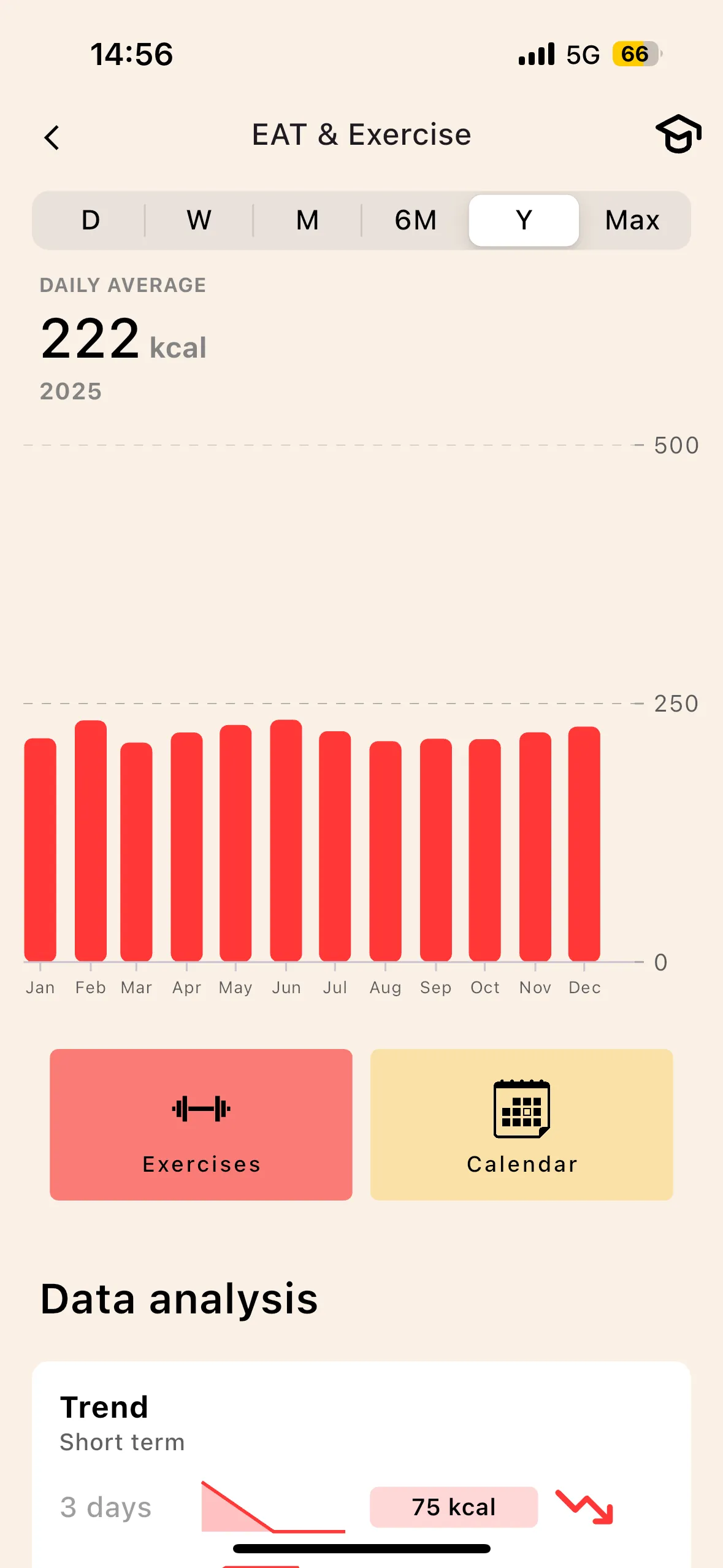
Your EAT (Exercise Activity Thermogenesis) is the energy burned during your sports activities: every activity with a MET above 3. Like NEAT, it depends on your BMR. The principle formula: EAT = sport MET × BMR × effective exercise time. The MET of each sport is in the Compendium tables, and the EAT pillar on this site details the common values.
The word that changes everything: “effective” time
The big EAT trap fits in a single word: effective. The time to count is the time you actually exert effort, not your session’s total duration. In weight training, rest between sets does not count: over a one-hour session, you may spend 15 to 20 minutes actually pushing weight. In amateur tennis, over an hour of play, actual playing time sits between 15 and 25 minutes. Result: a serious weight training session represents 200 to 250 kcal, no more.
The dominant error: the watch showing 1,050 kcal
Smartwatches stack their two flaws here: a BMR calculated on weight, without body fat, so already overestimated, and the full session duration counted, warm-up, rest and Instagram scrolling included. Absurd result: weight training sessions displayed above 1,000 kcal for an actual expenditure of 200 to 250. An error factor of 4 to 5, consistent with the validation studies of consumer sensors (PubMed 24777201).
kcal displayed: overestimated weight-based BMR × total session duration, rest included.
actual kcal: lifting MET × BMR on lean mass × 15 to 20 min of effective time.
Do the math on what this error destroys. Target deficit: 100 kcal per day, 700 per week. Your watch counts one session at 1,000 kcal instead of 200: an 800 kcal error, your entire weekly deficit erased by a single miscounted session. Among Lean users, this error shows up in almost every stagnation story: years of overestimating sports expenditure because of a number displayed on a wrist.
The real place of sport in your expenditure
“I will crush the gym and blow up my expenditure”: the orders of magnitude say the opposite. The gym burns little, and the real room for progress is in your steps. In Lean, you select your sport in the EAT section, you enter the time actually practiced or the intensity, and the app runs the MET × BMR × effective time calculation with your real metabolism. No fantasy bonus, no 1,000 kcal session.
TEF: digestion burns calories, and not at a flat rate
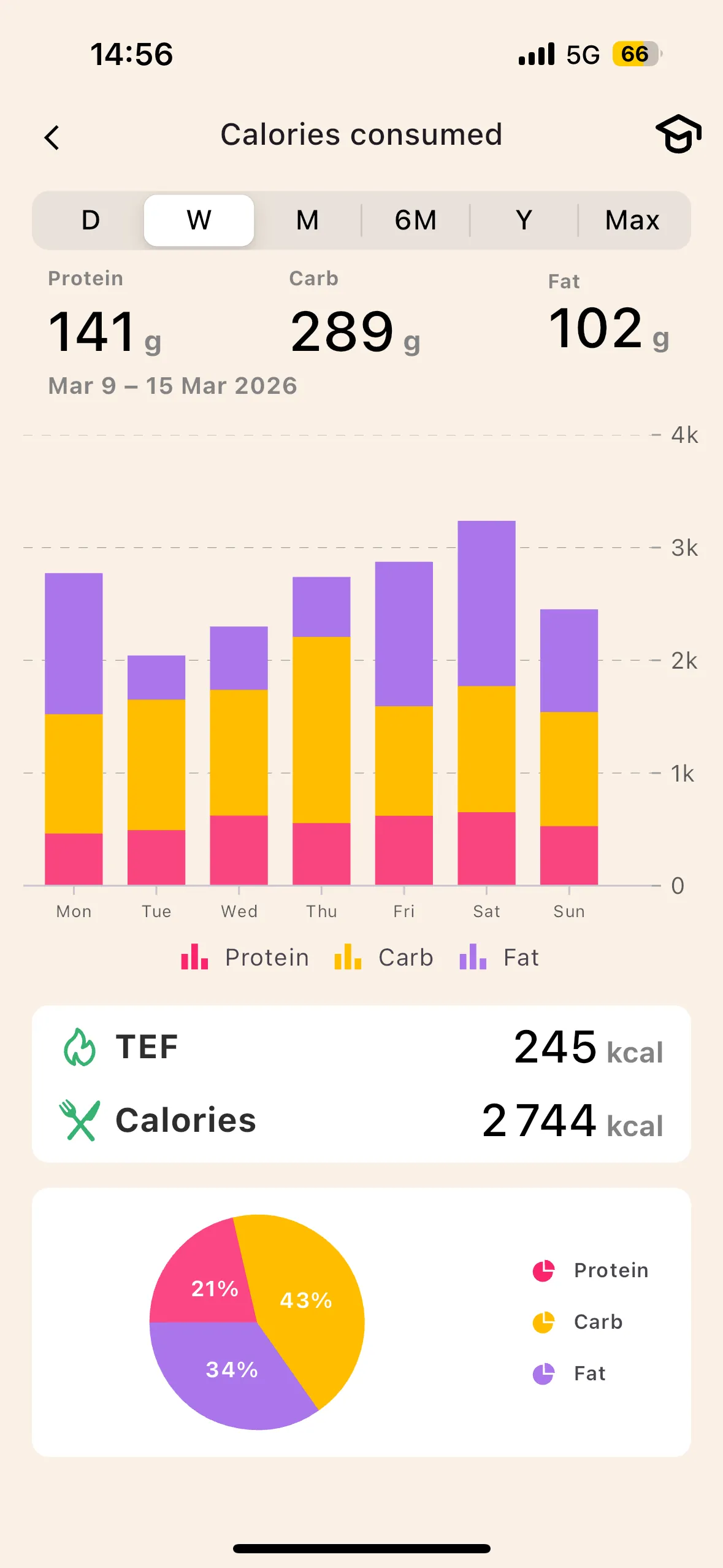
Your TEF (Thermic Effect of Food) is the thermic effect of food: the energy your body spends digesting, absorbing and metabolizing what you eat. Yes, eating burns calories. It is the most forgotten TDEE component: most trackers simply do not calculate it, or crush it into the famous activity coefficient. The thermic effect of food pillar is entirely devoted to it.
The dominant error: the flat 10 % rate
When TEF is taken into account, it is almost always as a flat rate: “about 10 % of calories eaten”. Yet TEF depends massively on macronutrients, as established by Westerterp’s reference review (2004, PubMed 15507147) :
The worked example: an actual 7 % versus an assumed 10 %
Take the average food split of a French adult according to public health data: about 45 % carbs, 42 % fat, 13 % protein. Run the macro-by-macro calculation: you get an actual TEF closer to 7 % of total calorie intake than to 10 %.
The reasoning also works in your favor: raise your protein share and your TEF mechanically increases. It is one of the reasons (along with muscle protection) why “eat more protein when cutting” is one of the few universally good pieces of advice.
The real method: calculate TEF on your actual macros
The only clean way to calculate TEF is to derive it from the macros actually eaten during the day. That is what Lean does: every tracked food feeds the calculation, and your exact TEF adds to your expenditure as meals go by. If you track your meals, your TEF is already calculated, no extra work.
Metabolic adaptation: the final boss
You know how to add up your 4 components. One step remains, the finest and perhaps the most important in this guide. In a calorie deficit, your body understands it is receiving less energy and, in a survival logic, it adapts its metabolism : it saves everywhere, while remaining perfectly functional. Like your iPhone’s low power mode: you barely notice the difference in use, but consumption drops.
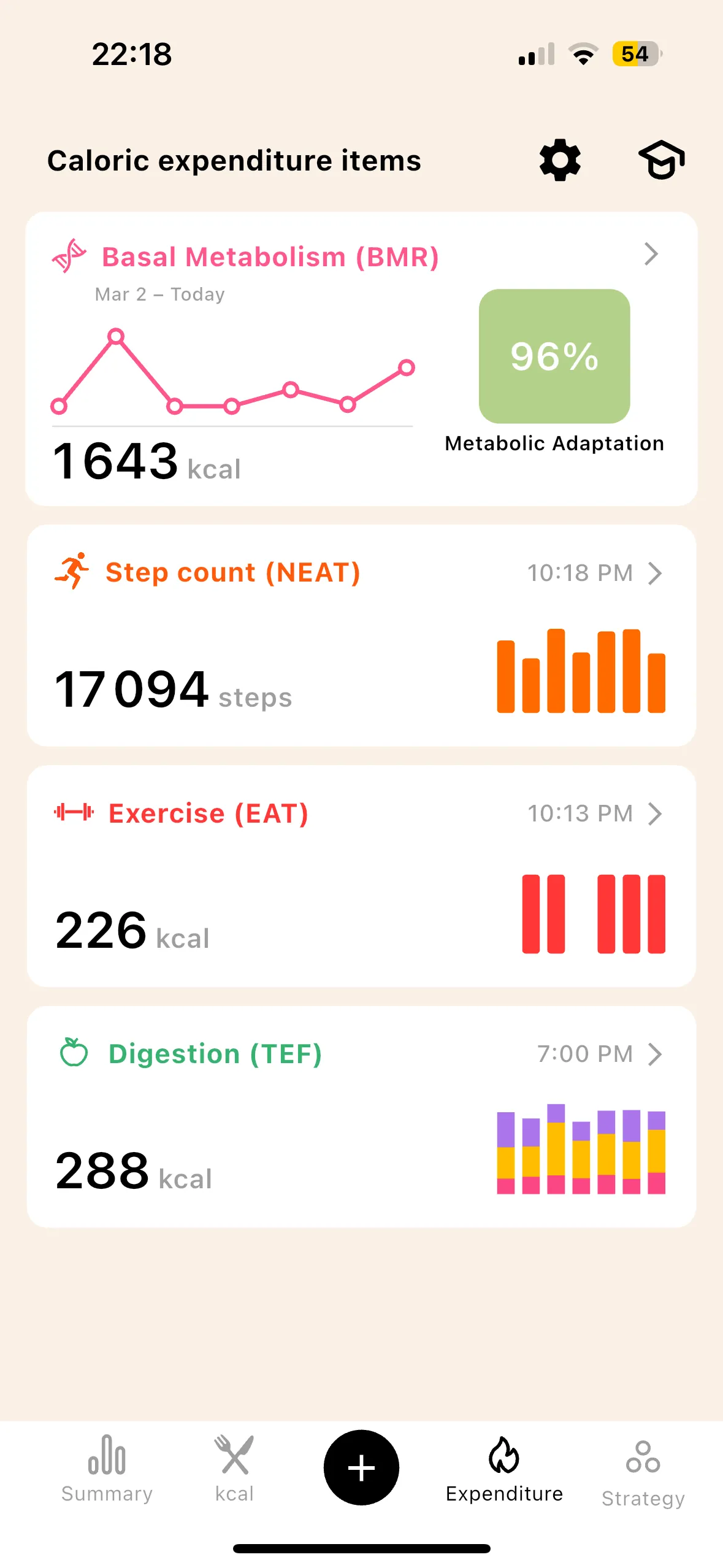
Crucial point: metabolic adaptation does not add to the 4 components. It is a coefficient that modulates your BMR downward. And since your NEAT and EAT themselves depend on BMR, almost your entire TDEE is dragged down. Lean displays it with a clear convention: a score that starts at 100 % (optimal metabolism, zero adaptation) and goes down as the deficit continues. A score of 90 % means your metabolism is running at 90 % of its optimal level.
What the studies say: 5 to 25 % depending on the deficit
The phenomenon is solidly documented: Doucet 2001 measured real adaptive thermogenesis during weight loss (PubMed 11430776), Müller and Bosy-Westphal quantified adaptation by revisiting the historical Minnesota data (PubMed 26399868), and Hall modeled the deficit actually required per unit of weight lost (PubMed 17848938). The orders of magnitude to remember, after 2 to 8 weeks of deficit:
- Deficit of about −250 kcal/day : 5 to 10 % adaptation, your score drops toward 90 to 95 %.
- Deficit of about −500 kcal/day : 10 to 15 % adaptation, score toward 85 to 90 %.
- Deficit of about −750 kcal/day : 15 to 25 % adaptation, score toward 75 to 85 %.
Now compare with your own plan: planned deficit of 10 %, adaptation at 10 %, actual deficit zero. You are at maintenance, while feeling like you are making every effort in the world. No matter how good your starting calculation was: your actual TDEE slid below your calculated TDEE, week after week, silently.
Actual TDEE versus calculated TDEE. Without adaptation tracking, your deficit melts week after week without you seeing it.
How to manage it: voluntary plateaus and returning to 100 %
Successful weight loss is not an ever-decreasing curve. Good practice: alternate deficit with voluntary plateaus at maintenance that reset your metabolism. When your adaptation score reaches the 85 to 90 % zone, go back to maintenance for a few weeks: your BMR climbs back, your score returns toward 100 %, and you set off again for an effective losing phase. In a continuous deficit, adaptation grows until it becomes blocking: you barely lose anymore, while eating very little. That is the classic spiral of overly harsh diets.
The practical problem: no classic tracker tells you where you stand. Lean is the first app in the world to calculate metabolic adaptation automatically : it estimates your adaptation across your weeks of deficit, modulates your BMR, and displays your score as a percentage. Your calorie target is pinned to your actual TDEE, not your theoretical starting TDEE. For the size of the deficit, the calorie deficit calculator helps you start on healthy footing: bold in the first weeks when motivation is high, then tapering.
And now, the calories you eat
Your expenditure is calculated, the other side of the balance remains: intake. This guide has barely talked about food so far, and that is deliberate: you cannot steer a deficit whose starting point you do not know. Now that your expenditure is solid, tracking your calories becomes simple. Three methods cover every use case:


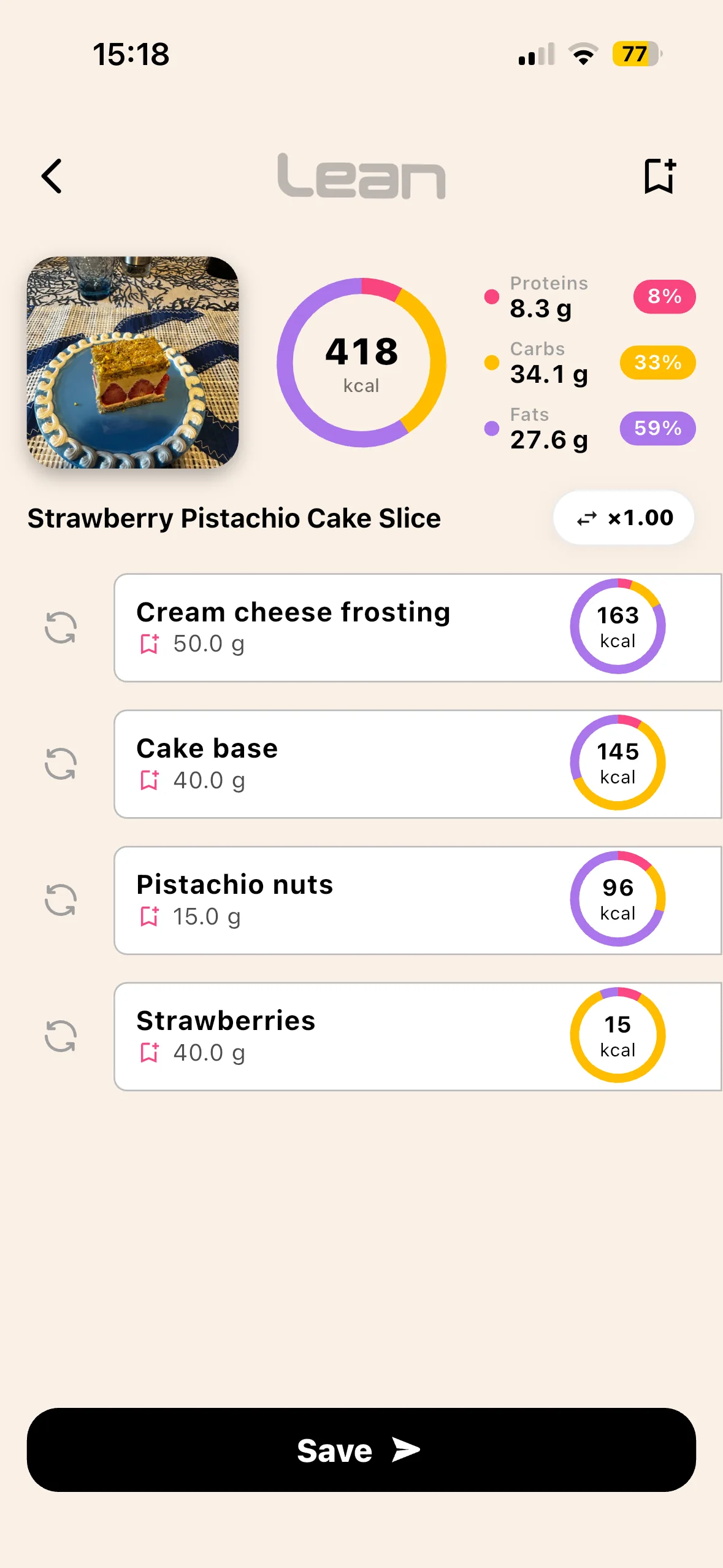
The food database (USDA + OpenFoodFacts in Lean) for whole foods you weigh. Barcode scanning for supermarket products. And AI photo scanning for everything else: the AI identifies the foods on your plate and calculates calories and macros per food. At a restaurant, at a friend’s, on vacation: one photo, done. Less precise than gram-level weighing, but a method that lasts 12 months always beats a perfect method abandoned after 3 weeks. The guide to the best calorie apps compares the market’s approaches.
A bonus that changes daily life: in Lean, your expenditure updates live throughout the day. The more you walk, the higher your TDEE for the day, and your calorie balance updates in real time. You know where your deficit stands at every moment.
A word on macros, deliberately kept for the end
Once your deficit is secured, the only macro setting that really matters is simple: raise your protein. About 2.2 g per kg of lean mass in protein, about 1 g per kg of lean mass in fat, the rest in carbs. Protein protects your muscle in a deficit and boosts your TEF, as you saw in pillar 4. The rest (fine-grained splits, low carb or not, fasting or not) is personal preference: choose what you can sustain.
The checklist to calculate your real expenditure
The entire guide, condensed into 8 actionable points. Tick all 8 and you know exactly whether you are in a deficit, at maintenance or in a surplus, and by how much.
Harris-Benedict 1919 and population formulas overestimate your BMR. Your metabolism follows your lean mass: weight × (1 − bodyfat).
Calipers and bioimpedance scales: too imprecise. DEXA: unrealistic as a routine. AI BodyScan: one photo, 5 seconds, every week.
In the morning, fasted. What counts is the trend over several weeks, never a single day’s number.
Your smartphone’s pedometer is reliable, your watch’s calories are not. NEAT = actual steps crossed with your real BMR, every day.
Sport MET × BMR × time actually exercised. A one-hour lifting session is 200 to 250 kcal. Never 1,000.
Protein 20 to 30 %, carbs 5 to 10 %, fat 1 to 3 %. No flat 10 %. At 3,000 kcal/day, the gap approaches 100 kcal.
A score from 100 % (optimal) that goes down in a deficit. Around 85-90 %, return to maintenance to reset your metabolism, then go again.
A bold deficit at the start if you want, then tapering. And track your meals with the method you can sustain for 12 months: database, barcode or photo.
Do it all by hand, spreadsheet and MET tables in hand, or let Lean run the 5 calculations in the background. Among users coming from Excel spreadsheets, the verdict is unanimous: the precision is the same, the adherence is a different world.
Frequently asked questions
How do you calculate your daily calorie expenditure?
What is the difference between BMR and TDEE?
Why am I not losing weight even though I am in a calorie deficit?
Are smartwatches reliable for calories burned?
How many calories does a weight training session really burn?
Does walking count as exercise in the calculation?
What is metabolic adaptation and how do you manage it?
How can you know your body fat without a DEXA scan?
Does my TDEE change from day to day?
Is Lean free or paid?
You now have all the weapons
All the trendy diets are just tactics serving a single theory: energy balance. It only works if you know your expenditure, and your expenditure cannot be guessed: it is calculated.
Every error in this guide, millions of people are making right now: the 1919 formula, the “active” box ticked six months ago, the lifting session counted as 1,000 kcal, the ignored TEF, the never-tracked adaptation. None of them is visible, all of them are paid for in weeks of stagnation. Now you know how to avoid them: by hand if you love spreadsheets, or with Lean running the 5 calculations continuously while you live, walk and photograph your meals.
The goal is the same for everyone: get lean, and stay lean, without sacrificing your social life or your mental health. The theory is there, the tools too. The rest is adherence.
The Lean Team
Lean is available as a free download
iOS and Android. BMR on actual body fat, NEAT on actual steps, EAT per session, TEF per macros, automatic metabolic adaptation. The only app that calculates all 5.
Internal links
- Free online TDEE calculator · your TDEE estimated in 30 seconds, same logic as the app.
- Basal metabolic rate calculator · your BMR on your lean mass.
- Calorie deficit calculator · choose the size of your deficit without burning out.
- Total daily energy expenditure (TDEE) in detail · the complete scientific pillar.
- Basal metabolic rate (BMR) · the first component of your expenditure.
- NEAT, non-exercise expenditure · why your steps weigh more than your gym.
- EAT, exercise expenditure · MET, effective time and true per-session values.
- The thermic effect of food (TEF) · digestion, the forgotten TDEE component.
- Lean vs MyFitnessPal · what a continuously recalculated TDEE changes.
- Best calorie apps 2026 · the complete market comparison.
References
- Harris J.A., Benedict F.G. (1919). A Biometric Study of Basal Metabolism in Man. Carnegie Institution of Washington. The historic weight-based equation, dismantled in this guide.
- Mifflin M.D., St Jeor S.T. et al. (1990). A new predictive equation for resting energy expenditure in healthy individuals. American Journal of Clinical Nutrition. PubMed 2305711.
- Frankenfield D.C. (2013). Bias and accuracy of resting metabolic rate equations in non-obese and obese adults. Clinical Nutrition. PubMed 23631843.
- Levine J.A. (2002). Non-exercise activity thermogenesis (NEAT). Best Practice & Research Clinical Endocrinology & Metabolism. PubMed 12468415.
- Levine J.A. et al. (2005). Interindividual variation in posture allocation: possible role in human obesity. Science. PubMed 15640470.
- Ainsworth B.E. et al. (2011). Compendium of Physical Activities: a second update of codes and MET values. Medicine & Science in Sports & Exercise. PubMed 21681120.
- Lee J.M., Kim Y., Welk G.J. (2014). Validity of consumer-based physical activity monitors. Medicine & Science in Sports & Exercise. PubMed 24777201.
- Westerterp K.R. (2004). Diet induced thermogenesis. Nutrition & Metabolism. PubMed 15507147.
- Doucet E. et al. (2001). Evidence for the existence of adaptive thermogenesis during weight loss. British Journal of Nutrition. PubMed 11430776.
- Müller M.J., Bosy-Westphal A. (2015). Metabolic adaptation to caloric restriction and subsequent refeeding: the Minnesota Starvation Experiment revisited. American Journal of Clinical Nutrition. PubMed 26399868.
- Hall K.D. (2008). What is the required energy deficit per unit weight loss? International Journal of Obesity. PubMed 17848938.