Lean versus FatSecret. Premium precision versus the free community database.
FatSecret is free and has a big community. Lean sees your real expenditure on an official database. Two promises that don’t play on the same field.
 The Lean Team · 12 min read · Updated May 24, 2026

 Free download
FatSecret calculates your TDEE with Mifflin-St Jeor 1990 (no bodyfat measured inside the app) and a static activity factor chosen at sign-up from 5 boxes (sedentary, lightly active, active, very active, extremely active). The real strength of FatSecret is elsewhere: a 100% free, ad-supported model, a large active community, meal and recipe sharing, presence in more than 50 countries. Lean takes a different stance: recalculate every component of TDEE (BMRBasal Metabolic Rate. Energy expended at rest. In Lean, calculated on actual lean mass via BodyScan AI. on real bodyfat via a patented proprietary model, NEATNon-Exercise Activity Thermogenesis. Expenditure from steps and daily activities outside of sport. from steps, EATExercise Activity Thermogenesis. Expenditure from your sport sessions, calculated via MET. via MET, TEFThermic Effect of Food. Energy spent on digestion. Depends on the macros you eat. by macros) and modulate the BMR through metabolic adaptation continuously, with a food database backed by USDA and OpenFoodFacts.
FatSecret gives you free access, not the accuracy of your expenditure
You are probably already a FatSecret user, and you chose it for what it does best: a complete food log, no subscription, with the barcode scanner included.
You have scanned products, searched foods in the database, reused recipes shared by the community. Intake tracking works.
Take a concrete case. FatSecret announces a TDEE of 2,500 kcal, you eat 2,250, you think you are in a 250 kcal deficit. If your real expenditure is 2,280, your effective deficit drops to 30 kcal: the scale will not move.
FatSecret's promise is clear and kept: a free log, a community, a database covering many markets. It simply does not cover the precision of expenditure.
The 1990 BMR formula, with no bodyfat measured in the app
FatSecret also has to estimate your basal metabolic rate to give you a target. It uses Mifflin-St Jeor, the de facto industry standard for three decades.
The equation dates from 1990: 498 subjects, indirect calorimetry, calibration on a more modern population than the 1919 work. It is an honest base, and free to implement, which explains why it is almost everywhere.
Where other apps offer the Katch-McArdle equation as an option, computed on lean mass, FatSecret sticks to the basic formula. No field to enter your body fat percentage, no alternative calculation: that is the accepted trade-off of a product without a subscription.
The gain of 1990 over 1919 stays small, because the conceptual problem is untouched: the formula only looks at your weight. Not your body composition.
Fat mass burns almost nothing at rest. The real spenders are organs and muscles: liver, brain, heart, kidneys. At equal weight, two different bodies burn differently.
Frankenfield 2013 (PubMed 23631843) measured the gap against indirect calorimetry: 87% accuracy in non-obese subjects, 68% in obese subjects, with drifts of up to 330 kcal per day.
Worked example. Man of 1.80 m, 120 kg, 30 % bodyfat :
Estimated BMR for a man at 1.80m, 120 kg, 30 % bodyfat. The patented proprietary Lean model accounts for lean mass. Mifflin-St Jeor (FatSecret by default, with no lean-mass option), doesn’t. A 500 kcal gap, the equivalent of a full lunch.
A 330 kcal error turns a theoretical deficit into real maintenance. The tracking is free, so is the error, but it is paid for in weeks of lost progress.
Mathematically, an equation fed only with weight cannot produce an individualized result. Free or paid, it is blind to what makes the difference.
The activity factor, picked once and for all, and the crowdsourced database
This is where free shows its technical limit.
After estimating your basal metabolic rate, FatSecret has to compute your total expenditure: BMR plus steps, daily movements, sport and digestion.
The chosen solution is the cheapest to implement: a single activity level choice at sign-up. That is the PAL coefficient.
- Sedentary (PAL 1.2): desk job, little walking
- Lightly Active (PAL 1.375): occasional walking, little sport
- Active (PAL 1.55): regular walking, sport 3 to 5 times per week
- Very Active (PAL 1.725): intense sport almost daily
- Extremely Active (PAL 1.9): very intense sport or heavy physical work
Your metabolism is multiplied by that coefficient, and the result becomes your daily target. One entry, valid indefinitely.
The gap with reality is considerable. A motionless day and a 15,000-step day are indistinguishable in this calculation.
FatSecret can import your steps from Apple Health or Google Fit, and can credit a detected workout. But the base of the calculation remains the coefficient declared at the start.
Real expenditure measured over 7 days for a Lean user. The grey line is what FatSecret was showing (2,400 kcal flat, PAL Active × BMR). The pink annotations show why each day moves.
An activity level is not a constant. It varies from one week to the next, with your work, the weather, your current shape.
None of the proposed boxes durably matches your reality, so the calorie target is permanently off.
That is the real lock: even with a better metabolism equation, a fixed PAL would be enough to distort the result. NEAT, EAT and TEF cannot be derived from a single multiplier.
On top of this problem comes the quality of the food database. FatSecret displays a massive database thanks to its community, but that database is crowdsourced: users add foods, brands, recipes. Several studies on user-generated food databases have documented gaps of plus or minus 20 percent on the calories of popular entries, due to duplicates, mis-entered portions, and approximate calorie copies. You can type “roast chicken” and get 30 different entries with kcal values ranging from single to double. Lean settles it: a database backed by USDA and OpenFoodFacts, verified official sources, and AI photo scan of a dish for foods outside the database.
A metabolism without a body composition measurement, plus activity reduced to a box ticked once: the final target has little chance of landing right.
Metabolic adaptation, never modeled
It is the variable no free app talks about, for a reason: modeling it requires continuous engineering.
When you eat less for weeks, your body reduces its expenditure to protect itself. The principle is that of a phone's low-power mode: nothing stops, everything slows down.
This mechanism has a name, metabolic adaptation, and it is documented: Müller 2015 (PubMed 26399868, reanalysis of the Minnesota experiment), Doucet 2001, Nunes 2020 (PMC7484122). The published magnitude runs from 5 to 25% of basal metabolic rate.
- Deficit of −250 kcal per day, over 2 to 8 weeks: adaptation of 5 to 10% (TDEE drops to 90-95 % of the initial level)
- Deficit of −500 kcal per day: 10 to 15% adaptation (TDEE drops to 85-90 %)
- Deficit of −750 kcal per day: 15 to 25% adaptation (TDEE drops to 75-85 %)
Lean convention: 100% corresponds to an intact metabolism, 90% to a 10% adaptation. Since NEAT, EAT and TEF derive from BMR, the whole TDEE shifts.
real TDEE over 8 weeks of deficit at −500 kcal/day. The pink curve drops. The FatSecret line stays flat. By week 6, you’re already at maintenance. Without having changed anything.
Concretely: a 25% deficit targeted on a 2,000 kcal TDEE, so 1,500 kcal per day. After a 14% adaptation, the real TDEE is only 1,720 kcal. The effective deficit drops to 220 kcal, and the loss stops.
The trap lies in the gradual nature. The first weeks bring results, which validates the method in your eyes. The gap then widens with no visible signal, until the stall.
Most people then blame the plateau on their willpower or on a "broken metabolism". A free app cannot correct them: it has never measured the variable in question.
FatSecret does not compute metabolic adaptation. Your target is the same in week 8 as on day one, unless you update your weight by hand. Free is not the problem: the absence of measurement is.
How Lean fixes each of the 3 problems
Lean was not designed as a paid FatSecret. FatSecret's fully free model is a real choice, an assumed one, and nobody takes it away from it. But a 100% free model imposes its constraints: a food database fed by the users themselves, and a calculation engine frozen for a decade because evolving it costs engineering. Lean makes the opposite bet: measuring every component of TDEE (BMR + NEAT + EAT + TEF), with metabolic adaptation modulating the BMR week after week. Here is how, brick by brick.
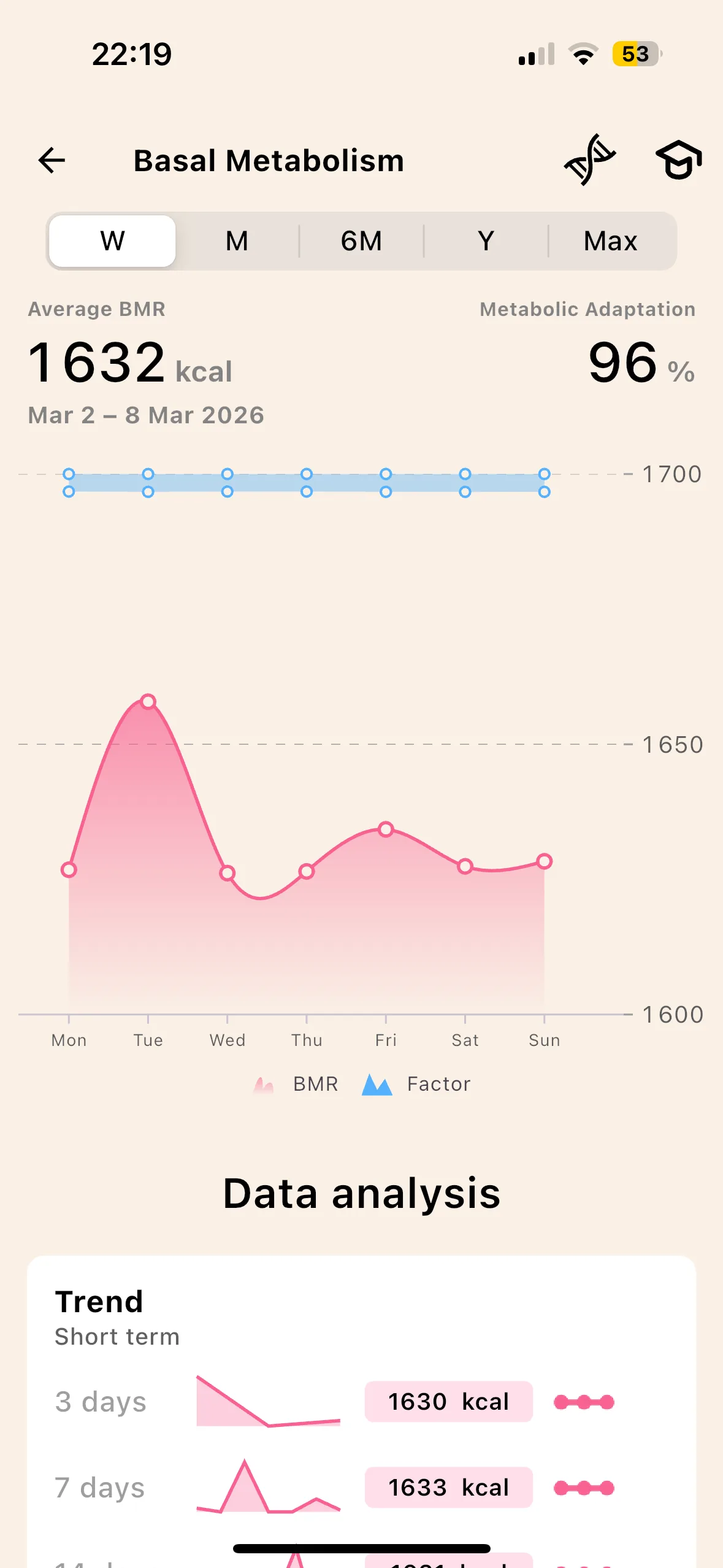
Proprietary patented model, built on lean mass
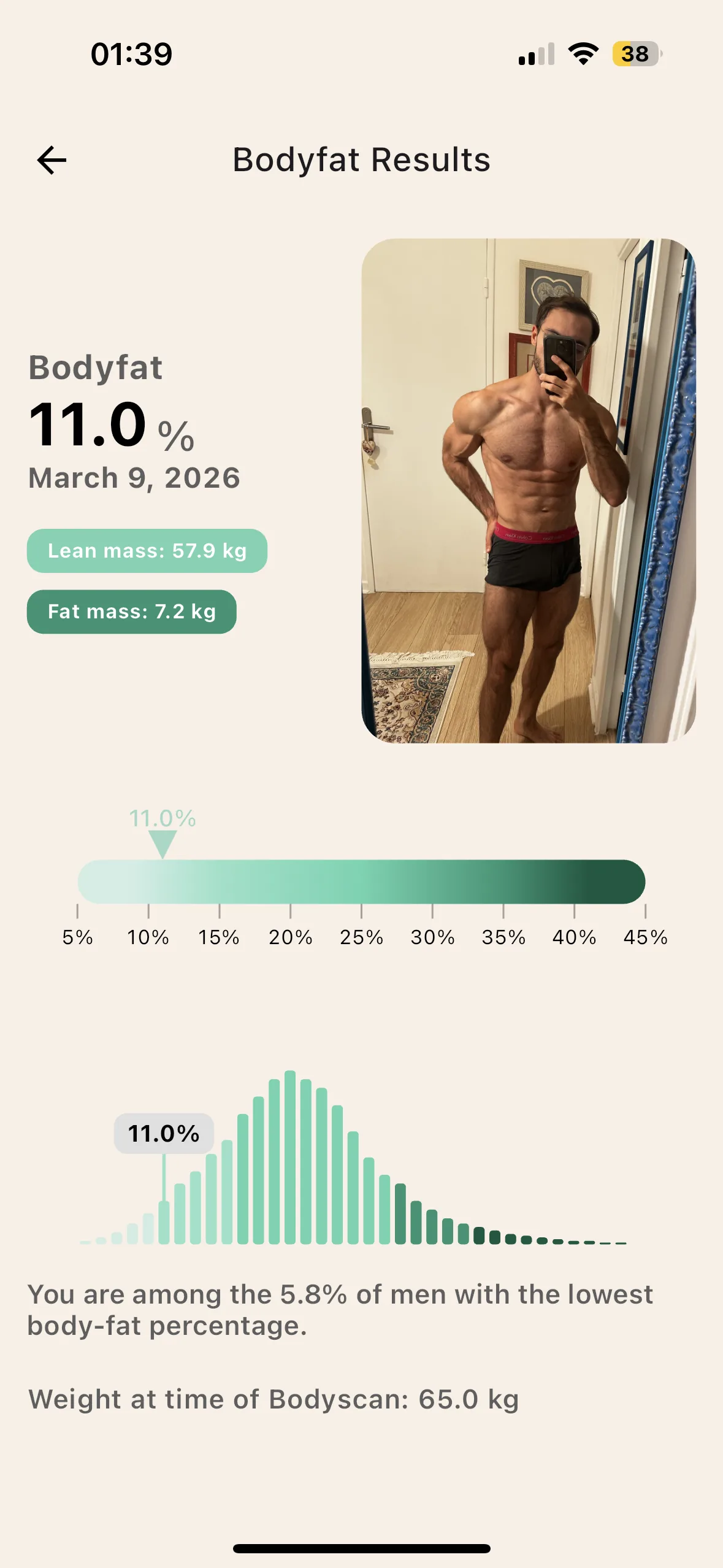
Where FatSecret asks for your weight and deduces your metabolism from it, Lean starts from your lean mass. The nuance is decisive: muscle burns energy at rest, fat almost none. The historical problem remains: how do you know your body fat percentage without paying for a DEXA scan at a clinic every week?
Lean's answer fits in a photo. The AI BodyScan analyzes your picture with a model trained on a bank of DEXA scans and returns your body fat in a few seconds. You redo it every week, your metabolism recomputes itself. This is precisely the kind of feature a free model cannot fund.
No more skinfold calipers and their margin of error, impedance scales and their swings with hydration, DEXA and its cost. One photo, five seconds, every week.
NEAT, EAT, TEF calculated separately
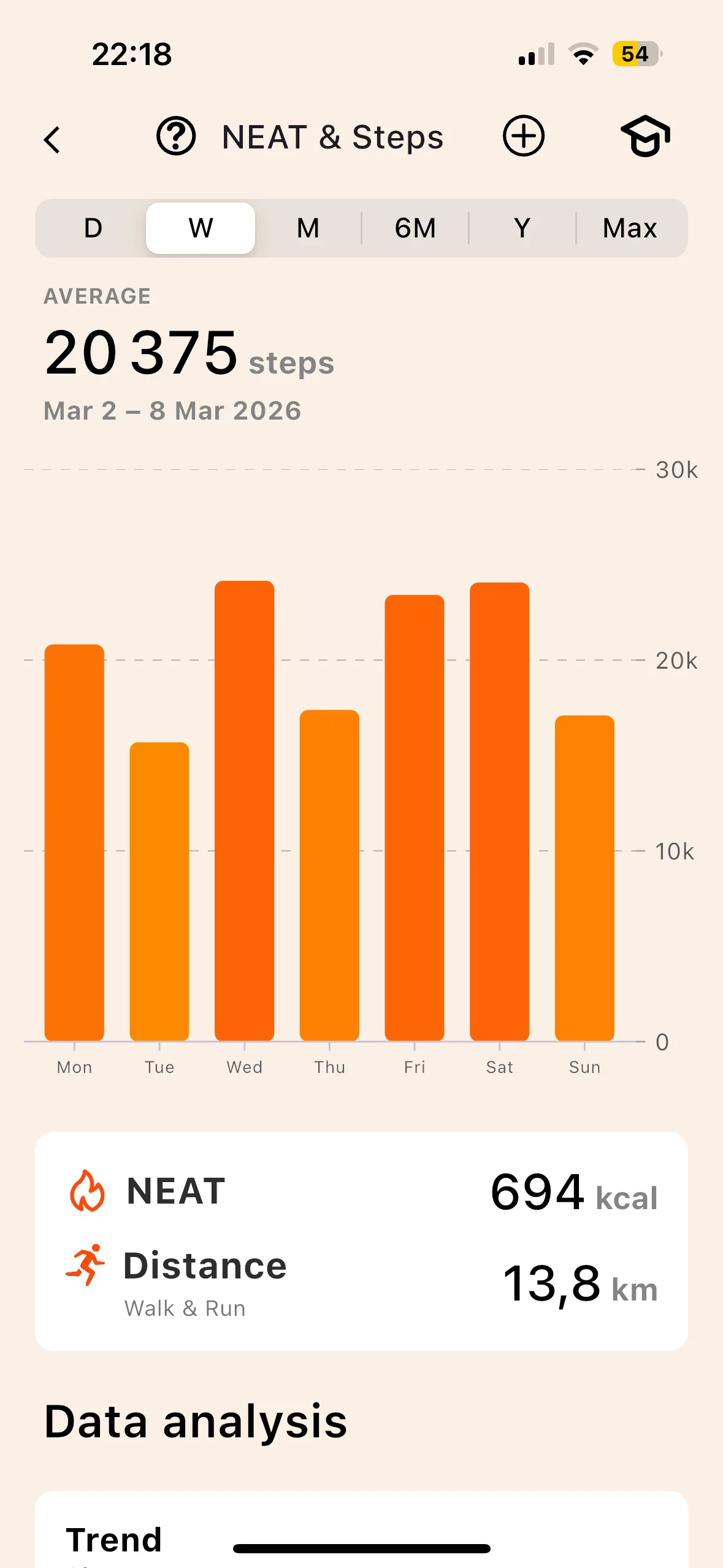
NEAT. Your real steps come in from HealthKit (iOS) or Google Fit (Android). Nothing to declare, nothing to estimate: your phone's accelerometers do the counting. Lean then crosses those steps with your metabolism to convert your daily activity into calories, whereas a "moderately active" box applies the same multiplier to a delivery rider and to a remote worker.
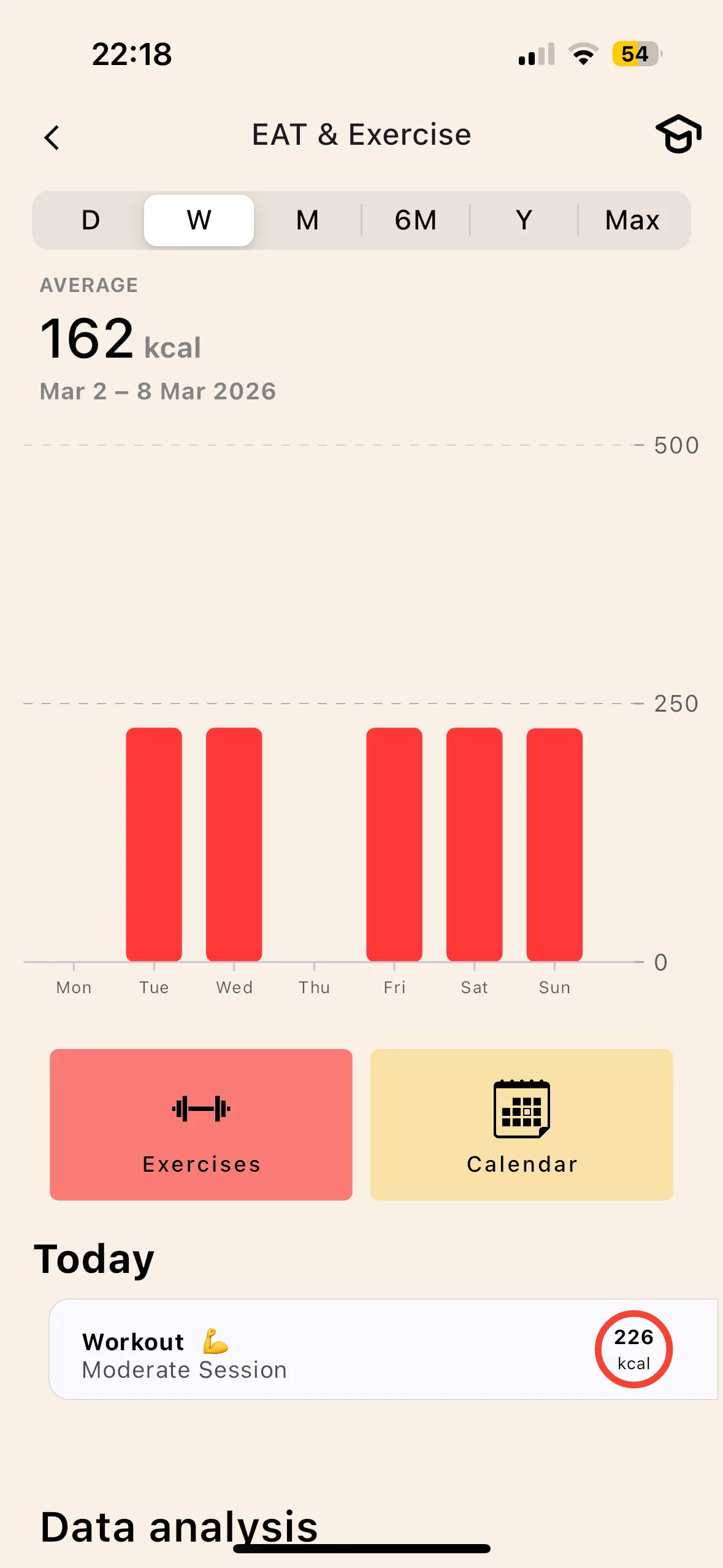
EAT. You pick your sport from a list (lifting, running, tennis, swimming) and Lean applies the matching MET to your actual effort time. An hour of lifting with rest periods is not worth an hour of continuous running: counting both the same way means being off by several hundred kcal over the week.
TEF. Digesting costs energy, and that cost depends on what you eat: 20 to 30% of calories for protein, 5 to 10% for carbohydrates, 1 to 3% for fat. Lean computes this item on your real macros instead of applying a flat 10% identical for everyone.
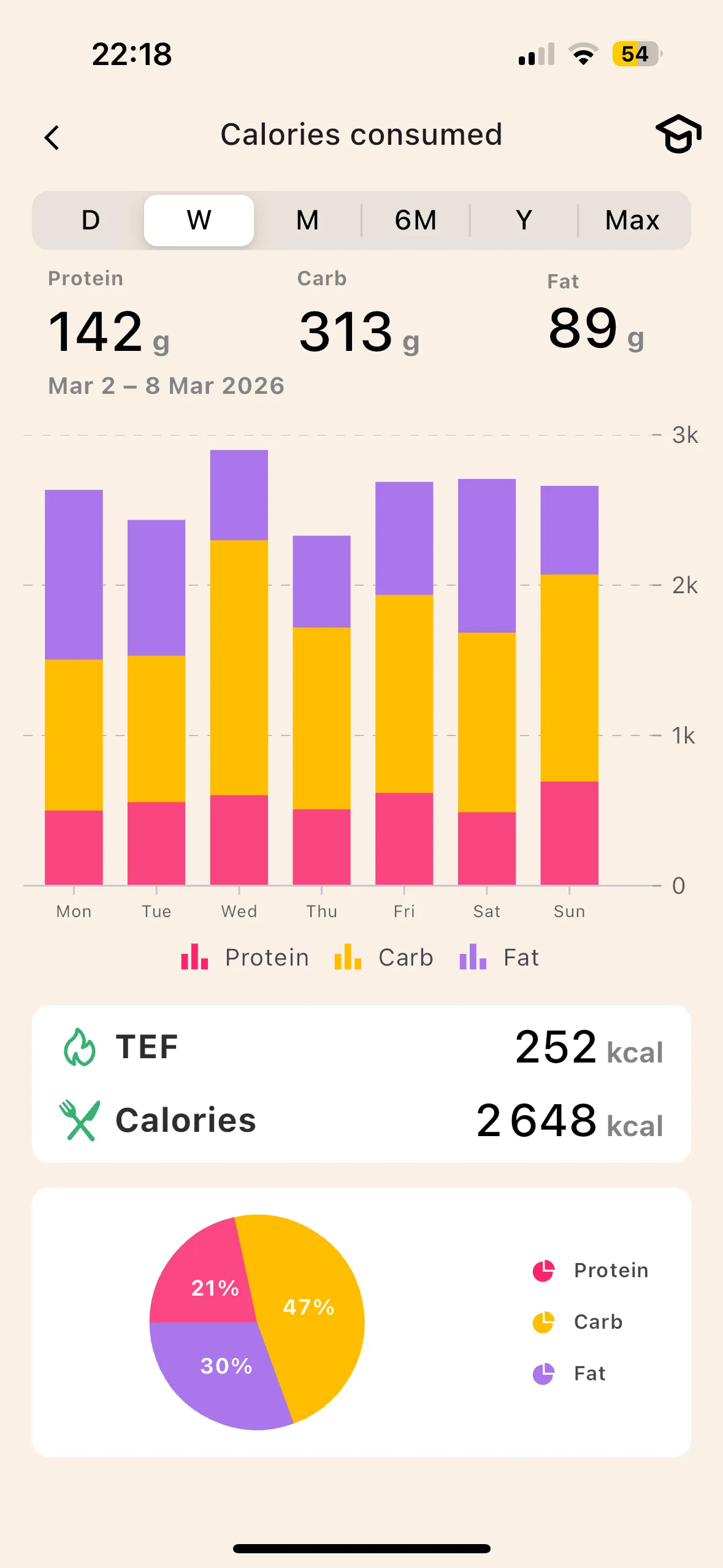
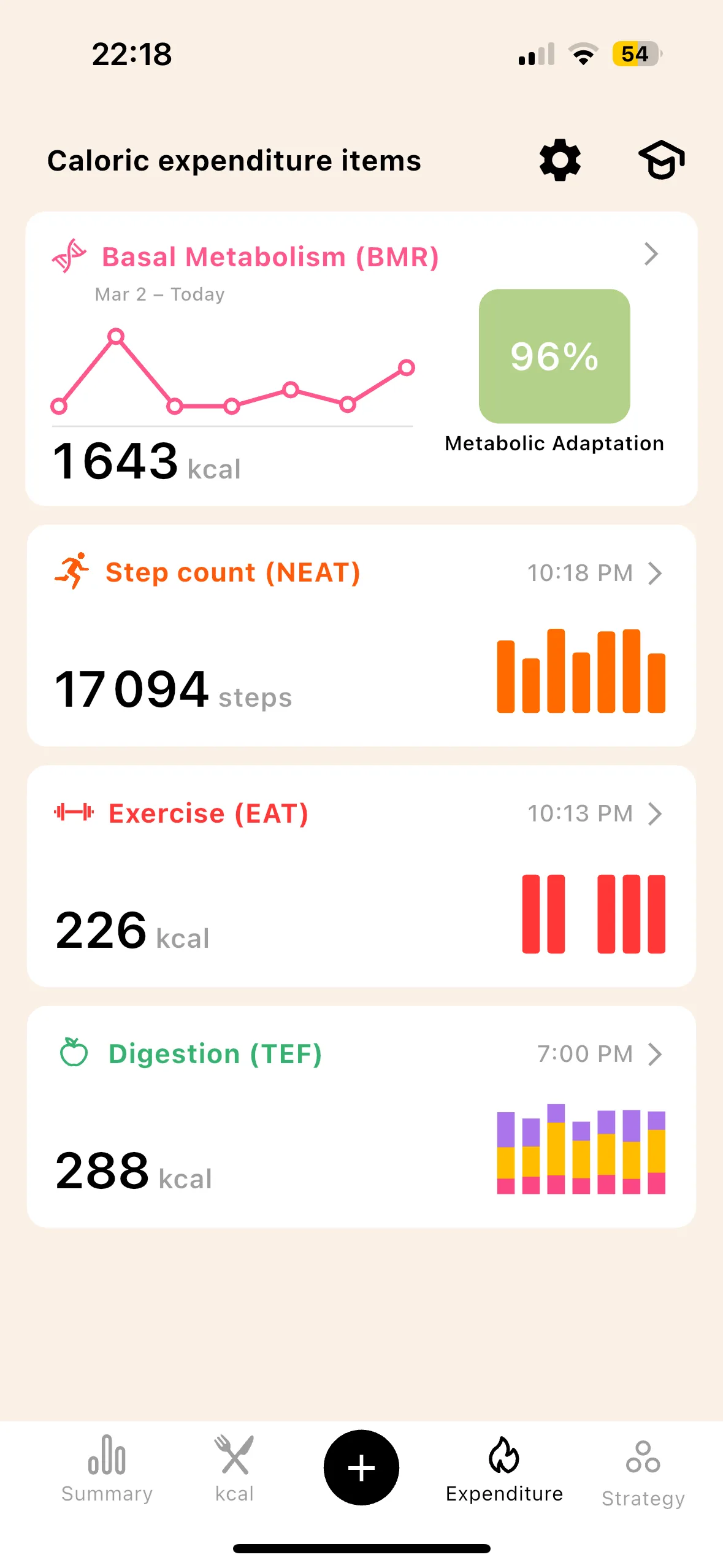
A world first on a consumer app
Metabolic adaptation. It is the brick no consumer app models, free or paid. Week after week in a deficit, your metabolism slows down: Lean adjusts your TDEE downward according to the published ranges (Müller 2015, Doucet 2001), instead of showing you the same calorie target in week 8 as on day one.
Past 10 to 15% adaptation, the app may recommend a return to maintenance to restart your metabolism before going back into a deficit. It is the protocol contest-prep coaches follow, made automatic.
No activity coefficient to tick, no box frozen at sign-up. Every component is measured, week after week.
Lean versus FatSecret, criterion by criterion
An honest read of each app's strengths and weaknesses. No criterion touches price.
Lean FatSecret
3 ways to track a meal
A free app is only useful if you are still using it in six months. So Lean offers three ways to log a meal, so that friction is never the reason for quitting.
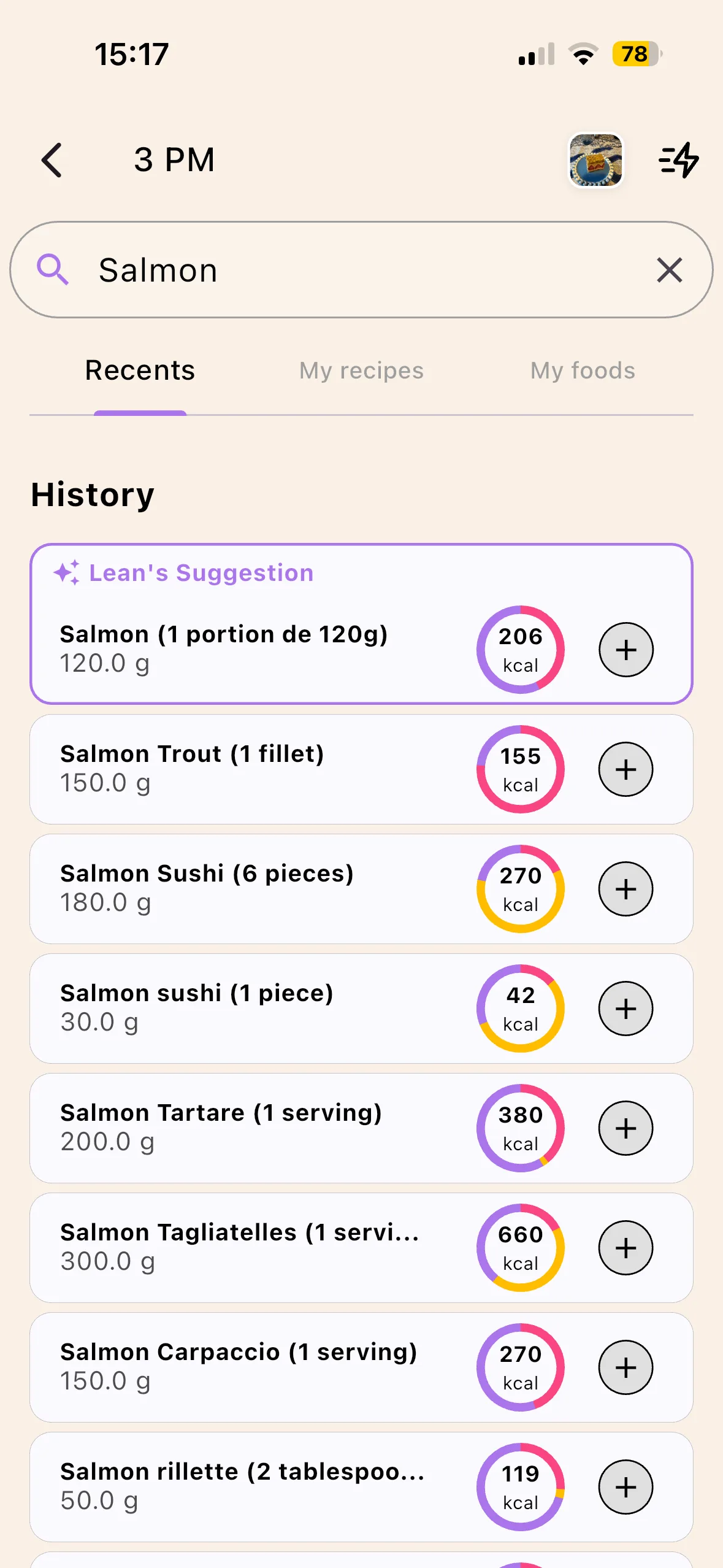

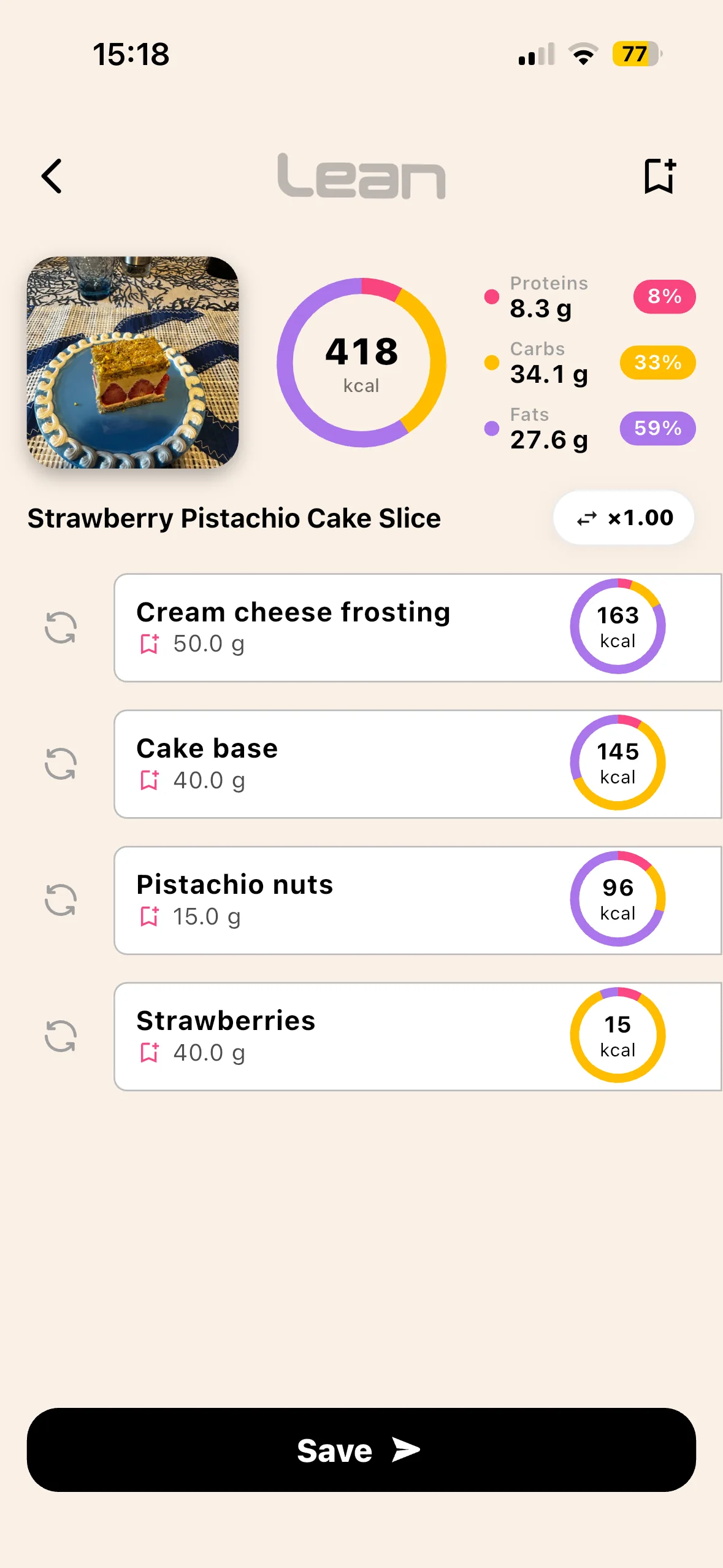
- Database search. Curated base, USDA + OpenFoodFacts. No community noise, no "Roast chicken" entered 47 times by 47 different users with 47 different values.
- Barcode scan. Standard. You scan your pasta box, you get the macros.
- AI photo scan of a meal. You photograph your plate, the AI detects the foods, you get the calories and macros per food.
AI photo scanning changes meals eaten out most of all. Where FatSecret's community database makes you choose between fifteen versions of the same dish entered by fifteen users, one photo is enough and you move on.
Beyond the meal, Lean shows a TDEE that updates during the day: every thousand steps raises your calorie target. A total frozen in the morning cannot reflect that.
And above it, the Progression Pyramid ranks what matters:
What FatSecret does better
Lean is not perfect, and FatSecret has several real strengths worth acknowledging. Honest read, criterion by criterion, on the axes where FatSecret stays ahead. None of these axes is secondary: they are real pillars of the FatSecret promise, and they explain its massive adoption among the cost-conscious mainstream audience.
FatSecret LeanHonest read. On the free model, FatSecret is the market reference: everything is accessible without a paywall, funded by ads displayed in the app. No critical calorie-tracking feature is gated behind a Premium. It’s a real differentiator, especially for users who are starting out or want a log without commitment. On multi-country coverage, FatSecret is present in more than 50 countries with localized versions and adapted food databases (local brands, regional dishes). No other mainstream app has invested as much in geographic expansion. On the community, FatSecret has built over 15 years an active network of users who share meals, recipes, tips, and successes. It’s an adherence mechanism few apps reproduce. On catalog size, FatSecret shows several million entries, which covers very specific foods that smaller databases would miss.
If your main angle is paying nothing to track your calories, getting access in a country where few apps are localized, or if the community dimension helps you stick with it, FatSecret is more relevant than Lean. If your angle is the precision of TDEE calculation, bodyfat measured every week through BodyScan AI, automatic metabolic adaptation, and a food database backed by USDA and OpenFoodFacts rather than crowdsourced, that’s exactly what was demonstrated in the 3 previous sections. Many users run Lean for measurement and FatSecret in parallel for rare-food coverage, which is entirely defensible.
Who Lean is built for
Four profiles. If one of them sounds like you, Lean is likely a good fit.
You’ve been using FatSecret for a long time and haven’t lost
You have used FatSecret for a long time, you appreciate that it is free, but you doubt the number displayed against your efforts.
You plateau after several weeks of cutting
The plateau settles in after four to eight weeks with nothing changed in your tracking. That is metabolic adaptation, which Lean computes and builds into your target.
You want to understand your metabolism
You want to understand where your target comes from: every component shown separately, rather than a total produced by a formula and a ticked box.
You want tracking that lasts 12 months
You want to log fast without browsing fifteen versions of the same dish: photo, curated database or barcode.
FatSecret stays more relevant for : paying nothing for your calorie log, enjoying an active community that shares meals and recipes, or accessing a very large multi-country catalog. Precision of TDEE calculation and metabolic adaptation just aren’t part of its main promise.
Switching from FatSecret to Lean (or using both) in 3 minutes
Download Lean
App Store or Play Store. Sign-up in thirty seconds.
AI BodyScan
One photo, five seconds: your body fat percentage appears, no equipment needed.
Weight & height
You enter your weight and height. That is all it takes to start.
Lean calculates
BMR on real lean mass, NEAT from your steps via HealthKit or Google Fit, EAT by MET, TEF on your macros, plus metabolic adaptation applied over the weeks.
Log a meal
Photo, barcode or curated database: three ways to log, with no duplicates to sort through.
Important note. Lean doesn’t import your FatSecret history automatically, nor your custom recipes. If you still use the FatSecret community to discover recipes or find a rare local food in its very large catalog, many users keep checking FatSecret as a complement, while using Lean daily for the TDEE calculation and precise tracking. The HealthKit / Google Health Connect sync, on the other hand, takes over immediately for your steps and activity history.
What Lean does, that FatSecret doesn’t (on TDEE)
Six features no free tracker offers, for a simple reason: they require continuous measurement, not just a database.
Your body fat percentage measured from a photo, every week. It is the data that individualizes the metabolism, and it cannot be obtained by manual entry.
A meal logged in two seconds by photo, without hunting for the right entry among fifteen versions typed in by the community.
Your TDEE readjusts week after week according to the published values. The second-month plateau stops being a mystery.
BMR, NEAT, EAT and TEF displayed distinctly and updated during the day, instead of a frozen total computed once and for all.
Your weight, body fat and lean mass trends over several months, to tell a real stall from a water fluctuation.
A hierarchy of priorities: adherence, then calorie target, then steps. You know what to fix first.
You install the app for free, you test without commitment, then you decide whether the tool fits your goal.
Frequently asked questions
FatSecret is free with a big community, why compare it to Lean on TDEE ?
Why doesn’t FatSecret calculate the BMR on real bodyfat ?
Is FatSecret’s crowdsourced food database reliable ?
FatSecret imports steps via HealthKit, is that enough for NEAT ?
Is Lean free or paid ?
Can you use Lean and FatSecret in parallel ?
1990 vs 2026
This is not a marketing duel. It is community-driven free against expenditure precision: two distinct promises.
FatSecret remains the best choice for tracking calories without paying anything, with an active community and wide coverage.
Lean answers the other need: a metabolism computed on lean mass measured by AI BodyScan with a patented proprietary model, NEAT from your real steps, EAT by MET, TEF on your macros, and metabolic adaptation tracked week after week.
Being free, the community and international coverage remain FatSecret's strengths. If you have used it seriously and your progress has stopped without explanation, the problem probably lies on the expenditure side.
Lean is available as a free download
iOS and Android. The AI BodyScan works from a single photo: no skinfold calipers, no impedance scale, no DEXA.
Internal links
- Free online TDEE calculator · web version, no sign-up, same logic as the app (BMR + NEAT + EAT + TEF).
- Understand TDEE in depth (BMR, NEAT, EAT, TEF, adaptation) · deep-science article.
- How to count your calories properly · practical guide for beginners.
- NEAT: expenditure from steps and non-exercise activity.
- TEF: digestion burns calories.
References
- Harris J.A., Benedict F.G. (1919). A Biometric Study of Basal Metabolism in Man. Carnegie Institution of Washington.
- Mifflin M.D. et al. (1990). A new predictive equation for resting energy expenditure in healthy individuals. American Journal of Clinical Nutrition.
- Frankenfield D.C. et al. (2013). Validation of Mifflin-St Jeor equation in obese and non-obese populations. PubMed 23631843.
- Müller M.J., Bosy-Westphal A. (2013). Adaptive thermogenesis with weight loss in humans. Obesity. PubMed 26399868.
- Doucet E. et al. (2001). Evidence for the existence of adaptive thermogenesis during weight loss. British Journal of Nutrition. PubMed 11319656.
- Nunes C.L. et al. (2020). Metabolic adaptation and energy compensation following weight loss. PMC7484122.
- Westerterp K.R. (2004). Diet induced thermogenesis. Nutrition and Metabolism.
- USDA FoodData Central. National Nutrient Database for Standard Reference. fdc.nal.usda.gov.
- OpenFoodFacts. Open and verified collaborative food database. openfoodfacts.org.
- Studies on the accuracy of crowdsourced food databases (documented variability of plus or minus 20 percent on popular entries).